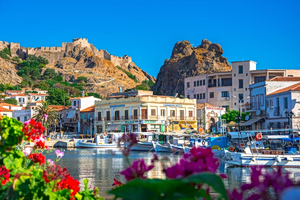
In Lemnos, an ambitious ecological restoration effort is underway to revive the largest seagrass meadow in the Eastern Mediterranean, led by the environmental organization iSea in collaboration with the Hellenic Ornithological Society and the Municipality of Lemnos.
The Posidonia meadow surrounding the island spans nearly 140 square kilometers and is estimated to store more than 270,000 tons of carbon dioxide—an amount comparable to the annual emissions of a small city’s car fleet. Far from being an inert underwater landscape, it functions as a vital carbon sink while sustaining marine biodiversity across the region.
Marking World Environment Day 2026, iSea and its partners in the “Reviving Lemnos” initiative have completed a pilot phase that included the transplantation of more than 250 Posidonia shoots. The species, Posidonia oceanica, is not a seaweed as commonly believed, but a flowering marine plant that forms dense underwater meadows serving as shelter and nursery grounds for a wide range of marine life. Its long, brown fibrous leaves are often mistaken for seaweed when washed ashore.
The seagrass meadow off Lemnos extends to depths of up to 30 meters and stretches for more than 20 kilometers, reaching beyond the boundaries of the Natura 2000 protected zone and into international waters. According to iSea, the ecosystem hosts more than 66 marine species, underscoring its ecological importance in the broader Aegean seascape.
The pilot phase is designed as the foundation for a larger restoration effort, which aims to re-establish over 10,000 Posidonia rhizomes across approximately 400 square meters in the coming years. Researchers and conservationists see the early results as a critical step toward scaling up restoration techniques in one of the Mediterranean’s most sensitive marine habitats.
“The knowledge gained from monitoring this pilot application will provide a valuable roadmap for completing restoration actions and ensuring the long-term success of ecosystem conservation in Limnos,” said Nikoletta Sidiropoulou, Program Manager at iSea.
The “Reviving Lemnos” program is one of seven large-scale initiatives funded under the Program for Endangered Landscapes and Seascapes, which supports the restoration of threatened natural environments across Europe.