It’s a discovery that may lead to the rewriting of paleontology and anthropology texts over the coming period, as Dr. Katerina Harvati, the director of Paleoanthropology at Germany’s University of Tübingen and the head of excavations at a site near Megalopoli – in the central Peloponnese – states with confidence: “We’ve uncovered the oldest wooden tools in the world”.
In an interview with the digital edition of BHMA (Vima), a beaming Harvati referred to the discovery before and after the publication of a ground-breaking article in the Proceedings of the National Academy of Sciences.
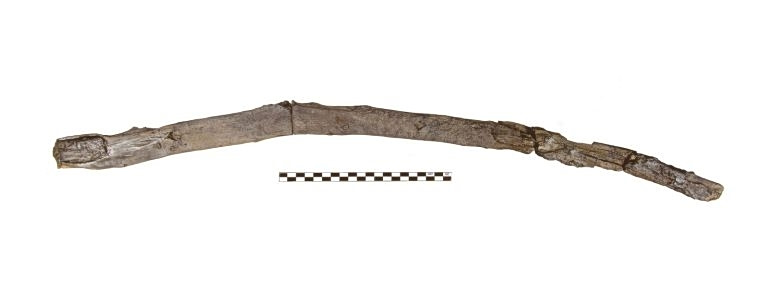
One of the two major artifacts discovered: A piece of a wooden trunk with clear signs of processing and use. Credit: Katerina Harvati
In its wake, the article fully justifies the enthusiasm of the internationally renowned Greek paleoanthropologist, who heads up the Senckenberg Centre for Human Evolution and Palaeoenvironment (SHEP) at the University of Tübingen. The findings at Megalopoli are reportedly the oldest of their kind ever discovered in the world, and they place the use of wooden tools by humans at some 40,000 years earlier than previously thought.
To be precise, the artifacts from the Marathousa 1 site date back 430,000 years, it what would be the “heart” of the Middle Pleistocene, which lasted from 774,000 to 129,000 years ago.
Asked about these very significant findings, Prof. Harvati says:
“These are two wooden artifacts with clear signs of human intervention and use…the first is a piece of a tree trunk that bears clear signs of having been processed to function as a tool, but it also signs of wear from subsequent use. We believe that it could have been used either to facilitate the removal of tree bark or as a digging tool. The second is a very small piece of willow wood, or perhaps poplar, and appears to have been processed so that it can be held in the hand. This is a completely new type of tool that has been observed for the first time, and therefore its use is not yet known.”

As a result, according to the US-educated paleontologist, researchers believe that an ancestor of Homo sapiens, some 430,000 years ago in the Megalopoli region (southern Greece) had the idea of working wood to better serve his needs.
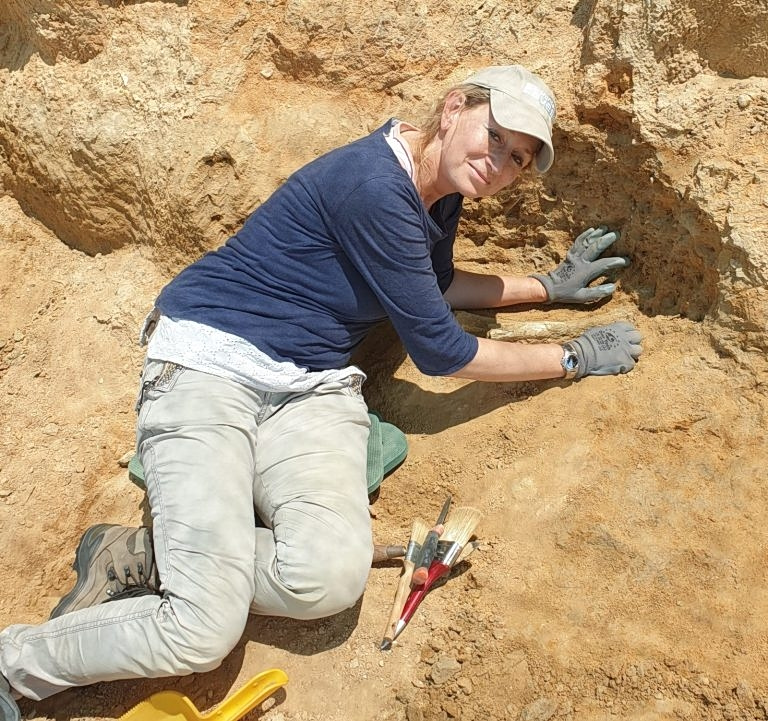
Prof. Harvati at the dig site, near Megalopoli, in the central Peloponnese, in southern Greece.
“The Middle Pleistocene is a particularly important period in human evolution. First, it is characterized by an unprecedented variety of hominin species,” she said, adding: ” In addition, during the same period, there was an increase in brain size and the development of complex behaviors. Finally, technological innovations were observed. The first reliable evidence of the targeted technological use of wood comes from this period.”

Prof. Katerina Harvati