It is July 2023. Biologist and PhD candidate at Aristotle University of Thessaloniki (AUTH) Thomas Daftsios, together with postgraduate students Dionysis Iakovidis and Nikos Gogolos, are in the Dadia–Lefkimi–Soufli Forest National Park conducting a thorough survey of animal biodiversity and species activity during the summer period. This survey was deemed necessary, among other reasons, because exactly one year earlier a wildfire had burned approximately 45,000 stremmas of forest. “Fortunately, that fire was relatively limited. We therefore had the opportunity to encounter a ‘living’ forest full of different species,” Mr. Daftsios tells BHMA-Science.
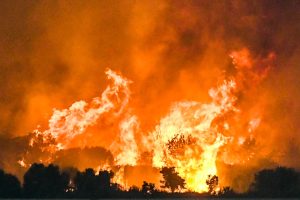
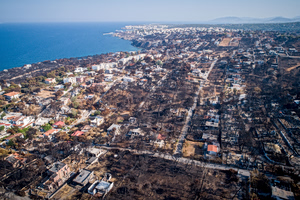
Unfortunately, that July of 2023 also marked the last time the researchers saw Dadia lush with greenery and wildlife. One month later, the largest wildfire in the history of the European Union broke out. The fire burned for 16 consecutive days, wiping more than 935,000 stremmas of forest off the map, with all that entailed for the animals that had called it home. Altogether, the fires of 2022 and 2023 reduced more than 70% of the Dadia forest to ashes.
A Devastating Picture
What did this destruction mean for the animals of the National Park? The team’s return to the burned areas a few months after the fire was devastating. As Mr. Daftsios recounts,
“When we arrived at the forest for the first post-fire sampling, we were confronted with absolute blackness covered by a layer of gray ash. We remained in Dadia for several days, trying to cover as large an area as possible to gain a representative picture of what had survived. Weather conditions were ideal for animals to be active outdoors, yet that never happened. Despite many days of sampling, we managed to record only one lizard and one pond turtle. Very often we found burned turtle shells or charred snakes and small mammals—a macabre sight when one considers that these animals were never able to escape and the fire passed right over them. I will never forget the initial joy of spotting the single European pond turtle during sampling, which, upon a second glance, unfortunately had burned limbs.”
The organized observations and sampling—which reveal much about the impact of the 2023 wildfire on Dadia’s fauna and serve as a “compass” for the future conservation of this valuable ecosystem—have now taken the form of a scientific study. The study has been submitted to a scientific journal and is expected to be published soon. Conducted by researchers from the AUTH Department of Biology in collaboration with the Thrace Biodiversity Protection Society and WWF, and implemented under the program “Restoring Key Landscape Values in the Dadia National Park” with funding from WWF International, the study maps the reptile species of Dadia after the fire. And from this map, many species vital to ecosystem balance are missing.
Reptiles Among the Biggest Victims
As Dr. Kostas Saganas, Assistant Professor of Biology at AUTH, explains to BHMA-Science, “The catastrophic fires of 2022 and especially 2023 exerted severe pressure on terrestrial fauna populations, as shown by comparing data collected before and after the fires. Reptiles were the main victims. Of the 29 reptile species previously recorded in Dadia (turtles, lizards, snakes), only 31% were detected again after the 2023 fire. It was characteristic that populations of Testudo graeca and Testudo hermanni suffered dramatic declines—dropping from 6.9 individuals per hectare in 2022 and 2023 to just 1.03 in 2024, showing an overall decrease of 92.54% compared to 2015. Similarly, the impact on snake populations was extremely severe, as no snakes were recorded even 14 months after the fire.”
According to the professor, the loss of more than two-thirds of reptile species is a major blow to ecosystem regulation. “The reptiles’ limited mobility and particular biological characteristics—such as their low ability to escape advancing fire fronts—made them extremely vulnerable. And it should be noted that the absence of snakes is not only a biological but also a functional loss, as they play a crucial role as mid-level predators in ecosystem regulation.”
Amphibians Were More “Fortunate”
Based on the study, amphibians proved more “fortunate,” with 73% of species still present after the fire. Mr. Daftsios explains that their survival was largely due to the fact that
“they are adapted to estivating underground and near water-collection sites and areas of increased humidity—a form of summer dormancy. Fire cannot penetrate extremely dense and insulating soil, especially at greater depths. We also believe that due to exceptionally strong winds, the passage of the firestorm was so rapid that the forest’s internal water sources—such as watering troughs, small dams, and springs forming ravines—did not have time to evaporate, thus providing refuges for amphibians. We were very pleased to observe that, although at lower population densities, amphibians were still present. However, since fire-affected areas are almost inevitably subjected to secondary flooding events that can negatively impact amphibian habitats, future intensive monitoring programs focusing on amphibians are needed before we declare them… survivors of wildfires.”
Although the study did not include mammals, the team did record several species with satisfaction a few months after the 2023 fire.“We observed the return of species such as foxes, wolves, jackals, roe deer, squirrels, and forest mice, mainly along the edges of the burned areas bordering unburned forest. This is a very positive sign,” Mr. Daftsios emphasizes.
A Holistic Management Approach Is Needed
Another important dimension of the issue—extending beyond the 2023 fire and completing the “puzzle” of what must be done to save Dadia—is presented by Panagiota Maragkou, herpetologist and Head of Environmental Protection Programs at WWF Greece, who participated in the study. “The turtle populations of Dadia had already been declining before the 2023 fire. This was partly because the forest had become denser, lacking the necessary openings reptiles need to move, as low-intensity livestock farming and agriculture—which, together with natural environments, create a beneficial mosaic for wildlife—had been abandoned. At the same time, drought in Evros, a result of climate change, also contributed to the decline of animal populations.” Then came the wildfire as the “icing on the cake.”
“What Evros needs is a holistic management approach that includes all components of its biodiversity. Management measures such as small-scale livestock farming and agriculture are required, as they provide the necessary openings for reptile survival. Climate change must also be taken into account in planning.”
Proposed Actions
The forest, as it always does, is trying to heal its wounds. But it needs time—and there is great concern that we may not give it enough. “Natural regeneration, observed just a few months after the fire, is encouraging, but it requires continued protection of remaining natural habitats and regular population monitoring,” stresses Dr. Saganas. He outlines actions that could positively affect reptile and amphibian communities:
“Construction of artificial ponds in the most severely affected areas to secure breeding sites, restoration of small habitat ‘islands’ within large burned areas to enable population movement, and the creation of a long-term biodiversity monitoring program.”
A long-term plan is indeed necessary so that no more forests burn—and with them, our future. Let us remember that every turtle and every snake of Dadia that burned is a link in an unbreakable chain of which we, too, are a part. And without each turtle, each snake, that chain may break—dragging us all down with it.