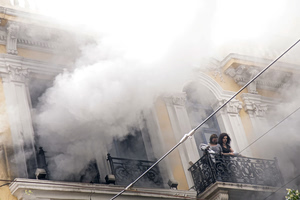
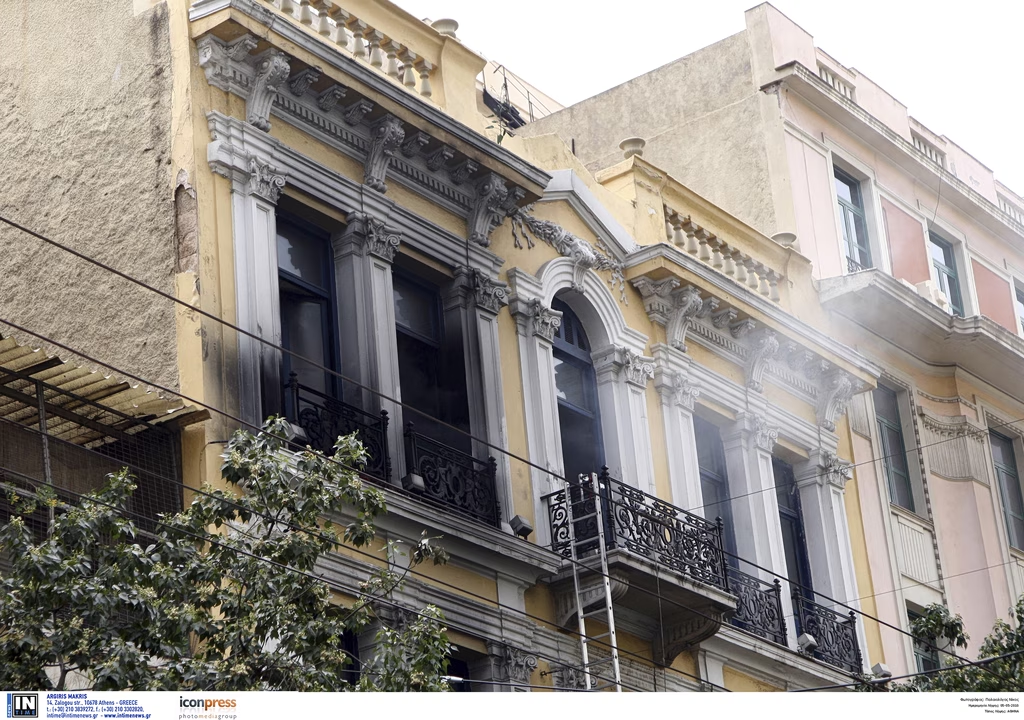
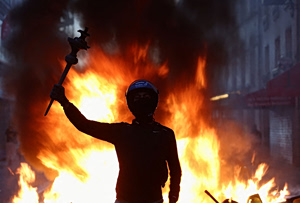
“To understand exactly what happened on that fateful afternoon of May 5, 2010, you have to remember the bigger picture. In the months surrounding the deadly Marfin arson attack, there had been a total of 500 to 600 similar attacks, some during the dozens of protests against harsh austerity measures, others in nighttime raids.
The people who attacked that particular bank branch went on to carry out three more arson attacks on public buildings shortly afterward, fortunately without further loss of life.
The tragic outcome might have been avoided if the bank had had better safety measures, including proper emergency exits, and if some citizens hadn’t blocked fire trucks from reaching the scene.
Police recorded damage to at least 94 buildings and vehicles across the wider area that day, part of a wave of arson and mass destruction that had by then become almost routine in downtown Athens.
In 2008, following the cold blooded killing of Alexis Grigoropoulos, extensive damage had already been done to 435 businesses, including 16 banks and 40 major stores and retail chains, 37 of which were completely destroyed. Another 100 buildings were set on fire, again mostly in the city center, between 2011 and 2012 during arson attacks that followed protests by angry citizens.
At the time, ELAS’s response, both in dealing with the violence and in building case files, was passive and inadequate. That’s why the deadly Marfin attack went unsolved for years, or why attempts were made to pin it on individuals with questionable backgrounds.”
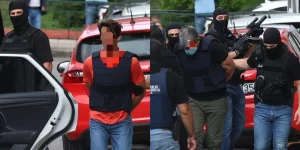
That’s how a senior ELAS officer described the situation to TA NEA, just hours after criminal charges were filed against three individuals sixteen years after the attack. The officer added that during those chaotic days, the Conspiracy of Cells of Fire alone had claimed responsibility for 100 similar attacks and had even planted bombs in Syntagma Square and at a New Democracy rally in Pedion tou Areos.
Clashes and “masked figures”
At the same time, dozens of groups such as Commando for the Spread of Chaos, Anarchists for the Destruction of the Existing Order, and Nucleus of Anarchist Direct Action kept emerging, claiming responsibility for attacks and constantly changing names, amid arson attacks and clashes with police that continued for at least five months, from December 2010 through the first five months of 2011, over the construction of a landfill in Keratea.
To round out the picture of that era, it’s worth noting that the same period saw the arrests of members of Revolutionary Struggle, a group that had even struck the U.S. embassy, while the still active Sect of Revolutionaries continued its campaign, killing a police officer and a journalist. Not long after Marfin, a parcel bomb sent to the Ministry of Citizen Protection killed police officer Giorgos Vasilakis, aide to Michalis Chrysochoidis, bearing the fingerprint of fugitive career criminal Vasilis Palaiokostas, who by then was working with anarchist groups.
Amid this chaotic and difficult climate, as police officers describe it today, investigators tried to crack the Marfin case by piecing together roughly 200 photographs and videos in an effort to identify the perpetrators. Attention at the time focused on the movement of a broader anarchist bloc, particularly the pre-rally gathering at the Athens Polytechnic, in an attempt to determine whether the masked individuals who attacked the Marfin branch on Stadiou Street had covered their faces there. That effort came up empty.
Police received information that within a day or two of the deaths of the three bank employees, groups of anarchists, dozens of whom had voiced their outrage, held a meeting. Some reportedly named the attackers as “anti-authoritarians who frequent a well known hangout in Exarcheia.” Police also recorded, during that period, an excerpt from a Conspiracy of Cells of Fire statement that referred to “informants from the lecture halls and the cafes.”
The message and the case file
In April 2011, a case file was opened against three individuals, based partly on an anonymous message that read:
“I’m a citizen, I don’t want to give my name, and I just want to say that the anarchists from Exarcheia go to Keratea with Molotov cocktails to throw at police during the unrest over the landfill. Three of them are [names, phone numbers, and addresses were listed] and they’re involved in the incidents in Athens, they’re always there. They were also at the Marfin fire on May 5, right at the front…”
In the end, after eight hours in custody, those individuals were released and asked to provide written statements, but nothing came of it. Responsibility was later placed on one or two officers described as careless, who in separate statements had expressed strong but ultimately unfounded certainty about the involvement of different individuals.
Five years later, in 2016, another anti-authoritarian who had been accused of being one of the Marfin arsonists, and who is not among the current defendants, was cleared of all charges and unanimously found not guilty.
Between 2019 and 2021, during his third term heading the police on Katechaki Avenue, Michalis Chrysochoidis requested that the case be reopened. Investigators sought out new visual material along with the bank’s surveillance footage and carried out fresh photo comparisons. As a result, in 2023 a new case file was compiled naming four suspects, with particular focus on “the tall man in the khaki hat and black bandana” and “the young woman with the blonde braid” seen among the group of arsonists.
In that file, the “tall suspect” was mistakenly identified as an anti-authoritarian previously flagged, without evidence, as a member of the Conspiracy of Cells of Fire. That same file, however, did correctly identify the woman shown in the footage as the 46 year old now facing charges, whose extradition from Britain is expected.
The investigation took its final shape in 2024, after Chrysochoidis returned to head police headquarters on Katechaki Avenue and issued an internal directive asking all security services to contribute any relevant footage from their archives.
That effort led to a previously overlooked hard drive being added to the comparative database of the Directorate of Forensic Investigations. The drive had been seized in September 2020 from the home of a former associate of Vasilis Palaiokostas in the Koukaki neighborhood. On it, investigators found vacation photos from the summer of 2009, just months before the Marfin attack, showing the associate’s partner alongside the three individuals currently facing charges, all carrying the same gear, including backpacks, that the attackers were seen wearing when they set fire to the bank.
The case was taken over by the new Digital Forensic Investigation and Analysis Subdirectorate within ELAS’s Forensic Science Laboratories, which conducts around 4,000 visual material examinations each year and identified 200 individuals through that work in 2025. The findings from that unit formed the basis for the current charges, after investigators matched the two 42 year old suspects who have since been arrested, while identification of the 46 year old woman carries a small degree of uncertainty.