Crowding and traffic problems are the two most significant consequences of the excessive number of visitors now observed on Mount Athos, while at the same time voices of protest from both the monasteries and the Holy Epistasia are increasing, sounding the alarm about the undoing of the hesychastic character, the loss of religiosity, and the touristification of Athos.
Since 2023 and especially in recent months, due to the escalation of military tension recorded in the Middle East, thousands of Orthodox Christians from the former Eastern European states—mainly Romanians, Bulgarians, and Serbs—are choosing the nearest and peaceful Garden of the Virgin instead of a risky pilgrimage visit to Jerusalem.
The numbers are climbing
The shift toward Mount Athos appears in the first statistical data now in the hands of the Holy Community in Karyes. According to these figures, only in the first half of 2025, the number of pilgrims–visitors who “entered” Athos, either from Ouranoupoli or from Ierissos, reached 85,000, compared to 75,000 in the corresponding half of 2024. It should be noted that the 85,000 registered holders of diamonitirion do not include the so-called work diamonitirion of permanent or seasonal workers. In recent years, due to extensive renovation and maintenance work in monasteries, sketes, cells, and kathismata, the number of workers entering the Athonite state has increased significantly, and it is estimated that in the first half of 2025 they amounted to an additional 4,000 people. Also not included are the special diamonitirion issued for staying in sketes and cells.
As for the data from the first half of this year, of the roughly 85,000 pilgrims, 40,000 were Greeks, followed by: 21,000 Romanians, 6,500 Serbs, 2,500 Ukrainians, 2,500 Bulgarians, only 1,500 Russians, and a small but steadily growing number of Chinese visitors, who so far this year have reached around 500. The remaining 10,000 visitors come from Cyprus, Georgia, the USA, Britain, France, etc. Athonite sources emphasize that the number of visitors would be much higher—exceeding 100,000 in just the first half—if the massive influx of Russian pilgrims had not stopped.
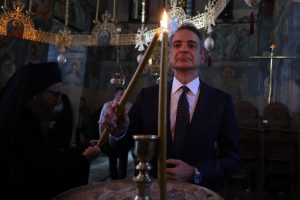
Another side effect of the high number of visitors recorded on Mount Athos is the excessive use of private vehicles either as taxis (small buses or private cars) or for transporting workers. These are vehicles beyond the permitted number allotted to each monastery. The large number of vehicles (private, work-related, machinery, trucks, etc.) has caused several traffic accidents, and for this reason traffic signs have now been installed. Furthermore, in the memorandum submitted to the Prime Minister last July, when Mr. Mitsotakis visited Mount Athos, one of the requests of the Holy Community was the improvement of the road network as well as the signing of the regulatory act that would allow the Holy Community—acting as the municipal authority under the Charter—to collect traffic fines, which are currently not imposed because no collecting authority exists.
A “cutoff” on diamonitirion
The first intervention by the Holy Community to limit the large number of pilgrims occurred in 1993, when the increase then becoming apparent led it to set each year a specific number of daily visitors per monastery, which may be changed only by its own decision. The most recent announcement by the Holy Community was made in May, before the first half of the year had even closed and before aggregate data were available. In this latest measure, the Community asks the monasteries to issue up to 300 diamonitirion per month, with the exception of Greeks and Cypriots, while also establishing exceptions for Russians, Ukrainians, Romanians, and Bulgarians for their respective monasteries (St. Panteleimon – Russian, Hilandar, and Zografou).