A significant share of Europeans accepts conspiracy-related claims often rejected by the scientific community, with Greece ranking among the countries where belief in such narratives is most widespread, according to a Eurobarometer survey examining public attitudes toward science and technology.
The survey asked respondents whether they believed two statements: that a cure for cancer exists but is being deliberately concealed for commercial reasons, and that viruses are created in government laboratories to restrict citizens’ freedoms. While both claims are considered unfounded by the scientific consensus, researchers found that many Europeans accepted one or both as true.
The analysis focused on respondents who endorsed both statements, using the results to map susceptibility to conspiracy thinking across the European Union. Although such beliefs were recorded throughout Europe, their prevalence varied sharply by region.
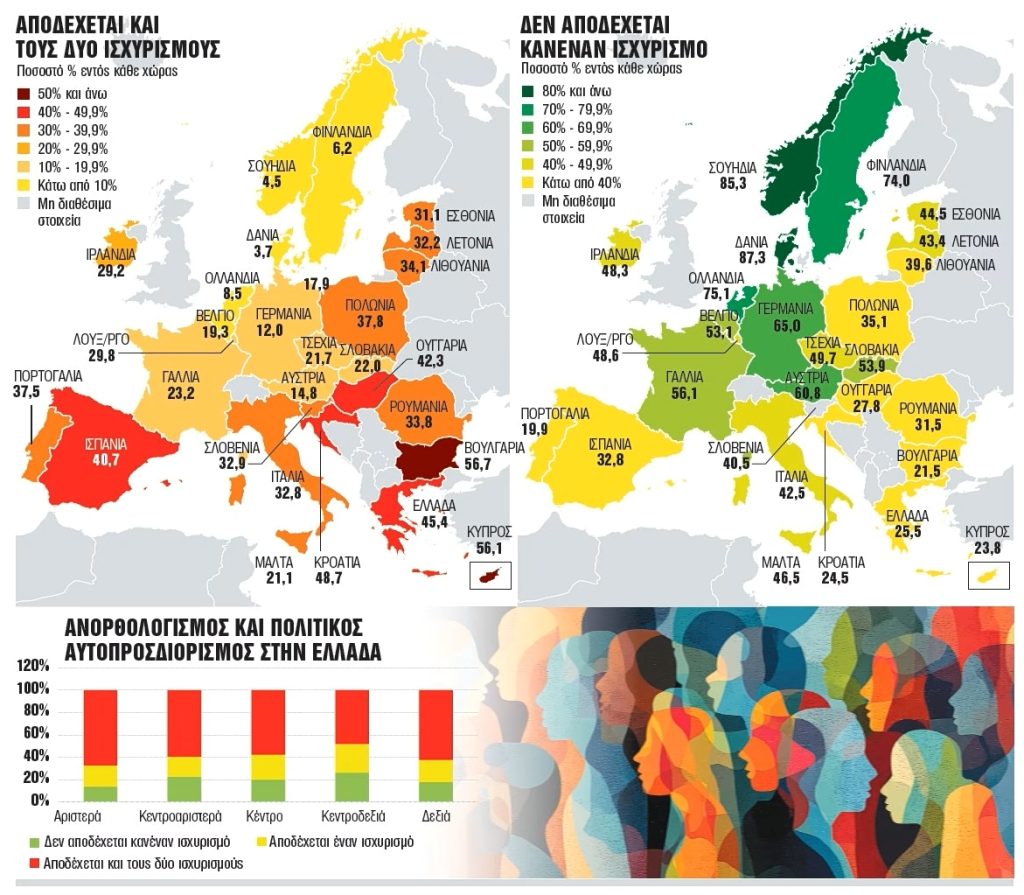
Greece ranked among the countries with the highest levels of acceptance. According to the survey, 45.4% of Greek respondents believed both claims, placing the country behind only Bulgaria, at 56.7%, and Cyprus, at 56.1%.
By contrast, the lowest rates were recorded in northern Europe, with only 6.2% of respondents in Finland, 4.5% in Sweden and 3.7% in Denmark accepting both statements.
The findings reveal a clear regional pattern. Countries in southeastern Europe, particularly the Balkans, recorded the highest levels of acceptance, while Spain and Portugal also posted relatively elevated figures. Nordic countries and much of central and northern Europe reported substantially lower levels.
Researchers argue the results have implications beyond public understanding of science. Widespread acceptance of demonstrably false or conspiratorial claims can make democratic debate more difficult by weakening agreement on basic facts, complicating efforts to build consensus on public policy.
Similar narratives surrounding vaccines, the COVID-19 pandemic and cancer have periodically appeared in political discourse across Europe, including in parliamentary debates.
The survey also examined whether susceptibility to these beliefs differed according to political ideology. Respondents identified themselves across five categories — left, center-left, center, center-right and right — before their responses were analyzed.
The results showed relatively small differences across the political spectrum. Acceptance of both conspiracy claims appeared broadly distributed rather than concentrated within a particular ideological camp.
The researchers caution that this does not mean political orientation is irrelevant to conspiracy thinking in general. However, for these two specific claims, ideology alone did not explain the pattern. Instead, vulnerability appears to be linked more closely to broader factors such as scientific literacy, trust in institutions, education, social insecurity and sources of information.
One of the survey’s more striking findings was that only about one in five respondents rejected both statements outright. Although the proportion varied modestly across political groups, the overall pattern remained consistent: rejecting both conspiracy claims was a minority position, while accepting at least one was considerably more common.
According to the analysis, this has direct implications for the quality of public debate. Democratic societies depend on a minimum level of agreement about factual reality. When large segments of the population begin from fundamentally different understandings of basic facts, disagreements extend beyond political values or policy preferences to competing versions of reality, making constructive dialogue more difficult and increasing the potential for polarization.
The challenge is further complicated by the growing role of social media, where information spreads rapidly with limited verification and repeated claims can acquire an appearance of credibility. At the same time, many citizens report low levels of trust in social media while continuing to rely on such platforms as primary news sources.
The authors argue that addressing the problem requires more than isolated fact-checking campaigns. Long-term investment in education, critical thinking and scientific literacy, combined with greater transparency and institutional credibility, is needed to strengthen public resilience against misinformation.
Conspiracy beliefs, they note, can influence decisions on public health, voting behavior, trust in democratic institutions and responses to national or international crises, making the issue one of democratic resilience rather than merely a cultural phenomenon.
The authors conclude that the survey points to two central findings: acceptance of these specific conspiracy beliefs is not confined to any single political ideology, and strengthening evidence-based public discourse requires sustained efforts across society rather than action by one political camp alone.
Note: The term “conspiracy beliefs” refers exclusively to acceptance of the two specific claims examined in the survey and should not be interpreted as a broader assessment of respondents’ personalities or overall belief systems.
Antonis Papakostas holds a PhD in computer science and is a research associate at ELIAMEP.