A plan to redevelop one of Athens’ most storied housing complexes has ignited a confrontation that spilled into the streets this week, pitting regional authorities against residents, activists and property owners who say they have been left in limbo for nearly two decades.
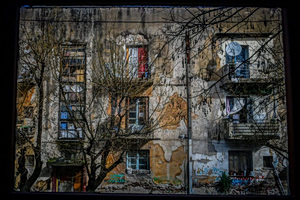
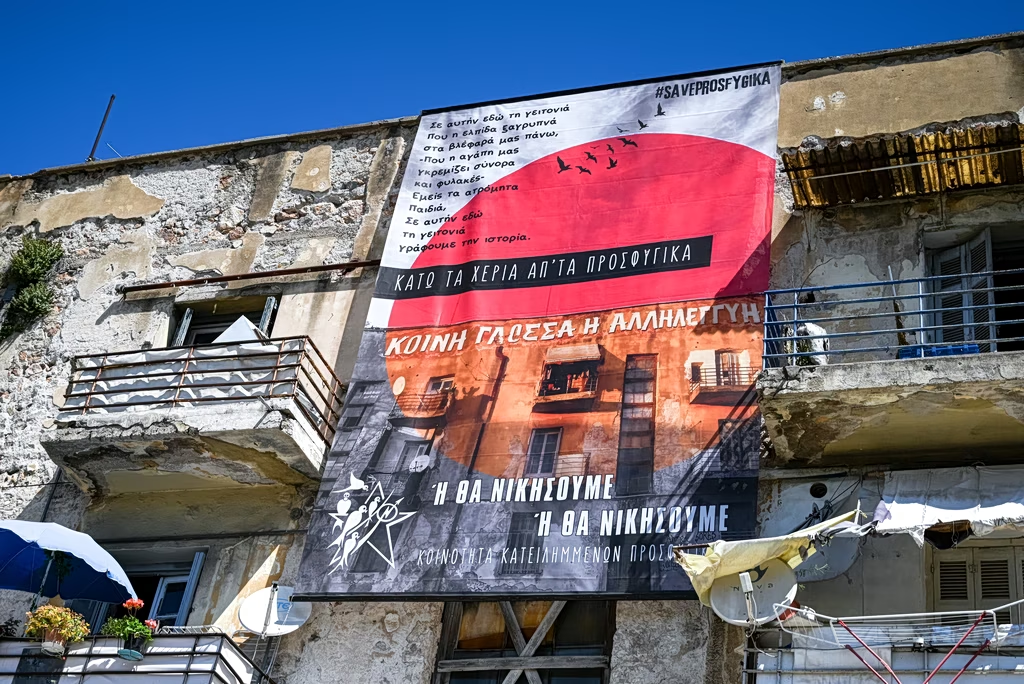
The Prosfygika, a cluster of apartment blocks on Alexandras Avenue, was built in the 1930s to house Greek refugees who fled Asia Minor. Over the decades it evolved into a self-organized community of squatters and vulnerable residents, and today shelters roughly 400 people, among them migrants, children, elderly people and the seriously ill.
On Monday night, about 100 people gathered outside the Agia Paraskevi home of Attica Regional Governor Nikos Hardalias, shouting and spray-painting slogans on walls in solidarity with hunger strikers at the complex. Hours earlier, Aristotelis Chantzis, a member of the Occupied Prosfygika Community who had been on hunger strike for nearly 140 days, was rushed to Athens General Hospital “G. Gennimatas” in critical condition. According to a statement from the community, he weighs just 35 kilograms.
Hardalias responded sharply on Tuesday, declaring that no one would intimidate the regional authority. He said the terrorizing of an entire neighborhood amounted to a direct affront to public institutions and the rule of law. The governor argued that the situation at the Prosfygika was the product of decades of state inertia and the repeated shifting of responsibility, and said the region had not created the problem. He maintained that the regional authority was the only party to have publicly tabled a concrete and workable plan for dignified housing and care for all, without demolitions or commercialization. Democratic dialogue, he added, could not function under conditions of blackmail and threats, and those who spoke of supposedly mutually acceptable solutions without naming them were merely engaging in populism.
The governing New Democracy party condemned the protest at Hardalias’ home, as did Athens Mayor Haris Doukas, who nonetheless insisted on the need for dialogue toward a commonly accepted solution.
Behind the public standoff, owners of apartments in four of the blocks at the rear of the complex say they have been forgotten. Many have been unable to access their properties for almost 20 years and still do not know whether the redevelopment plan addresses them at all.
One of the 51 owners of flats in the rear buildings, identified only by her initials, was among the first to register on the region’s new digital platform, through which current residents are invited to submit their details and proposals until July 19. She grew up in an apartment in the first block on Alexandras Avenue that was later expropriated; the flat she now owns was bought by her father from other refugees. For nearly two decades, she told the newspaper Ta Nea, she has held a property she cannot use because it is occupied. “We pay ENFIA and we have no property,” she said, referring to Greece’s unified property tax. She explained that in her building there are six apartments, three privately owned and three belonging to the region, all of them under occupation.
On the platform, she said, she voiced the concern shared by most owners whose properties do not currently appear to be part of any plan, and who are seeking clear answers about whether their flats will be accounted for and what their status will be once the redevelopment is complete. The owners say they want the neighborhood revived, but through legal channels.
The plan presented so far by the Attica regional authority focuses on the apartments already in state hands in the first four blocks. The aim is to restore them for use as social housing and to accommodate companions of patients at the neighboring hospitals.
In a video released on Monday, Hardalias said those living at the Prosfygika today were not “invisible” to the authorities, describing a shift “from abandonment to care, from arbitrariness to responsibility.” What exists at the complex now, he said, was not a solution but a dead end, adding that the informal use of public buildings without rules, safety or any institutional guarantee of rights could not be considered social policy.