 Μake us preferred on Google
 When ballistic missiles launched from Yemen headed toward Saudi oil installations at Yanbu last month, one of the countries helping defend the kingdom was conspicuously absent from the new military alliance Riyadh was preparing to sign.
It came from Greece. Greek troops operating a U.S. Patriot battery in Saudi Arabia intercepted two missiles aimed at oil installations, according to Greek security officials.
Two weeks later, Crown Prince Mohammed bin Salman of Saudi Arabia joined President Recep Tayyip Erdogan of Turkey and Prime Minister Shehbaz Sharif of Pakistan in Mecca to sign a sweeping mutual defense agreement. The pact declares that an armed attack on any one of the three countries will be considered an attack on all.
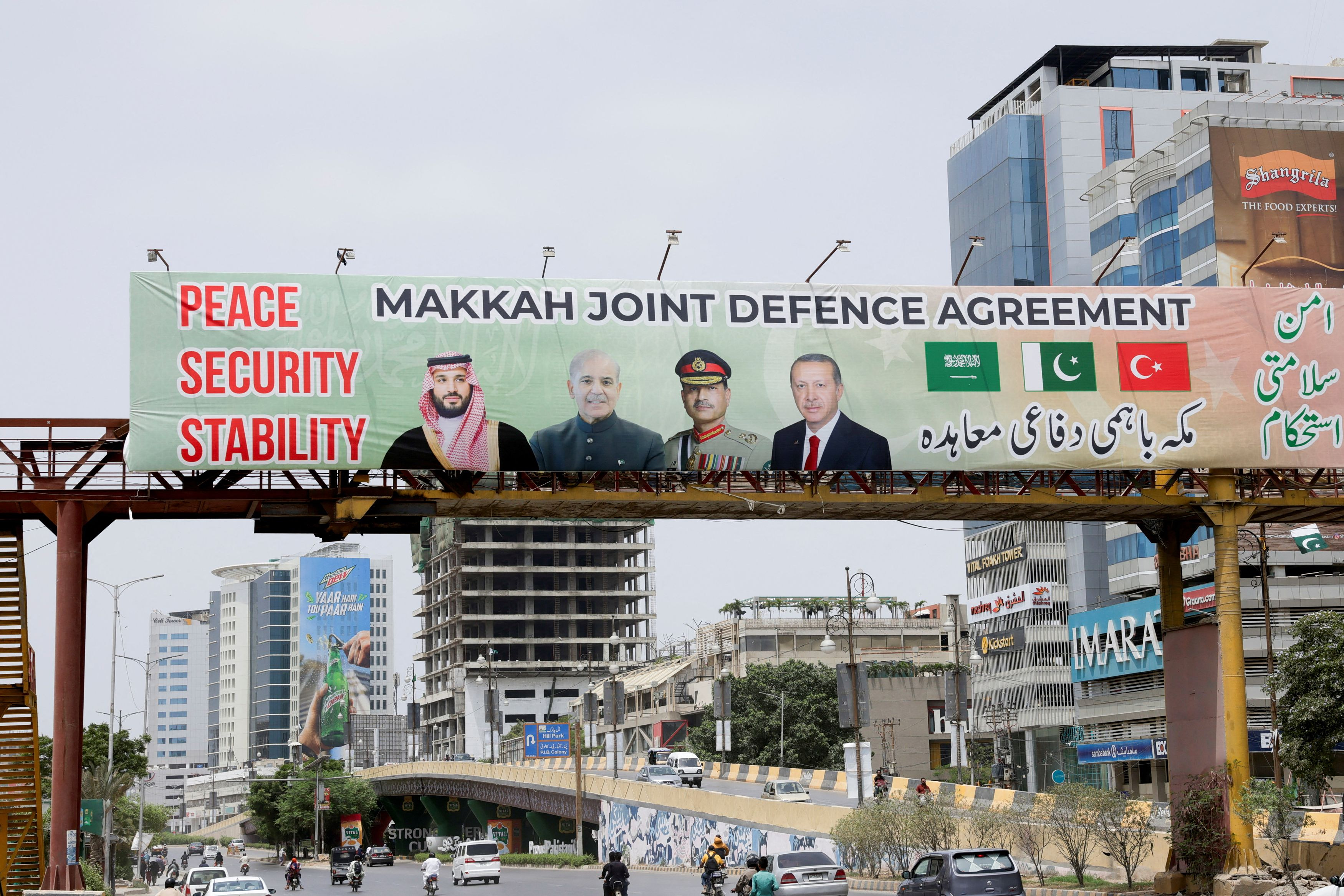
A billboard displays portraits of Saudi Crown Prince and Prime Minister Mohammed bin Salman, Pakistan’s Prime Minister Muhammad Shehbaz Sharif, Pakistan’s Chief of Defence Forces (CDF) and Chief of Army Staff, Field Marshal Asim Munir, and Turkish President Recep Tayyip Erdogan, following the signing of the Makkah Joint Defence Agreement, in Karachi, Pakistan, August 9, 2026. REUTERS/Akhtar Soomro
The two events offer a glimpse of a Middle East that is becoming more heavily armed and more densely connected, but not necessarily divided into tidy opposing camps.
For Greece, the shift matters directly. Athens is deepening security and energy ties with Israel and Cyprus even as Saudi Arabia, one of its close regional partners, builds a new defense mechanism with Turkey.
Saudi Arabia is building that structure with Ankara and Islamabad even while Greek forces help protect Saudi territory. Greece, Cyprus and Israel are deepening their own security and energy cooperation with Washington, while President Trump is simultaneously pursuing warmer relations with Mr. Erdogan.
Egypt maintains close ties with Greece and Cyprus, yet Turkey has already suggested that Cairo could one day join the new pact.
In an interview with To Vima, Gregg Roman, the executive director of the Middle East Forum in Washington, argued that these arrangements should nevertheless be understood as part of an intensifying competition over the region’s security order.
Mr. Roman, who previously worked for Israel’s Defense Ministry and served as a political adviser to an Israeli deputy foreign minister, cautioned against treating the Mecca agreement as the “Islamic NATO” that some commentary has suggested.
“I think that this was more signaling and posturing by the Saudis to a few parties rather than a committed defense agreement,” Mr. Roman said.
The text of the agreement leaves room for that skepticism. Although its mutual defense language resembles NATO’s collective defense clause, the signatories did not publicly specify what each country would be required to do if another were attacked.
At the same time, the pact is already becoming more than a declaration.
Turkey’s Defense Ministry said Thursday that the three countries planned to establish political and military coordinating bodies involving their defense and foreign ministers and senior military commanders. They also plan joint exercises involving land, naval and air forces and greater cooperation on air defense, unmanned systems, electronic warfare and military technology.
For Mr. Roman, the central question is not whether the three governments have signed an alliance, but what each believes it is getting from it. Their calculations, he said, are not the same.
Saudi Arabia can use closer ties with Turkey and nuclear armed Pakistan to signal to both Washington and Tehran that it has alternatives. Turkey gains a deeper relationship with Pakistan and access to Saudi capital. Pakistan, struggling with debt and facing its own rivalry with India, can strengthen its defense ties with two important Muslim powers.
“Each country that signed on to this did not do it for the same reasons,” Mr. Roman said. “They all have different ways to project what this agreement means for them.”
He views the agreement primarily through the contest with Iran. Saudi Arabia, he said, is signaling that it has partners on Iran’s northern and eastern flanks if Tehran or its proxies escalate attacks on the kingdom.
The governments themselves reject the suggestion that they have created an anti Iranian or sectarian axis. Saudi officials have said the accord is not intended to establish such a bloc, and Turkish officials have described it as defensive and not directed at a particular country.
The distinction matters because Saudi Arabia has spent years cultivating relationships that do not fit easily into one camp.
Athens is one example.
Greece deployed its Patriot system to Saudi Arabia in 2021 as part of a defense relationship that has expanded alongside broader ties between the two countries. The battery’s interception of missiles at Yanbu last month made that partnership more than symbolic.
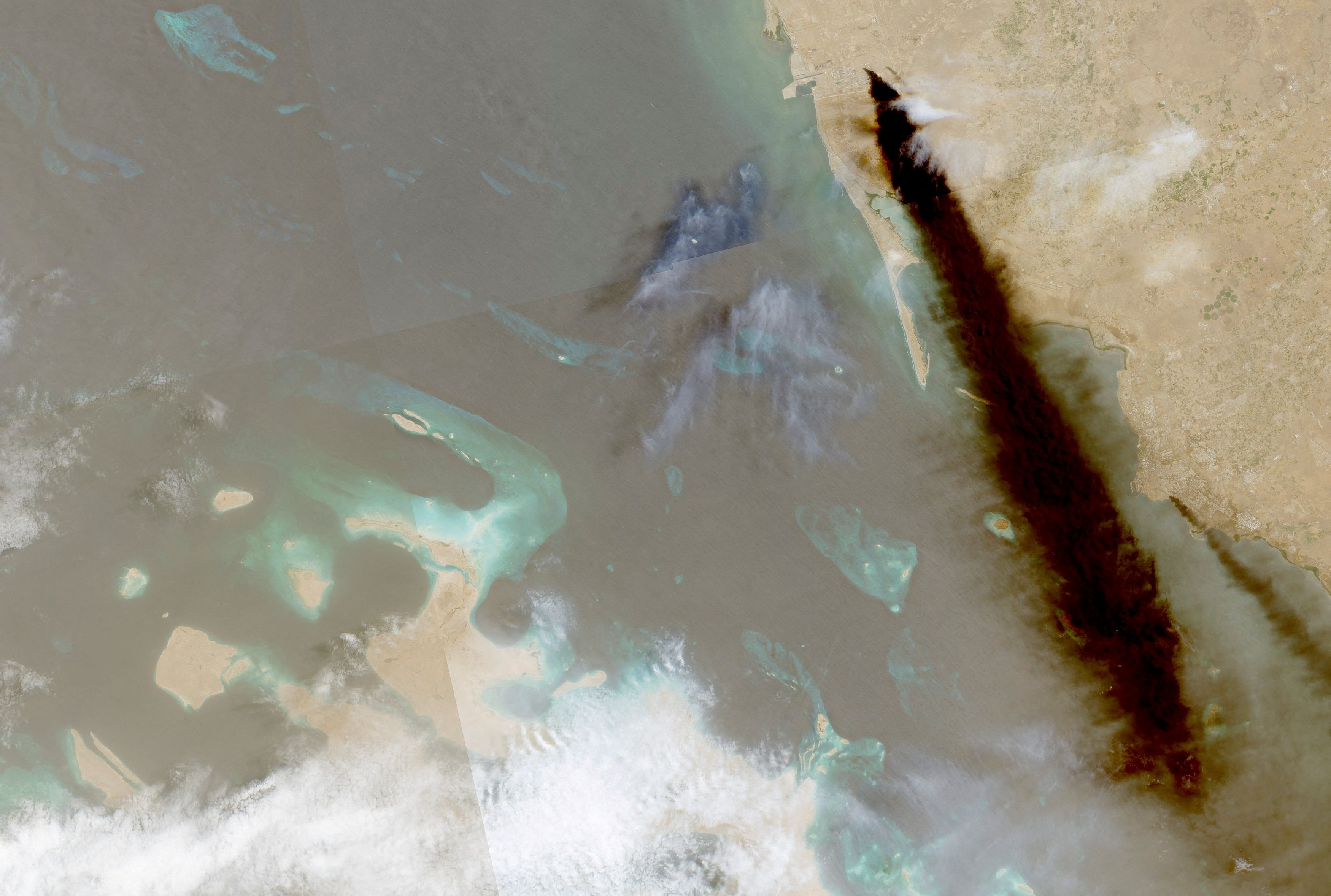
FILE PHOTO: A composite satellite image shows trail of smoke rising from an oil facility, in Jizan, Jazan province, Saudi Arabia, July 26, 2026. European Union/Copernicus Sentinel-2/Handout via REUTERS THIS IMAGE HAS BEEN SUPPLIED BY A THIRD PARTY. MANDATORY CREDIT/File Photo
Mr. Roman said Greece would make a mistake if it interpreted Riyadh’s agreement with Ankara as a reason to pull away.
“The more Greece invests in its strategic relationship with Saudi Arabia, the more it weakens Turkey Saudi relations,” he said. He argued for more military exercises and maritime cooperation between Athens and Riyadh. “You make this agreement (Mecca Pact) weaker by strengthening your relationship with the Saudis. You make it stronger by pulling back.”
That argument is especially relevant in the Eastern Mediterranean, where Greece, Cyprus and Israel have spent a decade constructing a separate network of diplomatic, defense and energy ties.
At a summit in Jerusalem in December, the three governments agreed to strengthen military and maritime security cooperation and reaffirmed the importance of their 3+1 framework with the United States. In June, officials from the four countries established the Eastern Mediterranean Energy Center at Rice University in Houston, an American backed initiative focused on energy security, infrastructure and regional cooperation.
Mr. Roman sees that grouping and the new arrangement involving Turkey as increasingly competitive.
“I do see it as competing blocs,” he said of the emerging regional structures.
But even here, the lines blur.
Saudi Arabia remains close to Greece. Turkey is a NATO member. Egypt has an established partnership with Greece and Cyprus, while Ankara says the Mecca agreement could eventually expand to include Egypt.
What is emerging, then, may be less a pair of rival alliances than several overlapping networks in which governments cooperate with one another on some threats and compete over others.
Nowhere is that ambiguity more apparent than in Washington’s relationship with Turkey.
Turkey was removed from the F-35 fighter program after purchasing Russia’s S-400 air defense system. Congress subsequently prohibited F-35 sales to Ankara while it retains the Russian system. But at the NATO summit in Ankara last month, Mr. Trump said he planned to lift sanctions imposed on Turkey and openly entertained the possibility of selling it F-35s. No such sale has been approved, and the statutory restrictions remain.
But the prospect has alarmed Israel. Prime Minister Benjamin Netanyahu has said he told Mr. Trump that he opposes the sale, warning that Turkish possession of the aircraft would alter the military balance in the Middle East.
Mr. Roman also opposes returning Turkey to the F-35 program, but his argument is different.
He said Israel should not frame the dispute principally around preserving its own qualitative military advantage. The stronger case, he argued, is that giving Turkey access to the aircraft could create risks for American military technology as Ankara develops its own fifth generation fighter, the KAAN.
“I think the argument has to be that this is dangerous for the United States,” he said.
Mr. Roman said he worried that Turkish engineers could use access to American technology to advance the KAAN and eventually produce an aircraft that competes with the F-35 in export markets.
Yet Washington is already supporting another part of Turkey’s combat aircraft program. In June, the Trump administration notified Congress of a proposed sale of more than $700 million in General Electric engines intended to power the KAAN, despite objections from some lawmakers.
That leaves the United States navigating many of the same contradictions as its regional partners.
Washington is investing in a security and energy framework with Greece, Cyprus and Israel while seeking a rapprochement with Turkey. Saudi Arabia is entering a mutual defense pact with Ankara and Islamabad while relying on Greek forces to help protect its territory. Turkey and Greece remain strategic competitors but belong to the same Atlantic alliance.
For Athens, Mr. Roman argues that this fluidity presents an opportunity rather than a reason for retrenchment.
Greece, he said, has developed unusually strong relationships with lawmakers in both American parties and should invest more heavily in them, building a more organized political presence in Washington.
“There’s an opportunity for a golden age of Greek American relations,” he said, “if the right people take advantage of that.”
The Mecca pact will provide an early test of how much these new arrangements ultimately mean. Its language is expansive, and its members are beginning to build institutions to support it. But the countries entering these agreements have not discarded their other partners, and in many cases they have no intention of doing so.
Saudi Arabia, Turkey and Pakistan have promised to defend one another. But across the region, countries are building security relationships that overlap as often as they compete.
For the moment, the most revealing feature of the region’s changing order may not be who has joined which alliance. It is how many countries are trying to belong to more than one.