Noise pollution is putting the health of nearly 112 million people across Europe at risk, according to a new report from the European Environment Agency (EEA). The main source is road traffic, followed by railways and air travel, with long-term exposure linked to heart disease, sleep disorders, mental health problems and premature death.
France records the highest number of people exposed to transport noise above EU safety thresholds, with 24 million affected — nearly 90% due to road traffic. At night, Germany tops the list, with 15 million residents exposed to harmful levels of noise.

Proportionally, Luxembourg is the most affected country: almost 70% of its population faces harmful daytime noise and 50% suffers from it at night.
The EEA warns that transport noise contributes annually to 66,000 premature deaths, 50,000 new cases of heart disease and 22,000 cases of type 2 diabetes. Children are particularly vulnerable, with studies linking noise exposure to difficulties in reading comprehension, behavioral issues and even obesity.
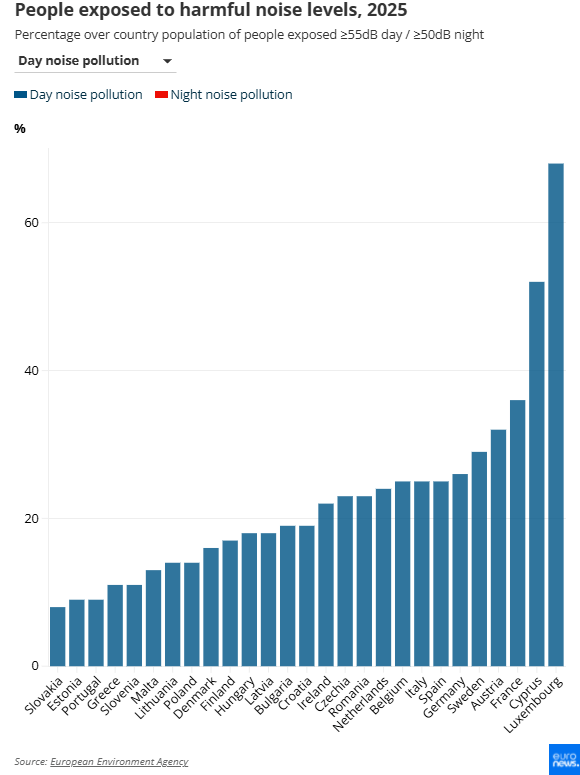
People exposed to harmful noise levels – Day, 2025 Source: euronews
Noise from vehicles can reach 100 decibels (dB), while a departing airplane can reach 120 dB. EU guidelines define transport noise above 55 dB as harmful. For comparison, a whisper is about 30 dB and normal conversation around 60 dB.
To tackle the problem, the EEA recommends investing in quieter transport systems, improving urban planning, and increasing access to green spaces to reduce stress and improve wellbeing. Exposure to natural sounds such as flowing water or birdsong can also provide relief. For air travel, the agency suggests night-time flight bans at all airports.