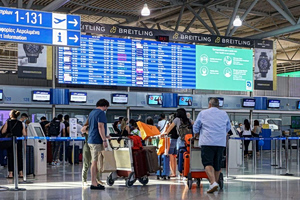
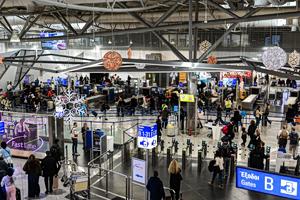
Flight delays have once again become a major issue at Greek airports during the busy summer travel season, despite a new operational agreement introduced earlier this year to improve the management of air traffic.
The framework, agreed in May 2026 by Greece’s Civil Aviation Authority, air traffic controllers and the Ministry of Infrastructure and Transport, was designed to reduce congestion during the summer peak. The agreement, formalized through a joint ministerial decision, established operational limits for arrivals and departures at the country’s busiest airports.
At Athens International Airport, for example, the agreement allows for up to 35 departures and 31 arrivals per hour during peak periods, with flexibility to exceed those limits when operational conditions permit.
Gap Between Planning and Reality
According to aviation industry sources, however, those operational targets are not consistently being met throughout the day. They argue that the main issue is not the number of scheduled flights, but the uneven implementation of the agreed air traffic management framework.
Traffic data does not indicate that the system is facing widespread overload. Aircraft movements at Athens International Airport increased by around 2% in June compared with the same month last year—a level the industry considers manageable, particularly as flight schedules have been distributed more evenly throughout the day.
That scheduling balance is credited to coordination between the national flight scheduling authority and airlines, which sought to spread departures and arrivals across more time slots instead of concentrating them during peak hours.
Industry sources note that only around 1.5% of weekly departures exceed the agreed limit of 35 departures per hour. Those exceptions are said to stem mainly from slot availability restrictions at destination airports rather than excessive demand within Greece itself. Out of roughly 4,000 weekly departures, only a few dozen flights fall into this category, a figure that, according to the industry, does not fully explain the scale of the daily delays.
Different Views on the Causes
Air traffic controllers maintain that flight management must always prioritize safety and reflect real-time operational capacity. Meanwhile, Greece’s Civil Aviation Authority points to the existing legal and operational framework and stresses the importance of complying with the agreed limits.
Airlines, for their part, argue that flight schedules have already been carefully coordinated and that only a small number of services exceed the agreed thresholds. They contend that the current delays cannot be attributed solely to flight volumes.
Industry representatives believe that more consistent implementation of the existing operational framework could significantly improve the predictability of air traffic and reduce delays. At the same time, they acknowledge that some disruptions are unavoidable, including those caused by adverse weather, technical issues, delays originating at other airports, or wider European air traffic flow restrictions.