Founded by Alexander the Great in 331 BC, Alexandria was once the beating heart of Hellenistic civilization—home to the legendary Library of Alexandria and the towering Lighthouse, one of the Seven Wonders of the Ancient World. It endured invasions, empires, and natural disasters across the millennia. But today, it faces a quieter, more insidious threat: climate change.
This summer, as temperatures rise across the Mediterranean, Alexandria is quite literally slipping into the sea.
According to a recent study published in Earth’s Future, the city is the most vulnerable coastal zone in the entire Mediterranean basin. The report, co-authored by Dr. Essam Heggy of the University of Southern California, warns that the convergence of three devastating forces—rising sea levels, coastal erosion, and subsiding land—is causing Alexandria to vanish from the map.

A view of buildings on the corniche in the Mediterranean city of Alexandria, Egypt, April 20, 2025. REUTERS/Mohamed Abd El Ghany TPX IMAGES OF THE DAY
“We’re seeing buildings in the city being eroded from the bottom up,” Dr. Heggy told Reuters. Satellite imagery and historical maps used in the study reveal that the shoreline has receded by an average of 3.6 meters (11.8 feet) per year over the past two decades. Cement barriers and seawalls have failed to halt the encroaching Mediterranean.
Each year, the foundations of Egypt’s second-largest city are gnawed away by saltwater, causing 40 buildings to collapse annually. A decade ago, that figure was just one.
The Sea at Their Doorsteps
For Alexandrians, this isn’t a distant scientific theory—it’s daily life.
From the balcony of her ninth-floor apartment overlooking what’s left of the Alexandria coastline, 50-year-old Iman Mabrouk stares at a narrow strip of sand that used to be a sprawling beach. As a child, she played there freely. Now, she has already relocated once from a beachfront building that had begun to tilt. “It had started to lean,” she says matter-of-factly. She reflects on the city’s decay with a kind of fatalism: “Everything ages over time.”
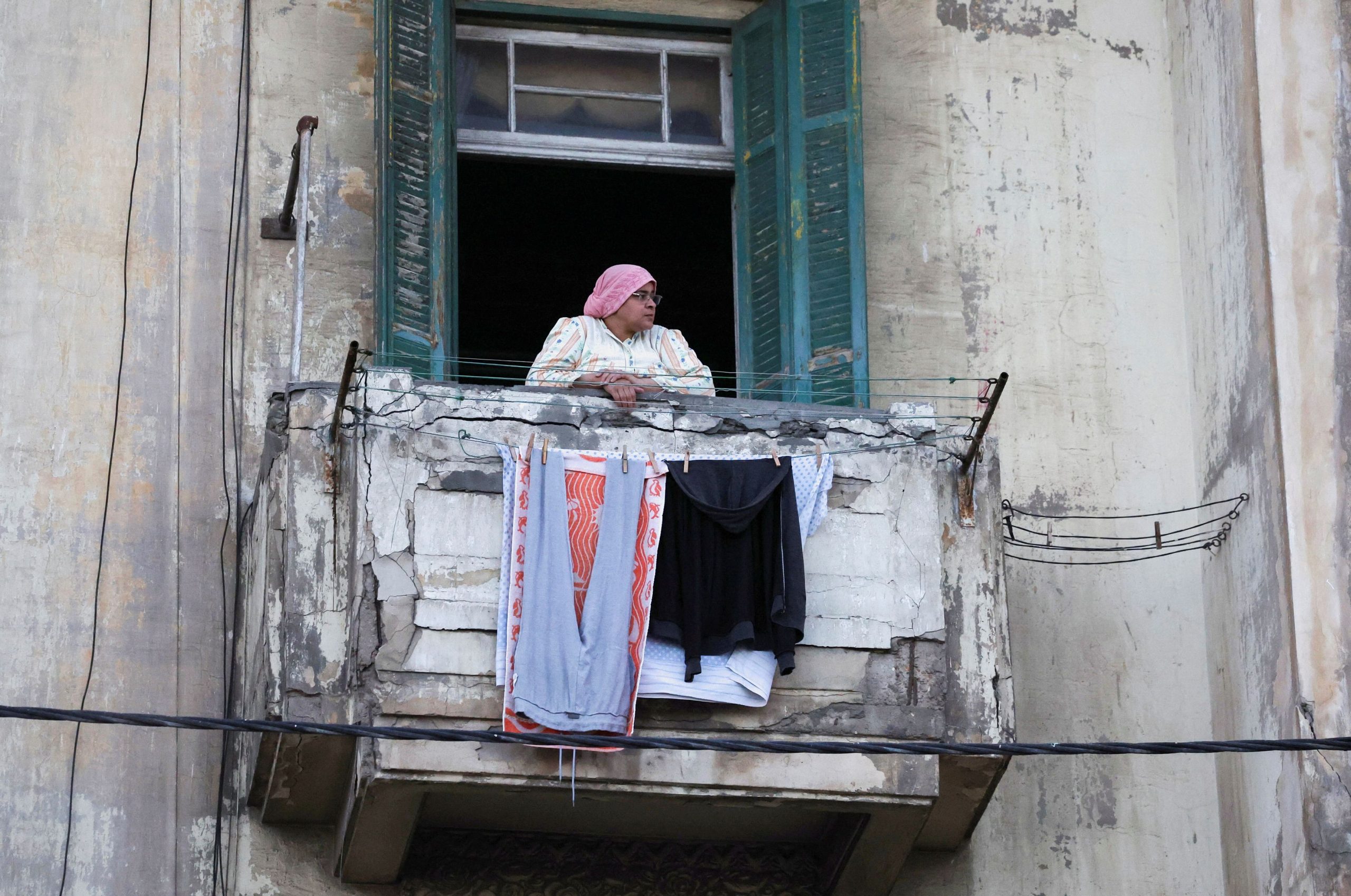
A woman looks out from a dilapidated balcony by the corniche in the Mediterranean city of Alexandria, Egypt, April 20, 2025. REUTERS/Mohamed Abd El Ghany
But time is a luxury Alexandria no longer has.
Dr. Sarah Fouad, a climate scientist at the Technical University of Munich and lead author of the study, puts it plainly: “For centuries, Alexandria’s buildings stood as marvels of resilient engineering. But rising seas and climate-intensified storms are now undoing in decades what took thousands of years of ingenuity to build.”
A Race Against Nature
Egyptian authorities are scrambling to respond. Off Alexandria’s coast, breakwaters are being constructed to blunt the waves. Emergency sand embankments are going up along eroding beaches. And more than 7,500 buildings—over 2% of the city’s housing stock—are marked for demolition due to imminent collapse.

A view shows dilapidated balconies on Alexandria’s corniche, where rising seas and coastal erosion are affecting shoreline structures, in Alexandria, Egypt, April 19, 2025. REUTERS/Mohamed Abd El Ghany TPX IMAGES OF THE DAY
At the same time, the city is trying to accommodate a population boom. Alexandria’s population has nearly doubled in the past 25 years, now nearing 5.8 million. Around 55,000 new housing units are under construction, driving real estate prices higher even as the ground beneath crumbles.
The Future Is Now
“For many people, climate change is something that will happen in the future,” says Dr. Heggy. “But for the people of Alexandria, it’s already here.”

A view shows a road expansion project underway on the corniche in the Mediterranean city of Alexandria, Egypt, April 20, 2025. REUTERS/Mohamed Abd El Ghany
The Mediterranean, long seen as the cradle of civilization, is not immune. As Alexandria drowns, so too does a piece of human history—a city that once lit the ancient world, now flickering under the weight of a warming planet.
This is not a poetic metaphor. As the sea takes back the land, the farewell to Alexandria—once imagined in verse—is becoming a reality written in salt and stone.