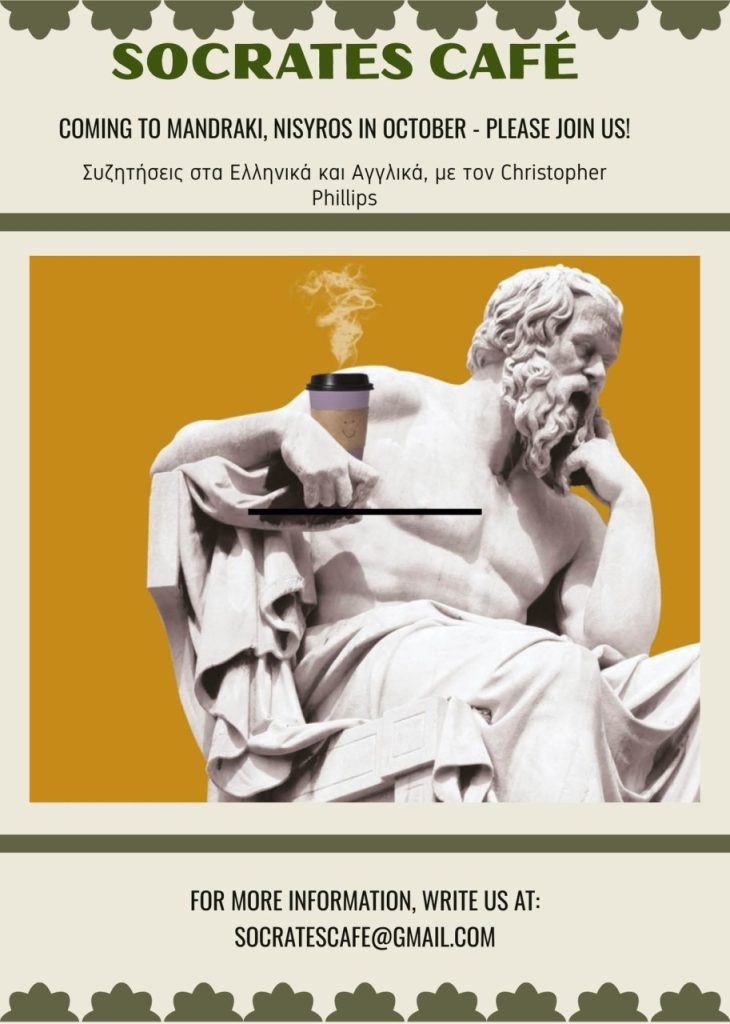
On the tiny Aegean island of Nisyros, philosophical conversations are set to come alive this October. The acclaimed author, professor, and philosopher of the Greek Diaspora, Christopher Phillips, is bringing his renowned Socrates Café to Greece—the homeland of the greatest philosopher of the ancient world, whose questions still resonate in the modern world.
A Legacy Rooted in Heritage
The creation of the Socrates Café movement back in 1996 was deeply inspired by the author’s Greek heritage and his love of philosophy, which was instilled in him by his father Alexandros, but above all by his grandmother, or ‘yiayia’, as he affectionately refers to her.
His beloved yiayia, who was one of the first (if not the first) teachers of Greek language and culture in the Tampa Bay region of Florida, is his driving force, Phillips admits.
“Without her teaching and her insistence that I read, at a very young age, Plato’s dialogues featuring Socrates—who became a hero and role model for me—I would not have had the brainchild of starting Socrates Café all the way back in 1996, at a time when citizens of the United States were so woefully polarized,” Phillips tells TO BHMA International Edition.
Living with Meraki and Arete
Two Greek concepts have profoundly influenced his stance in life: meraki and arete. The first leads him “to live a life of soul and passion and commitment,” while the latter inspires him to strive for excellence and to live in a way “that elevates others, with integrity and social conscience.”
His grandmother and father have been paradigms for him, as they embodied these concepts in their way of living.
Socratic Method & Modern Relevance
Today, the Socrates Café movement has become a global phenomenon, with hundreds of ongoing groups worldwide. But why does the Socratic Method—questions more than answers—still resonate in our fast-paced, polarized world?
Phillips points out that, as he writes in his international bestseller Socrates Café: A Fresh Taste of Philosophy, the Socratic Method is a way to seek truths by your own lights. It is a system, a spirit, a method, a type of philosophical inquiry and an intellectual technique, all rolled into one.
The Socratic Method is named after Socrates because he, more than anyone else before or since, modeled philosophy as a practice—as a deed, a way of living, and something that anyone can do. It is an open system of philosophical inquiry that allows one to interrogate an issue from multiple vantage points.
He cites Gregory Vlastos, a Socrates scholar and Princeton philosophy professor, who called the Socratic method of inquiry “one of humanity’s greatest achievements” because it made philosophy a shared human endeavor, accessible to all. Socrates used his method to promote self-knowledge and challenge error, superstition, and dogma.
Socratic Circles Beyond the West
The popularity of Socratic dialogue comes as no surprise in Western societies, where ancient Greek philosophy has shaped thought. But how can its popularity among diverse audiences—from cafés in the U.S., Latin America and Africa—be explained?
Phillips explains that societies all over the globe have traditions akin to the Ancient Greek custom of gathering in the agora—the public marketplace—to exchange ideas and ideals. The tribal democracy in pre-colonial South Africa and the concept of ubuntu (meaning “I am in you and you are in me”) is kindred in spirit to the agora, as is the indigenous Mayan tradition in Latin America of batsilwinik (which translates as “a true human being” and conveys the meaning that we are all equal and deserve to live in dignity).
Their community dialogues feature circle groups in which everyone is considered an equal and has an equal right to voice their views.
Civic Engagement Through Dialogue
Phillips views philosophy as a form of civic engagement, noting that Socratic dialogue can contribute to democratic renewal today. Public gatherings at which people willingly explore questions together that are as timely as they are timeless tap into the best democratic traditions of the past in ways that can help forge a brighter future.
“Open selves and open societies go hand in glove, in my view—and so, if we extrapolate from this, individual selves need to be just as ‘democratic,’ as open and empathetic and caring, as the societies as a whole that they inhabit; the two go together and are entwined,” he emphasizes.
Despite his academic achievements—three master’s degrees and a doctorate—he stresses that philosophy is at its best when practiced outside the academic cloister. Much of academic philosophy today is, he argues, pretentious and filled with jargon, far from its original purpose. He believes societies must keep philosophical inquiry at their core if they want to remain vibrant and open.
Bridging Divides One Café at a Time
In times of deep global division, small community dialogues—like Socrates Cafés—can play a role in bridging divides.
As Phillips says, if you have hundreds of small community dialogues all over the world that bring together thousands of diverse people on a regular basis, that can make a big difference.
“One of the wondrous fruits of engaging continually in this kind of ‘Socrates Café method’ of inquiry—in which listening to others with all of our being is just as important as speaking out ourselves—is that we often discover areas of agreement, what I call ‘uncommon common ground,’ with people that we would otherwise have thought we had nothing in common with,” he emphasizes.
Coming Full Circle on Nisyros
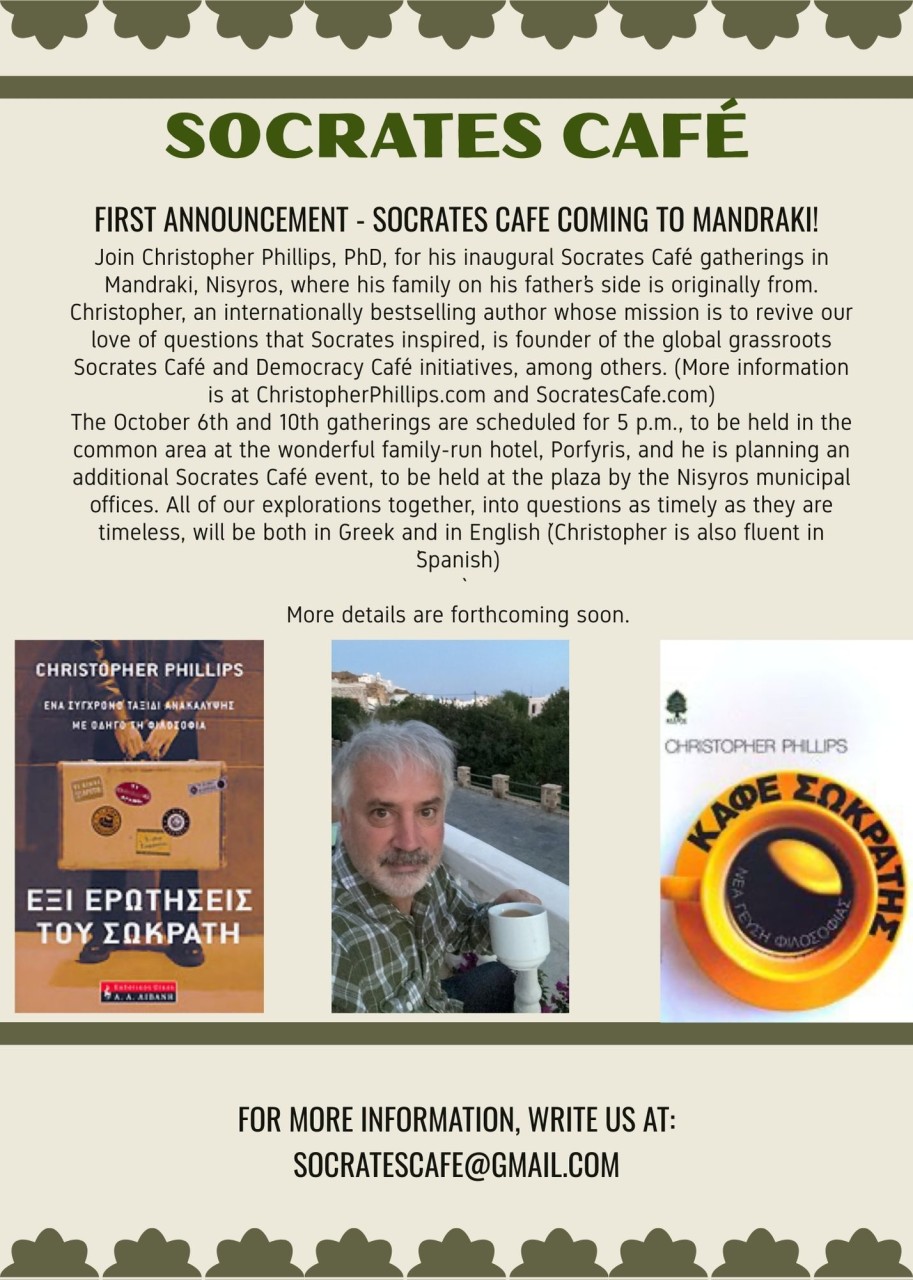
The Nisyros Socrates Café initiative to be held on the island on October 6 and October 10 (in both Greek and English) has a symbolic meaning for Phillips. It will be like a returning home, coming full circle, while honoring Calliope Philippou, his yiayia, who was forced to leave Nisyros, with his grandfather in 1923 to emigrate to the United States.
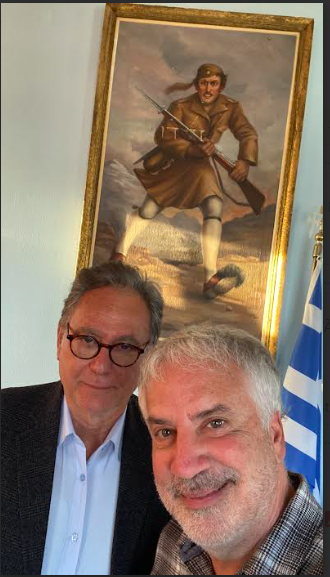
Author, professor and philosopher of the Greek Diaspora, Christopher Phillips (right) on Nisyros with the island’s mayor Christofis Koroneos.
People will experience a “fresh taste” of a very ancient philosophical tradition that will, ideally, reconnect Nisyrians with the tradition itself. He hopes to make Nisyros a go-to place, where people from all walks of life and parts of the world can immerse themselves in the Socrates Café tradition when they visit the island in the Dodecanese. His plans also include establishing Socrates Cafés throughout Greece.
Shakespeare Café: The Next Chapter
Finally, another project is underway: a new dialogue initiative in the spirit of the Socrates Café, but even more ambitious. It seeks to enable people to directly counter and rise above the extremism, polarization, and authoritarianism that are so pervasive in our world today—not only in the U.S. but across much of the world.
Known informally as the “Shakespeare Café,” it hosts the exploration of questions which, stemming from the Bard’s brilliant plays, can produce insights and solutions that can ensure open societies do not go into decline.
Stay Connected
Readers are invited to visit democracycafe.org