By nine in the morning they have showered, changed and opened their laptops. They take calls, deal with customers and draw a salary. What their colleagues do not know is that, when the working day ends, some of them go back not to a flat, but to their car.
Speaking to TO VIMA International Edition, Maria Karra, founder of the Emfasis Foundation, says the charity is currently supporting six such people in Kallithea, a dense district just south of central Athens. Volunteers bring food, help them charge phones and laptops and, where they can, find somewhere cheap to shower and wash clothes. The modest aim is to keep them functioning long enough to save the deposit and advance rent that even a small flat now demands.
“All they have is a laptop,” Karra says. To her, these workers embody a form of homelessness Greece has been slow to recognize, because it does not resemble the image the word conjures. “Say ‘homeless’ and people switch off,” she adds, “they picture an old man with a beard on the pavement.”
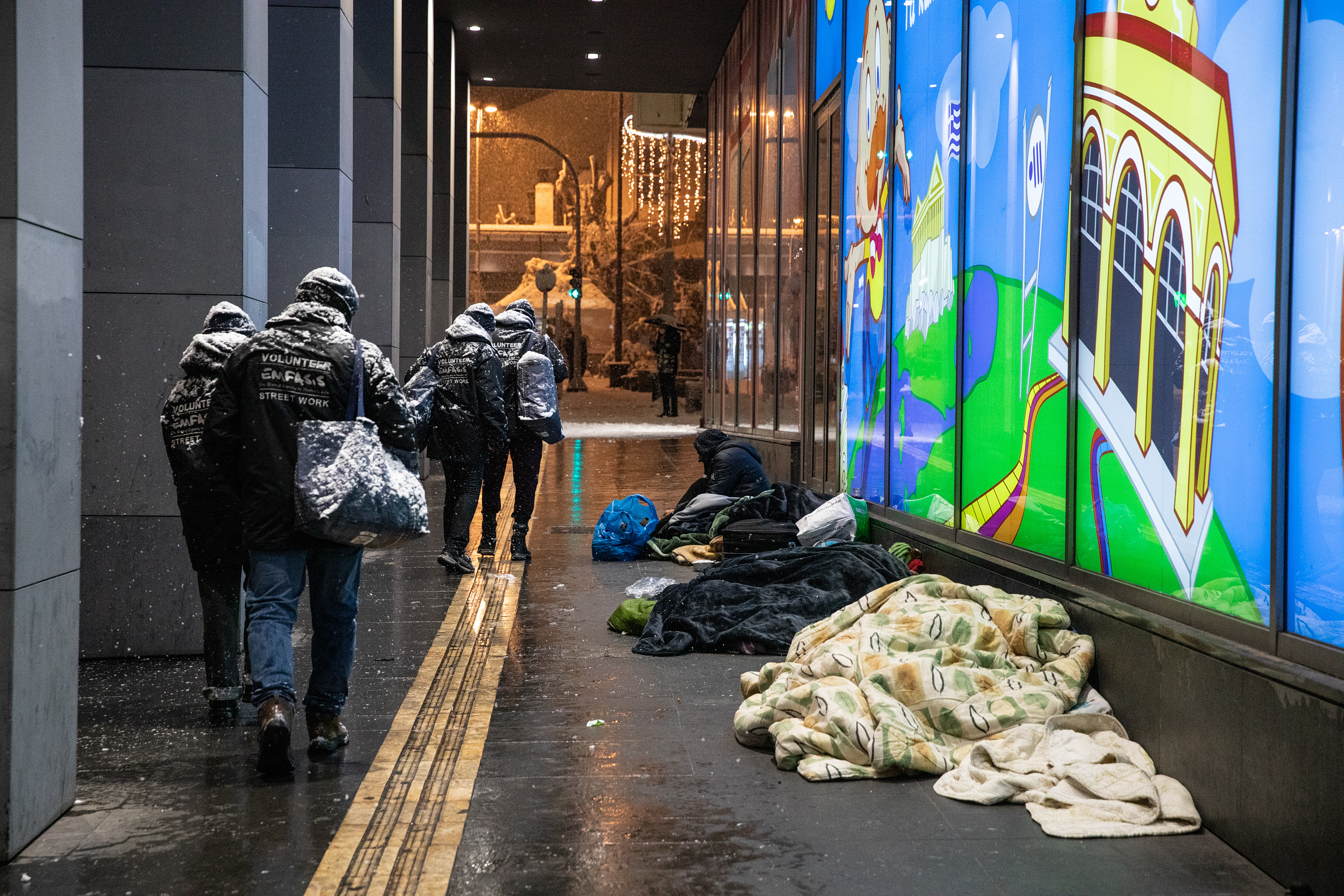
Night shift workers from the EMFASIS foundation checking up on homeless people during a rainy evening, near Monastiraki Square, Athens, Greece. Photo courtesy of EMFASIS foundation
The line between housed and homeless has become harder to draw. It runs through parked cars and borrowed rooms; through students drifting between friends’ sofas because rent is out of reach; through adults who have lived in a relative’s spare bedroom for years; through patients who travel to Athens for treatment and cannot afford a bed near the hospital; through families living in buildings with no electricity or running water.
Athens’ Deputy Mayor for Social Solidarity, Mina Fountzoula, meets the same people from a higher rung of the administrative ladder. Municipal teams, she says, know of some people living in abandoned cars, on vacant plots and in homes cut off from basic utilities. “These are conditions of homelessness,” she says, “even if this is not the homeless person you see sleeping in the street.”
The further homelessness drifts from the pavement, however, the harder it is to count, and what is not counted is rarely governed.
The arithmetic of invisibility
The OECD’s latest country data capture the problem with troubling precision. Greece’s figure for 2026 is 809 homeless people, but that number is just a January snapshot of people staying in night shelters and homeless hostels listed on a ministry digital registry. It omits everyone sleeping rough, living in cars or makeshift dwellings, held in institutions or staying with family and friends for want of anywhere else.
Greece, the OECD notes drily, has no legal obligation to collect homelessness data at all.
The 809, in other words, captures solely shelter occupancy rather than homelessness. The state-registered network of 34 homeless facilities offers 1,122 beds, according to the Ministry of Social Cohesion and Family Affairs. The Municipality of Athens’ own count last October found 681 people within the municipality alone — a city of about 640,000, not the wider metropolitan area of some 3.7 million.
Greek law already takes a broader view than Greek statistics.
It defines as homeless anyone lacking secure access to adequate housing, including people living temporarily, out of necessity, in institutions or unsuitable accommodation. On a European level, FEANTSA, the European Federation of National Organizations Working with the Homeless, has spent years trying to settle the definitional question through its ETHOS framework. It defines a home as more than a roof: it requires adequate physical space, room for privacy and social life, and legal security of tenure. From that follow four categories — rooflessness, houselessness, insecure housing and inadequate housing — along a continuum of exclusion that includes tenants facing eviction, sofa-surfers, domestic abuse victims, and families living in spaces unfit for habitation.
Karra puts the taxonomy more plainly: “The moment you don’t have your own key, you don’t decide where you live, for how long or on what terms,” she says, “you are not an autonomous person, you can’t be independent.”
The Athens count, carried out with Panteion University’s Department of Social Policy in October 2025, attaches numbers to that abstraction. It recorded 681 people, 384 of them on the street and 297 through support organizations, but even that count captures only part of the picture. Marianella Kloka, President of the Greek Anti-Poverty Network, has argued that Greece still lacks systematic national recording not only of precarious housing but even of visible homelessness. The people easiest to count are those whose housing crisis has already reached its most acute stage; those still sliding towards it remain statistically invisible until they finally fall through. That gap is where most of the problem lies, and where the most pressing policy questions remain unaddressed.
Rent as a root cause of poverty
In the Athens count, 72.2 percent of people said they had lost their homes for financial reasons. Addiction and mental illness still play a part, but the main driver is now the housing market, and in Greece it bears down harder than anywhere else in Europe. According to Eurostat, 26.4 percent of Greeks lived in 2025 in households spending at least 40 percent of their disposable income on housing, more than three times the EU average of 7.7 percent. Rents rose 10.1 percent last year, second only to Croatia. Little wonder, then, that 87.1 percent of Greeks reported difficulty making ends meet, again the highest share in the Union, against an average of 42.5 percent.
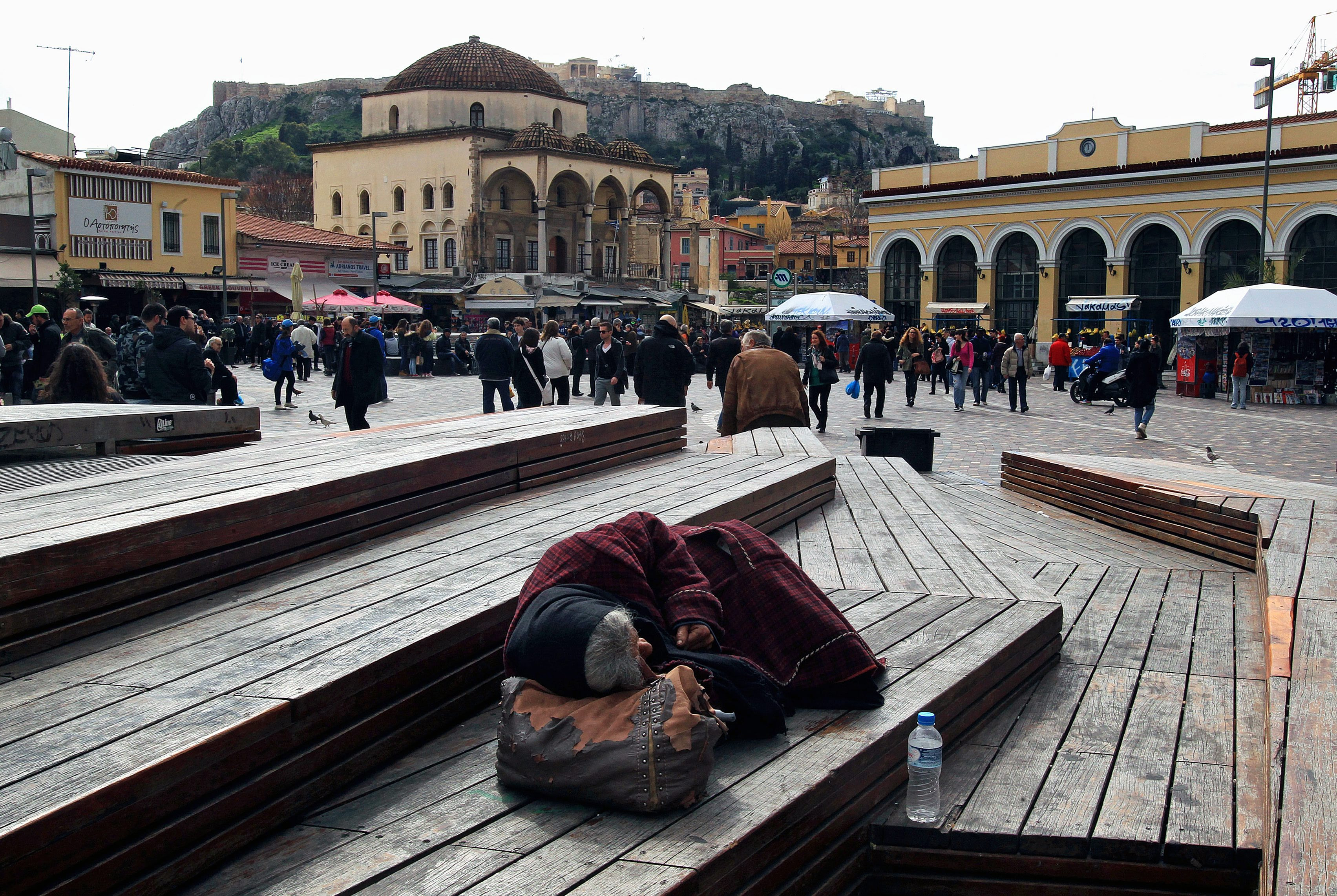
An elderly homeless woman sleeps on a bench in the touristic area of Monastiraki in central Athens, Greece. EPA/SIMELA PANTZARTZI
That poverty did not arrive all at once, each of Greece’s crises has produced its own homeless, and Kloka traces a decade of overlapping emergencies — the debt crisis, the arrival of refugees, the pandemic, climate disasters — each generating new forms of poverty faster than policy could keep up. Today, she argues, expensive housing is no longer merely one hardship among many for poor households but a producer of poverty in its own right.
For years, the Greek family absorbed much of that pressure: adult children moved back in, grandparents gave up rooms, relatives took in relatives. In a country of high home ownership and almost no social rented housing, the family home functioned as a form of asset-based social security — Greece’s traditional “safety net”.
But the mechanism is now weakening in both directions.
Karra says younger adults, already struggling with rents, stagnant incomes and the cost of raising children, increasingly lack either the space or the money to absorb an aging parent who can no longer live independently. Families contact Emfasis, she says, not because they are unwilling to care for an elderly relative but because they simply cannot afford to do so.
“It’s not only that you don’t have the space,” Karra says. “You don’t have the money.” The result is that a system that long depended on families to compensate for gaps in the welfare state is becoming less able to do so. The net, as Karra puts it, “now has holes in it.”
As rents, energy, food and care costs rise, a spare bedroom becomes harder to offer indefinitely. The informal arrangements that keep people off the street also keep them out of the statistics. Fountzoula concedes that the municipality can identify people in cars and visibly inadequate homes. Those moving quietly between relatives and friends are another matter. “They are not recorded,” she says.
The gap between institutions
Homelessness rarely registers in the statistics until it is well advanced, and it is often on hospital wards and in shelters, at the point of crisis, that public services first meet it.
Among the cases known to Kloka’s network are two cancer patients who are homeless while undergoing chemotherapy, whose treatment does not require a hospital stay, and who return from each session to the street. Karra describes others who travel to Athens from the provinces for treatment and, unable to afford a room nearby, sleep in their cars. At the other end of the process are what social workers call “social cases”: patients well enough to be discharged from hospital whom doctors keep in the ward, at their own discretion, because there is nowhere safe for them to go.
Psychiatric care exposes the same fault line. Municipal shelters, Fountzoula explains, can only take in people they are equipped to look after: someone whose condition is stable, who is following treatment and can manage on their own. Those whose needs are too acute for a shelter, yet not severe enough to warrant admission to a psychiatric unit, fall between the two. “And that,” she says, “is where the absence of the state becomes visible.”
It is a revealing remark, because the gap it describes is not between hospital and pavement. It lies between institutions, each built to deal with one piece of a problem. The hospital treats illness, the shelter provides a bed for a time and the municipality can recover lost identity documents, supply medication and food and offer job advice, yet what the individual often needs falls between all of them: a stable home with continuing support attached.
The same logic applies to women leaving domestic-violence refuges. Society urges them to leave abusive homes; it is far less clear on the question that follows. “We keep telling her: leave, leave, leave,” Karra says. “Leave for where?”
For Karra, the recurring weakness of the state’s response fits in a single word: temporary. Emergency accommodation, food programmes, shelters and transitional housing are all indispensable, yet each is built as a stopgap: Athens’ Multifunctional Homeless Centre houses about 200 people a day, usually for six months, renewable once.
The trouble starts when a temporary intervention has no permanent destination, a distinction Fountzoula draws herself. The municipality, she says, can improve shelters, hire specialist staff and bring vulnerable people in from the street, but “the state has to guarantee people stable, autonomous housing”. The Municipality of Athens, in other words, can move someone from the pavement to a bed, but taking them from that bed to a home is a job for the state.
Policy after the fall
It would be wrong to say Greece is doing nothing. According to the Ministry of Social Cohesion and Family, the government now has some 48 housing-related programs under way with a combined budget of more than €6.5bn, most of it aimed at home purchase, renovation and energy efficiency rather than at people on the margins. The instruments for those at the bottom are smaller, and their take-up is uneven.
The program, Housing and Work for the Homeless III, launched in 2025, pairs rent and basic-needs subsidies with psychosocial support, links to services, wage subsidies and training. Its €20 million budget was designed to reach 1,640 people nationally. In Athens, the current cycle funds 46 households, yet the support is also time-limited: rent subsidies run for a maximum of 24 months, after which those who have not found work or cheaper housing risk losing their homes again.
Catching people before the fall: prevention as policy
What Greece still lacks is a prevention system: a mechanism that identifies households as they begin to fall behind and intervenes before eviction.
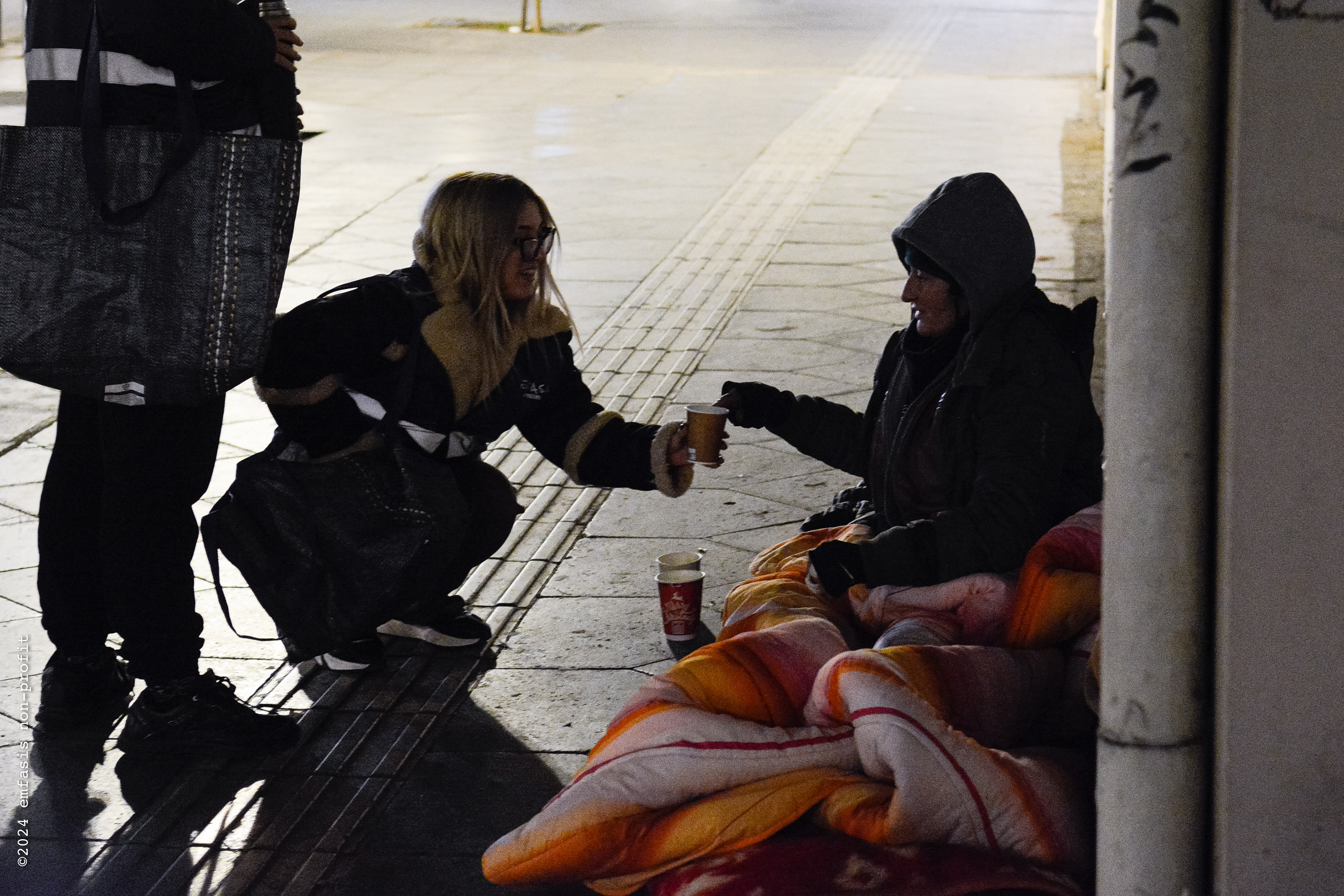
Images of night shift street work of EMFASIS Foundation volunteers and social work professionals in Athens. Courtesy of EMFASIS foundation
Vienna offers an instructive contrast. For three decades the city has funded a dedicated eviction-prevention service that steps in when tenants fall behind and negotiates with their landlords; a study by the Vienna University of Economics and Business found it averted eviction in almost nine cases out of ten. When inflation surged in 2023, the city went further and began paying off tenants’ rent arrears directly, through a scheme called Housing Security Plus (Wohnungssicherung Plus) that it says had saved more than 11,300 households from eviction by mid-2024.
Spain has lately offered Europe the opposite impression. On September 23 police carried Maricarmen Abascal, 87, on a stretcher from the Madrid flat she had lived in since 1956, after the investment company that had bought the building pressed a fourth eviction attempt. The case ignited protests across the country and, within days, a deal allowing her to return.
It also forced the government’s hand. Spanish Prime Minister, Pedro Sánchez, rushed through emergency decrees to shield vulnerable tenants from eviction until 2030, curb speculative purchases by investment funds and extend expiring leases. On October 2, Congress threw them out, as the Catalan separatists of Junts joined the conservative Popular party and the far-right Vox in voting against.
Sánchez responded by dissolving parliament and calling a snap election scheduled November 29. On October 6, his cabinet re-approved a revised package, including interest-free loans for first-time buyers, a two-year lease extension for tenants who are up to date with their rent and limits on rent rises, which it hopes to pass through parliament’s standing committee, the scaled-down chamber that sits while Congress is dissolved.
At the Thessaloniki International Fair (TIF) in September, Greek Prime Minister Kyriakos Mitsotakis, also touched upon home ownership, with a third round of the My Home (Spiti Mou) scheme: €2 billion in low-interest loans for young buyers from January 2027. On October 6, the day Sánchez relaunched his decrees, Mitsotakis, speaking at the “Dialogues for Athens” Conference, stated that the housing crisis was a European problem requiring incentives and political agreement.
Both leaders have put home ownership at the center of their policy proposals, yet the most pressing issue is addressing households which are already sliding towards homelessness: those in rent arrears, in insecure or inadequate accommodation, or dependent on relatives for a roof. For them, ownership support is largely irrelevant; what matters is prevention and a supply of affordable rented homes.
Who will hand over the key?
The debate about what Greece should do next keeps returning to permanent housing.
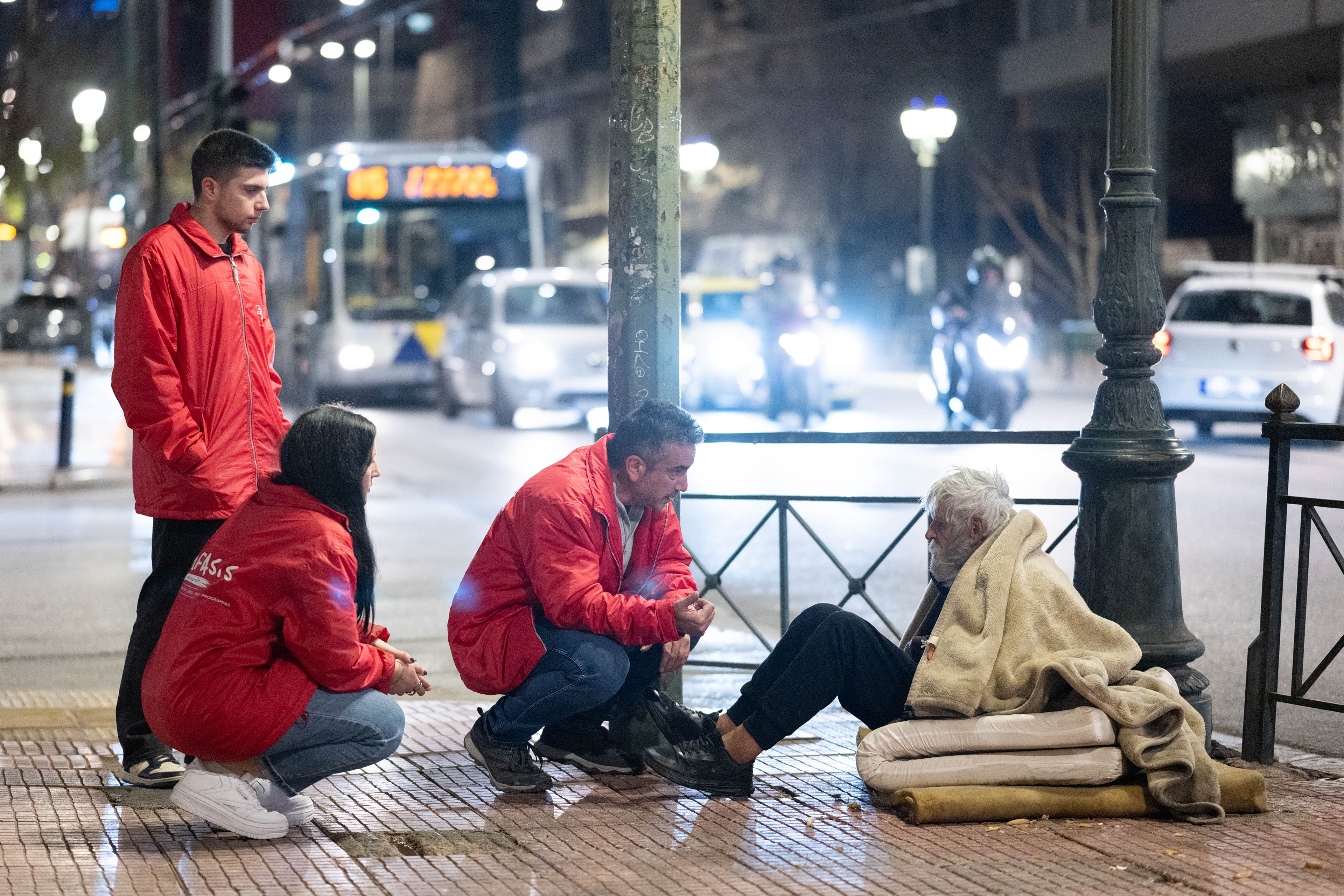
Images of night shift street work of EMFASIS Foundation volunteers and social work professionals in Athens. Courtesy of EMFASIS foundation
Kloka advocates mobilizing both public property and empty private homes, while Karra wants Greece to test Housing First, the model that inverts the traditional sequence of homelessness policy. Instead of requiring people to become sober, employable, medically stable or otherwise “housing ready” before they are offered a permanent home, Housing First begins with the home and builds support around it.
Crucially, access does not depend on fitting a category. Where Greek schemes are tied to age bands, income thresholds or benefit status, Housing First sets no conditions on treatment or behavior, gives tenants an ordinary lease and keeps support in place for as long as it is needed. In a Greek pilot, tenants would cover their rent through state allowances.
European evaluations consistently find that most participants of the program, roughly 80 to 85 percent, stay housed.
Finland, which made the model national policy in 2008, had cut long-term homelessness by about two-thirds by 2022.
Emfasis’ own request is deliberately modest. It wants to secure 12 apartments for 24 months to run as a pilot, evaluated in collaboration with Greek universities that would bring expertise in social policy and the research methods needed to measure its effects in Athens.
The municipality does not dispute the principle, “of course we support it,” Fountzoula says. But she is equally clear about the limits of what the city can do: within its mandate and budget it can run shelters and street teams, not supply permanent homes. The initiative, in other words, has come from civil society, which is importing models proven abroad, while the decisive levers of housing stock, funding and legal powers remain with the central government.
Until the state steps up with a housing policy equal to the scale of the problem, the people at the heart of this story will remain suspended between policy and pavement.