 Μake us preferred on Google
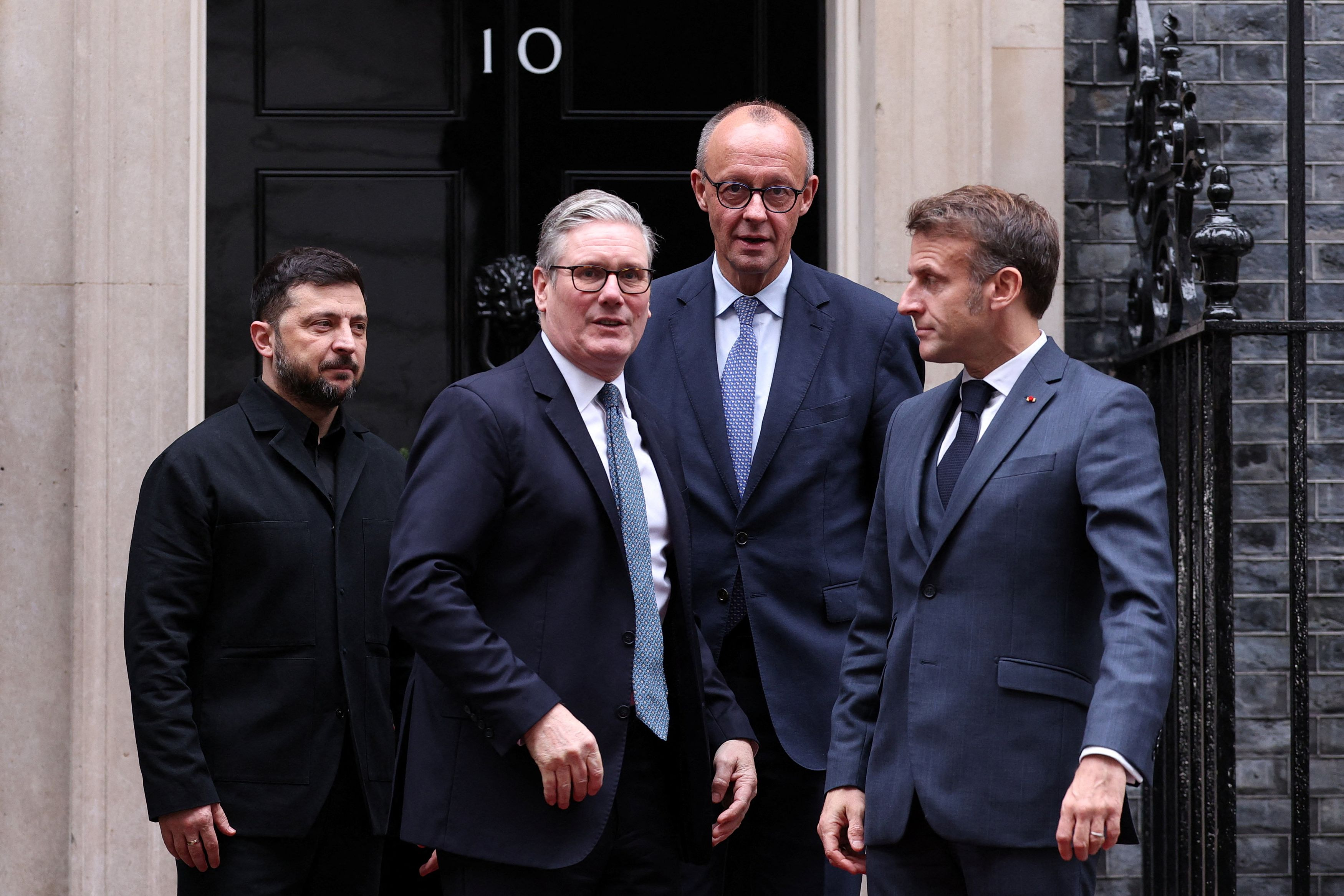
 The tall Christmas tree and the gleaming wreath adorning the entrance of the Prime Minister’s office at Downing Street seemed almost out of place, strikingly at odds with the gravity of the informal summit set to shape Ukraine’s future.
At 13:08 local time, Volodymyr Zelensky passed through the doorway, and Prime Minister Keir Starmer greeted him with a firm embrace, as if to convey support through a single gesture. The Ukrainian president arrived under immense pressure, following the recent declaration by the US President that he had yet to review the proposed peace plan.
From the very first minutes of the meeting, the leaders – representing the three NATO member states with the largest defence budgets, excluding the United States – gathered in the Prime Minister’s private office to discuss “security guarantees” for Ukraine, contemplating the fragile framework of a potential peace settlement, whose outcome remains far from certain.
In their opening remarks, Keir Starmer said:
“We stand with Ukraine, and it needs to be a ceasefire; it needs to be a just and lasting ceasefire. That is why it is so important that we repeatedly assert the principle that matters concerning Ukraine are for Ukraine to decide. We are here to support you in the conflict, to support you in the negotiations, and to ensure that this results in a just and lasting settlement.”
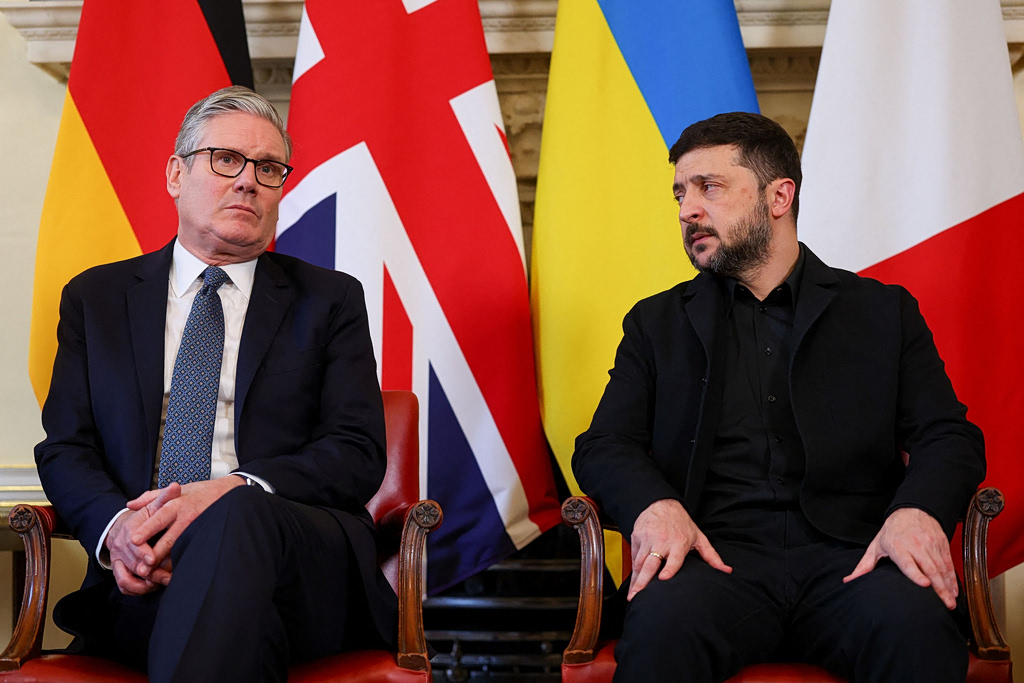
British Prime Minister Keir Starmer and Ukrainian President Volodymyr Zelenskiy meet with French President Emmanuel Macron (not pictured) and German Chancellor Friedrich Merz (not pictured) at 10 Downing Street, in London, Britain, December 8, 2025. REUTERS/Toby Melville/Pool
Zelensky said:
“I believe it is very important now to organise such meetings, to meet and discuss highly sensitive issues regarding the peace talks, including what we had in the United States and between us. Our team has returned, and I think they will bring us the talks with the American people, as well as the discussions between Americans and Russians. There is a great deal we need to discuss. We are speaking about certain matters that are extremely important for today.”
Emmanuel Macron continued:
“I believe we all support Ukraine, and we all support peace and peace negotiations to achieve a sustainable, robust peace. I think we hold considerable power in our hands: financing equipment and various programmes for Ukraine, the fact that Ukraine is resisting in this war, and the fact that the Russian economy is beginning to suffer, particularly after our recent sanctions and those of the United States. Now, I believe the key issue is the alignment between our common positions—Europeans, Ukrainians, and the U.S.—to finalise these peace negotiations and re-engage the European space.”
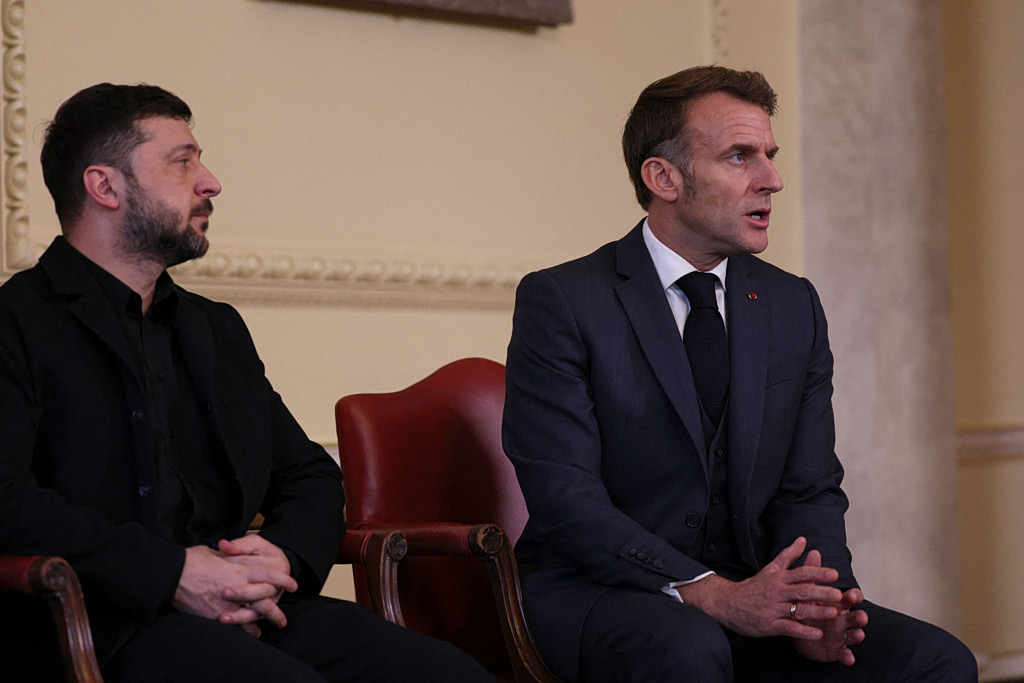
French President Emmanuel Macron speaks next to Ukrainian President Volodymyr Zelenskiy, during a meeting with British Prime Minister Keir Starmer (not pictured and German Chancellor Friedrich Merz (not pictured), at 10 Downing Street, in London, Britain, December 8, 2025. ADRIAN DENNIS/Pool via REUTERS
Friedrich Merz explained:
“We remain firmly and strongly behind Ukraine, providing support to your country, because we all know that the destiny of this nation is the destiny of Europe. That is why we are here, trying to determine what we can do. No one should doubt our support for Ukraine. This is something we stand firmly behind, and the outcome remains open. I am sceptical about some of the details we are seeing in the documents from the U.S. side, but that is what we need to discuss. That is why we are here.”
The high-level meeting in London on Monday – bringing together Prime Minister Keir Starmer, Ukrainian President Volodymyr Zelensky, French President Emmanuel Macron and German Chancellor Friedrich Merz – marked a decisive moment in Europe’s attempt to maintain unity over the future of the Ukraine war and the ongoing peace negotiations led by the United States.
Downing Street said Ukraine’s security and right to self-determination were “at the heart” of discussions, adding that the talks are taking place at a “truly pivotal moment.”
With the Trump administration exerting increasing pressure on Kyiv to accept concessions and Moscow showing no willingness to compromise, European leaders are striving to assert their influence. The coalition of willing powers – led by the UK and France – is aiming to secure guarantees that protect Ukraine from future aggression while reinforcing its sovereignty.
Speaking to TO VIMA,Professor Michael Clarke, Visiting Professor in the Department of War Studies at King’s College London described the London meeting as an effort to bolster Zelensky’s position against the United States, which he claims is pushing a peace plan that “is actually a surrender plan.”
Clarke explained: “The leaders of Britain, France and Germany don’t want Ukraine to be manoeuvred into a situation where they simply have to surrender to the Russian attack without any security guarantees to stop the Russians attacking a second time or another time. Although publicly these leaders support President Trump’s peace plan, in reality, they want to strengthen Ukraine’s own position in what has become a very one-sided process.”
Clarke added that, so far, the ongoing peace talks do not offer adequate security guarantees for Ukraine: “The Europeans have suggested some sort of Article 5 arrangement, similar to NATO, but nobody has come up with any credible guarantees. The best security guarantee for Ukraine would be the ability to push Russian forces back so they don’t feel as if they are constantly winning.”
On US intentions, Clarke was equally clear: “Trump wants to take the lead himself and have the Europeans follow. He wants Europe to be obedient to American requests, which they will never be. The US policy now is to pressure Ukraine into surrender.”
Regarding the prospects of the current peace plan succeeding, Clarke was sceptical: “I’m certain the peace plan will fail. We have gone around this circle before-in April, August, and now again in November and December. Same issues, same problems. The key question is not whether Trump walks away, but who he blames for the failure of the negotiations.”
Speaking exclusively to TO VIMA, Markian Prokopovych, Professor of Modern European History at Durham University, underlined the significance of the London talks.
“Today’s meeting between President Zelensky and the leaders of Ukraine’s key European partners-the UK, France and Germany-is significant as another attempt to see whether the ‘peace deal’ currently pursued by the United States can lead to a just, sustainable and long-lasting peace for Ukraine,” he said.
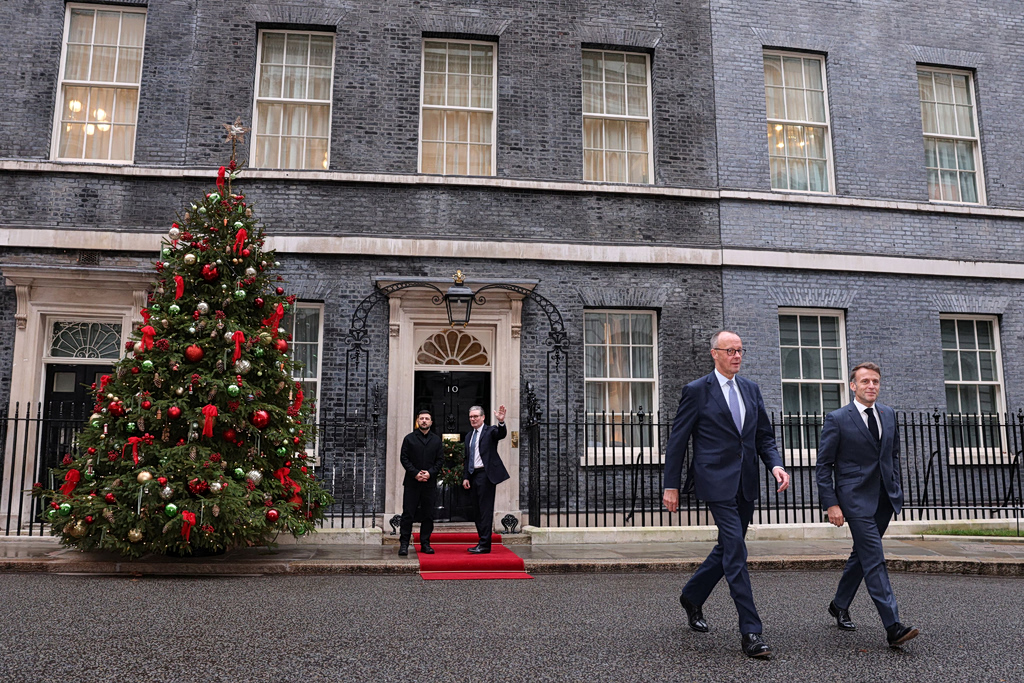
British Prime Minister Keir Starmer and Ukrainian President Volodymyr Zelenskiy look as French President Emmanuel Macron and German Chancellor Friedrich Merz leave following a meeting at 10 Downing Street, in London, Britain, December 8, 2025. ADRIAN DENNIS/Pool via REUTERS
According to Professor Prokopovych, the value of the meeting depends heavily on Europe’s ability to hold a united line: “If the European leaders continue to act as a united front against the Trump administration’s perceived drifting towards the Russian position in the ongoing negotiations, and if they manage to ensure Ukraine’s sovereignty, territorial integrity, a continuous support for the Ukrainian armed forces, and the working mechanism for the security guarantees for Ukraine on behalf of its European and North American partners, then the benefits would be significant.”
Yet he warned that optimism should remain restrained. “There have been no signs from the Kremlin on the willingness to any sort of compromise, and the fears that Ukraine, rather than Russia, will be pressured to an unacceptable deal are not ungrounded. European history is ripe with examples of how such an outcome would only lead to a continuation of war and its eventual escalation into the broader region of East Central Europe.”
European Unity and U.S. Influence
Professor Anand Menon, Professor of European Politics and Foreign Affairs and Director of UK in a Changing Europe, also spoke to TO VIMA about the implications of the London meeting.
He emphasised that while the gathering underscores Europe’s ongoing support for Ukraine, its practical impact remains constrained by Washington.
“The benefit is that it highlights the solidarity of the key European powers with Ukraine,” Menon explained. “The problem and the shortcoming is that ultimately everyone is still dependent on the United States. It’s a useful signalling device that reassures President Zelensky the Europeans are not abandoning him, but everyone knows this will hinge on how the Trump administration responds.”
Asked whether Europe is attempting to present a unified stance on Donald Trump, Menon was clear: “Europe doesn’t have one position on Donald Trump. But the French, the Germans and the UK do. Europeans meet in smaller formats precisely because, in an EU setting-with the Hungarians, the Slovaks-Europe is far from united.”
Ambiguity in Washington and Pressure on Kyiv
Commenting on suggestions that Donald Trump wants Europe to take the lead in negotiations with Russia, Menon pointed to contradictions in the American approach.
“The US position is complicated. Yes, they want Europe to take the lead. But the US also wants to be the primary actor speaking to the Russians. There’s a degree of ambiguity in the American stance.”
Regarding Trump’s recent remarks about Zelensky, Menon was unequivocal:
“President Trump is putting enormous pressure on Zelensky. You saw that in the comments overnight, where he claimed Zelensky’s team were keen on the deal, whereas Zelensky himself isn’t. The American administration is very keen to exert heavy pressure on him.”
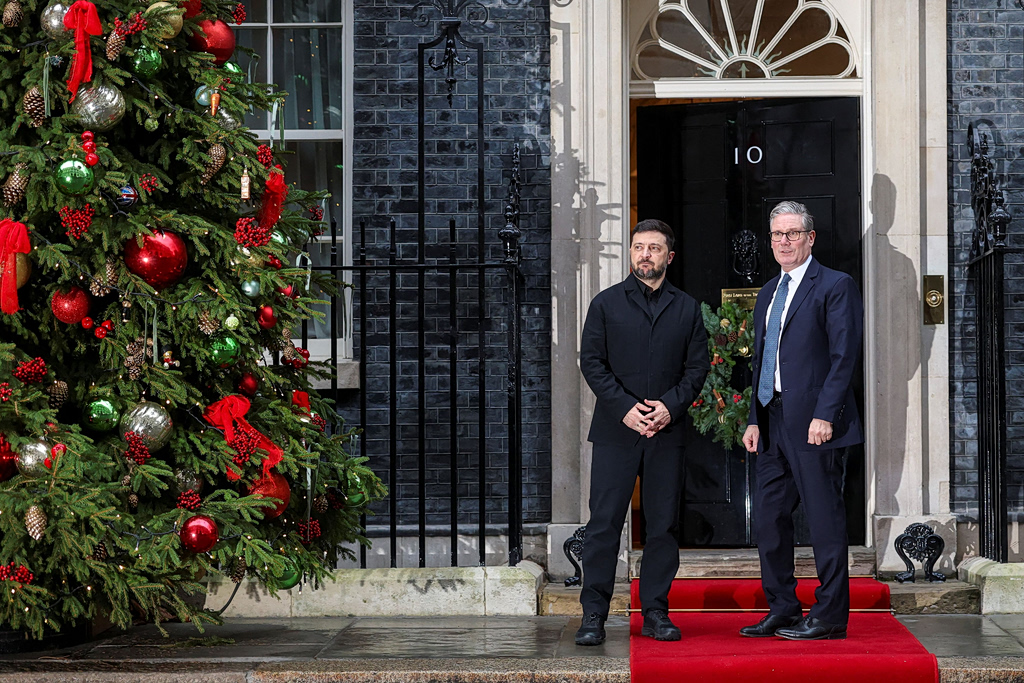
British Prime Minister Keir Starmer stands with Ukrainian President Volodymyr Zelenskiy after a meeting at 10 Downing Street, in London, Britain, December 8, 2025. REUTERS/Toby Melville/Pool
Peace Prospects Remain Dim
Asked whether a peace agreement may soon emerge, Menon was blunt. “No, because the positions of the Russians and the Ukrainians are still so far apart. The nightmare scenario is that the United States ends up supporting a peace deal that the Ukrainians can’t support. That is precisely what the Europeans are desperate to avoid. But no-I’m not at all optimistic that we’re close to a peace deal.”