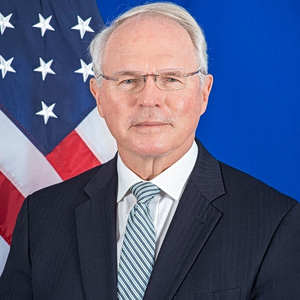
From empty U.S. embassies to the wars in Ukraine and Gaza, and the turbulence in Latin America, Hill exposes the strengths, failures, and high-stakes challenges of American foreign policy. He shares his insights ahead of his appearance at the Delphi Economic Forum this April, where he will discuss these critical global issues in depth.
Ambassador, what strengths and weaknesses have you observed in U.S. diplomacy, and how have they changed under President Trump?
Things are quite different. We now have a situation where many embassies lack ambassadors—some 105 embassies don’t have one. And frankly, there are a lot of vacant positions even within the State Department. So it’s a very different situation. Over the years, I think the U.S. has done well in trying to be actively engaged. Sometimes, however, we are too engaged, and some countries have asked us to back off. Frankly, I understand that. I’ve been a bit of a critic of my own country for that. But right now, this is a completely different situation. One does not get the sense that we have overall strategies that would really lead us forward.
With your experience in Europe, the Balkans, and the Middle East, do you think a two-state solution between Israel and Palestine is still possible today?
I have long believed, as have many American diplomats, that the two-state solution is the way to proceed. Obviously, the events in Gaza starting in October 2023 changed a lot of perceptions. I’m still not clear, though, where we can go without a two-state solution. I think it’s always been important, even though we’ve had a close relationship with Israel over the decades, to be able to talk to both sides. That approach has not been really strengthened in this latest crisis, and I worry about our capacity to provide the conditions for peace and security, which is what has to happen.
With your experience as a diplomat, do you see any realistic way to end the war in Ukraine while Putin remains in power?
History has shown that wars are easier to start than to finish, and this is certainly a case of that. I think the Russians went into it with a very inaccurate understanding of Ukraine. Ironic, because Ukraine is a neighbor, and they should have understood it better. The fact is, we now have a war going into its fifth year. I don’t think the Russians have quite understood that whatever they thought about Ukraine in the beginning has completely changed.
My sense is that it’s going to require some kind of negotiating process. But we also need to understand the Ukrainian perspective—having had the Russians annex Crimea just a few years earlier, and then, as if to take more, expecting them to give in, is not the way to proceed. Any eventual solution needs to involve the U.S. and must include security guarantees.
One of the main issues is that the U.S. seems to have a new surprise every other week regarding its policy in Ukraine. Surprises may be fine for birthday parties, but in diplomacy, you don’t want surprises. People need to understand your position and policies. Too often, there have been shifts in U.S. policy that are, at best, confusing to many. The U.S. needs to be clearer, and most Americans understand this: Ukraine needs to be defended. We cannot allow Russian aggression to stand, because if they succeed in Ukraine, they will succeed elsewhere. We need to make it clear that trying to restore the Soviet Union cannot come at the expense of Ukraine or any of its neighbors. I like to think Marco Rubio understands this, but I’m not sure everyone in the administration does.
Do you fear Russia might attack a Baltic country, given past misjudgments of Putin’s intentions?
In fairness to the Trump administration—or at least the first Trump administration—after 2014, there was a much more serious effort to equip and train Ukrainian forces. That was an important positive step, which has helped Ukraine withstand Russian aggression. But the question is, what are we doing now? The Russians feel that somehow we want peace more than they do, and as a result, they take a very hard-line position.
I think we need to be very clear with Russia that this cannot be allowed to stand. In some ways, the Trump administration did a good job tracking these so-called “phantom tankers”—large ships delivering Russian energy to various places. That is positive. But we also need to make clear to Russia that they can’t just carve off parts of their neighbors and expect us to give in. You don’t need to be a historian to understand that such policies of appeasement never work.
Given recent developments in Venezuela, Cuba, and Mexico, do you see a coherent U.S. strategy in the region?
I think you’ve put your finger on it. The problem is, we haven’t seen a plan. There hasn’t been a real explanation to the American people about what’s going on here. Venezuela has many problems under Maduro, but shipping drugs to the U.S. was not the main issue. Yet, from the administration’s statements, you would think the issue was Venezuela’s illicit exports. Clearly, there are other factors, and it’s concerning that these have not been explained. Is it about Venezuela’s energy resources? Is that why the U.S. is engaged? It’s not clear that it’s about the absence of democracy under Maduro.
Americans, and many Europeans, have long opposed Maduro and his regime. But if you want to displace someone, you need a plan for what comes next. I don’t see efforts to get Venezuela back on its feet or to help displaced Venezuelans return home. It’s unusual that something as serious as military action has been undertaken without a clear purpose. The main outcome seems to be that Maduro now faces charges, while Cuba appears to be the bigger focus.
The U.S. position on Cuba has been longstanding since the late 1950s. So, what is the plan there? Many of these foreign policy actions—these “adventures”—have not been adequately explained to the American people. As a result, there is considerable division within the U.S. about whether these actions should be pursued.