From the hill dominated by the Goulandris Foundation’s Museum of Contemporary Art on Andros, the gaze wanders out over the Aegean. The June light striking the exhibition poster reveals Richier’s almost tearful face as—inconsolable—she embraces one of her sculptures. “She often called them her children. She spoke to them and cared for them as if they were alive,” we learn a short while later from Laurence Durieu, an expert on her work and her biographer. The wind, more tempestuous than ever on this “Isle of Winds”, seems to be trying to unite the Mediterranean commune of Grans—where the sculptor was born—with the Cycladic sky of Andros in a celebration in which the elements pay collective tribute to a woman whose absolute connection to them has been matched by only a handful of creators.
Shortly before the guided tour of the Germaine Richier exhibition begins, Laurence Durieu stands in front of one of the sculptures and speaks about the woman she has spent years studying. She does not describe her techniques as such, but rather a personality that never stopped observing the world around her. An artist who could spot a piece of wood on the side of a road and treat it as a supreme revelation. “Don’t bring me sweets,” she used to tell friends who visited her. “Bring me a piece of nature, like an olive trunk or a palm frond.” Her words might seem amusing to some, yet they conceal something deeper. For Richier, nature was an endless organism from which everything stemmed. People, animals, trees, insects—even the bizarre hybrid creatures her works would later spawn—were all part and parcel of the same universe.
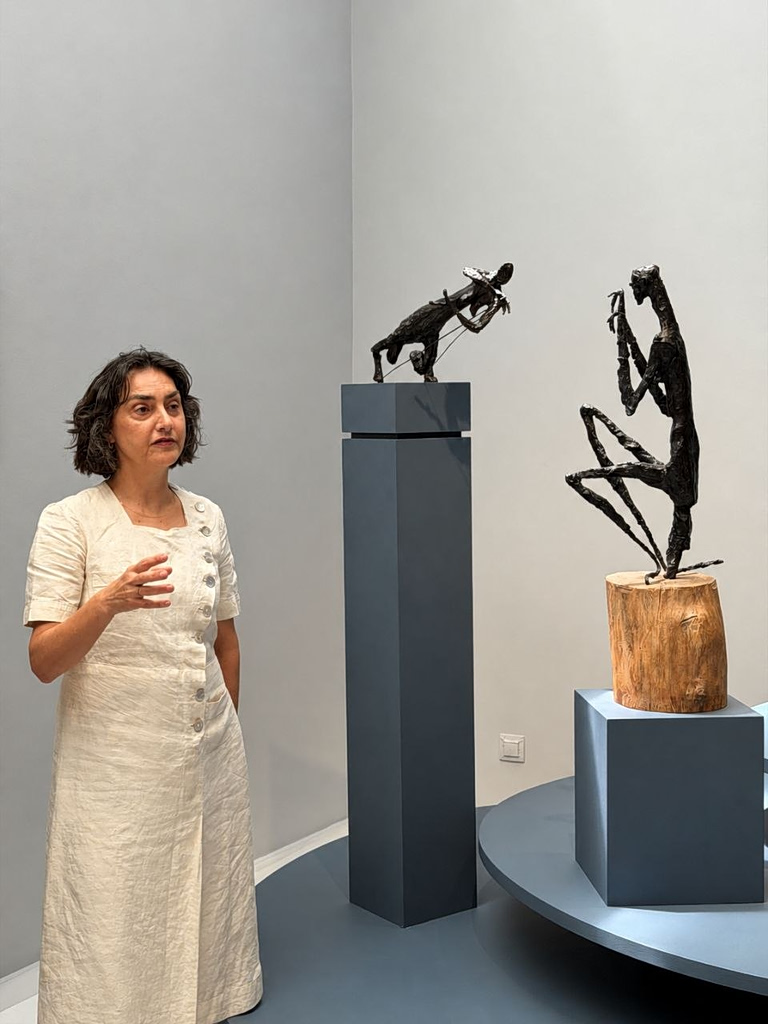
Laurence Durieu during the gallery tour.
PANOS KOUGIAS/TO BHMA INTL EDITION
Walking through the exhibition rooms, one thing becomes clear: what Richier sought was to reveal the world exactly as she felt it. With all its contradictions and paradoxes, its oddities. A world in a state of constant flux, where nothing remains fixed and the lines demarcating Man and Nature are far more permeable than we think. And this may well be the exhibition’s greatest triumph. That almost seventy years after her death, in a small corner of the Aegean, the Basil & Elise Goulandris Foundation can honor the memory of an artist who remains so unexpectedly relevant and moving.
The girl who grew up among cicadas and olive trees
Germaine Richier was born in 1902 in Grans, southern France, amidst a landscape that calls to mind the Mediterranean more than the image we often have of France. The Provence of her childhood was a land of olive groves, arid earth, insects, rocks, and powerful winds. It was an environment her mind’s eye would never stop returning to.
Laurence Durieu argues that, to truly understand Richier, this is where one must start. With the child who spent more time exploring nature than reading her schoolbooks. With the girl who gathered objects—insects, twigs and stones—with the same devotion she would later bring to her study of the human body.
What is striking is that this relationship with nature never remained at the level of memory. It continued to shape her life and her work through to the end. Even when she found herself in Paris, at the epicenter of the European artistic avant-garde, Richier remained deeply connected to the natural world. This connection explains why her sculptures look so different from her contemporaries’. Nature does not function as a reference or an inspiration for her works. It is there within them, in the very body of her forms. Her figures seem to have sprung from the earth. To have been forged by the same forces that create the trees or rocks. It is no coincidence that on Andros, amidst the dry-stone walls and olive groves and bathed in Cycladic light, her work acquires an almost organic presence. As if they are returning to a place which, though she never made its acquaintance, was somehow always profoundly familiar.
From Bourdelle to the post-war nightmare
Richier belonged to a generation that was trained within tradition, but came of age amidst the great catastrophes of the 20th century. She studied under Antoine Bourdelle, one of Rodin’s most important pupils, acquiring a technical mastery that impressed even the most demanding critics of the era. Her early works reveal a sculptor with a profound understanding of anatomy and the structure of the human form. However, her development as an artist would veer away from the path of academic continuity. The war would be the rupture.
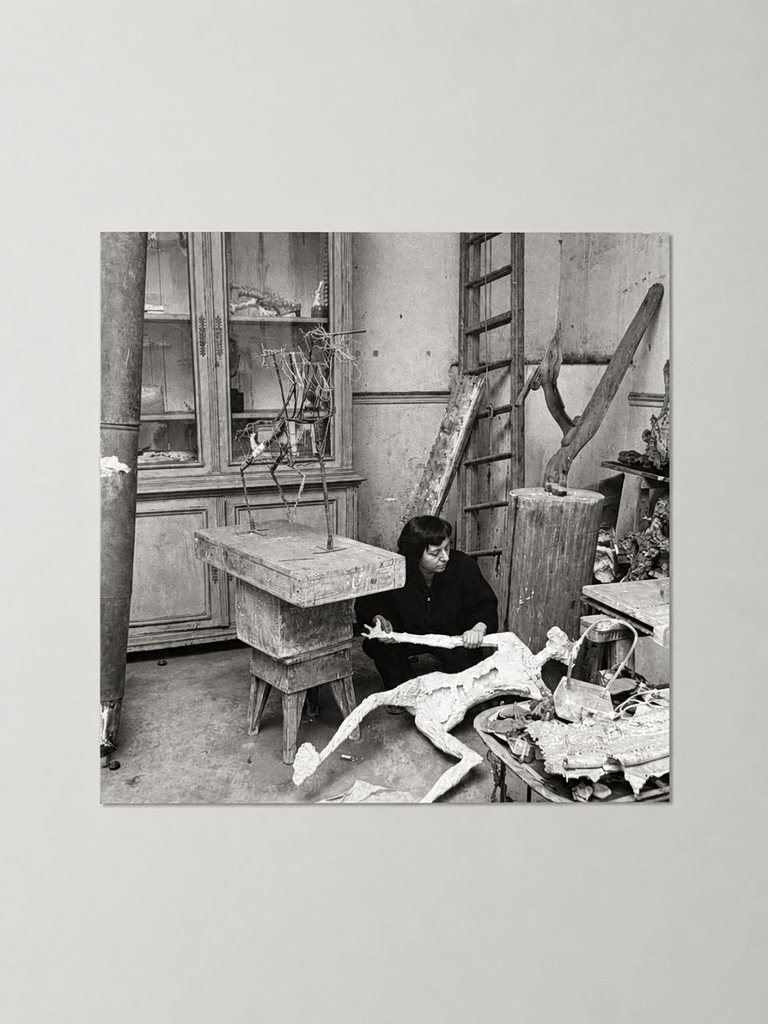
“Oftentimes she would call them her children. She spoke to them and nurtured them like they contained life.”
PANOS KOUGIAS/TO BHMA INTL EDITION
When World War II breaks out, Richier is in Switzerland. When Europe collapses, many of the certainties that had shaped the art of previous decades implode with it. When she starts to sculpt again, Man’s image has changed, definitively and irrevocably. Her forms are no longer serene and solid. They become fragile, eroded, scarred by an invisible violence. The human figure appears wounded, as if bearing the traces of history.
It is the era that will give us the great works that connect her to the existential angst of post-war Europe. Yet, unlike other creators of her generation, Richier does not turn toward abstraction. She remains faithful to the body. Only this body is no longer the body of classical humanism; it is a body whose form is forever changing. The Forest Woman, The Forest Man, The Grasshopper, The Bat, The famous Tatou—these are existences sculpted into being by her imagination. They are creatures that defy the dictates of logic: humans that look like animals; animals that look like humans; forms with no respect for clear boundaries. Today, with the debate over the relationship between humans and nature very much in the foreground, her work seems almost prophetic.
Giacometti, fame, and her silencing
For many years, Germaine Richier was frequently referenced in terms of her relationship with Alberto Giacometti. There is no doubt that the two creators shared common artistic quests and moved in the same circles. However, art history’s persistence in presenting Richier as a secondary figure at the Swiss sculptor’s side says more about the era than it does about her work. She was extraordinarily popular during her lifetime. She exhibited internationally, enjoyed recognition from critics and collectors, and was considered one of the foremost voices in post-war sculpture. Nevertheless, after her death in 1959, her name began to fade into the background. Durieu frequently refers to the difficulties a female creator faced in a space dominated almost exclusively by males. She specifically notes that, although Richier had staged her first solo exhibition a few years before Giacometti, the male artist tellingly told the gallerist they shared: “You have to choose. It’s her or me.” Today, as art historians re-examine that period, they increasingly recognize that numerous female figures were sidelined despite their importance. Richier is perhaps the most characteristic example. It is no coincidence that she became the first female sculptor to be honored—posthumously, of course—with a major retrospective at France’s National Museum of Modern Art. It was belated, though profound, recognition.
The Christ that outraged the Vatican
In the early 1950s, Richier receives an exceptionally important commission: to sculpt the Christ Crucified for the church of Assy in the French Alps. Her selection is a milestone in itself. Never before has a woman been charged with such an important religious commission. The work she delivers is far removed from conventional representations of Christ. The figure is dramatic, stripped of all realistic elements, with a horizontal axis for arms and a vertical one for a body.
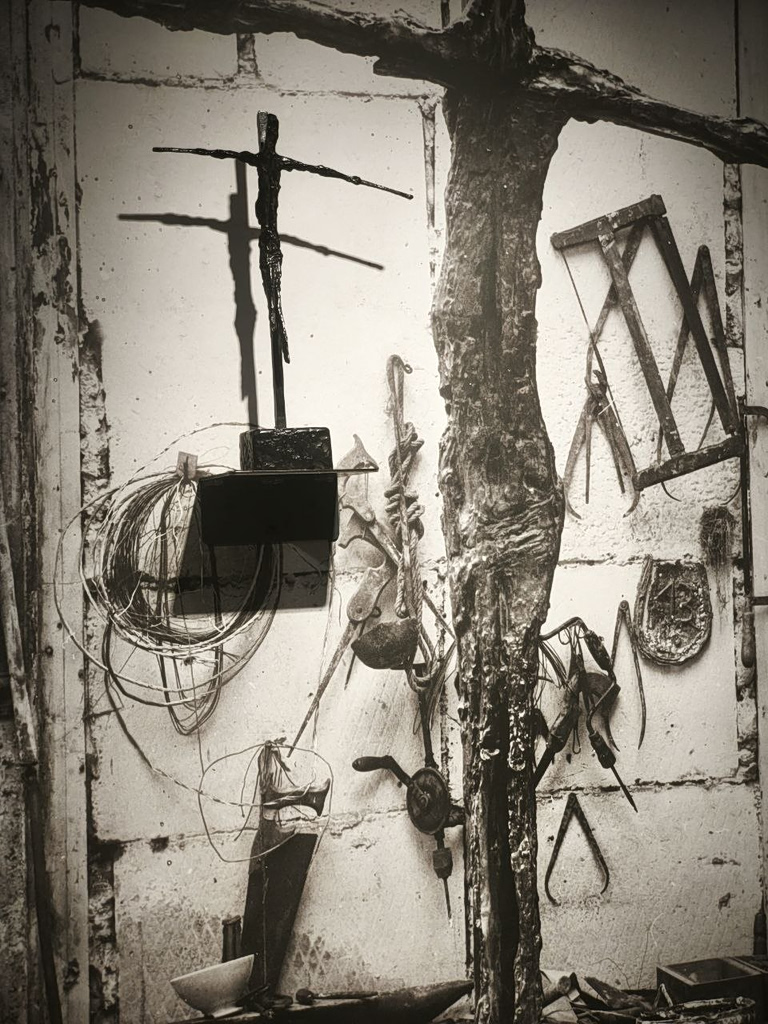
Le Christ d’Assy – the piece that scandalized the Vatican.
PANOS KOUGIAS/TO BHMA INTL EDITION
Initially, its installation does not provoke any particular backlash. Soon, however, a campaign is launched against it. Conservative Catholic circles deem the work blasphemous. Photographs are sent to the Vatican, and the matter reaches Pope Pius XII himself. The verdict is damning, and the work is removed. For about ten years, Richier’s Christ remains in exile from the church it was created for. Ultimately, however, the story will take a different turn. The work is reinstated, returned to its rightful place, and transformed into one of the most iconic examples of the relationship between modern art and religion. Today, it is considered a masterpiece. It was exhibited at the Centre Pompidou in 2023 as one of the artist’s most important works. This journey from condemnation to vindication seems to encapsulate Richier’s trajectory through art history.
The studio as a way of life
As the guided tour draws to a close, Laurence Durieu shares one more remarkable story. Richier once entered her studio very late at night and had the distinct feeling that the sculptures were alive. That they were communicating with one another in the silence. The anecdote sounds almost like a fairytale, yet it accurately describes the way Richier perceived her work. Her sculptures were not objects; they were organisms. Organisms she had birthed with her hands, but also through her entire body.
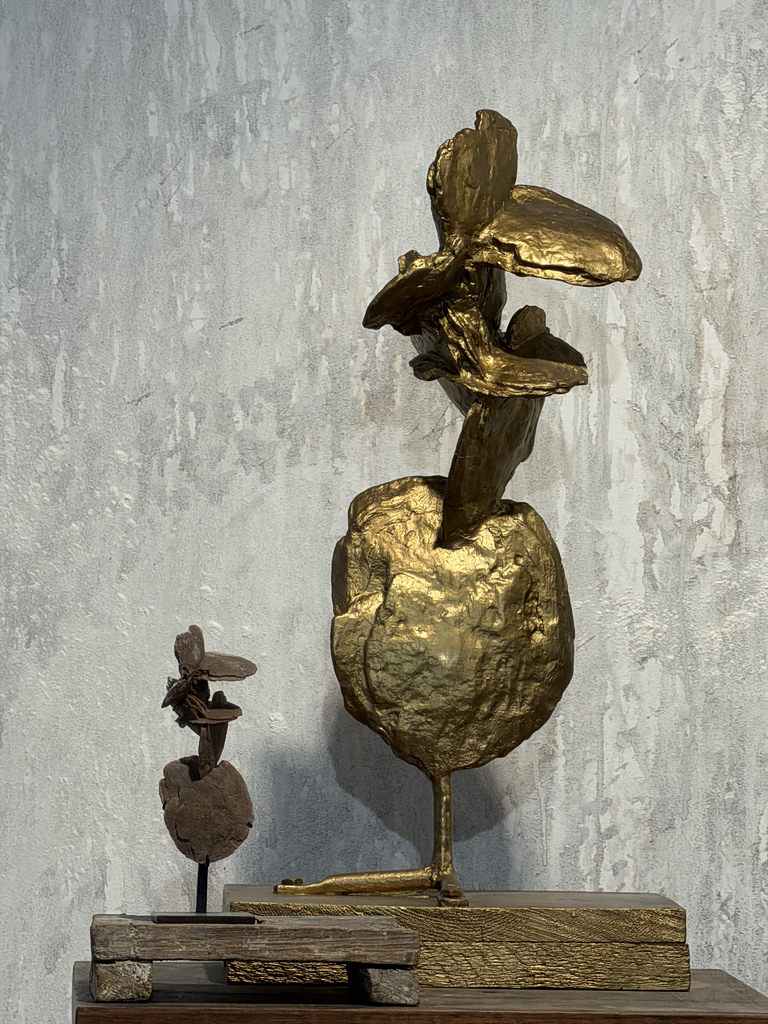
Towards the end of her life, Richier began experimenting with the scale of her works. This piece is a characteristic example of that exploration.
PANOS KOUGIAS/TO BHMA INTL EDITION
Within her studio, bronzes, plaster casts, branches, bones, insects, shells, and all manner of found objects coexisted. She even kept the bones from her meals, transforming them into a source of inspiration. For Richier, there were no boundaries between life and art. Everything could serve as creative material. It is this freedom that allows her work to remain so vibrantly alive. Richier was never interested in perfection; she was preoccupied with energy, movement, and metamorphosis. In our era of collapsing certainties and challenged distinctions, Germaine Richier returns to remind us that life does not reside in static forms, but in their perpetual metamorphoses.
Leaving the museum, the visitor’s gaze alights once more upon the Aegean landscape. On the olive trees, the insects and stones. But now, it is as if their viewing is slightly altered—as though the landscape is filtered through the sculptor’s gaze and identity. As if she has managed, with a metaphysical sleight of hand, to initiate us into the secrets of how life should be beheld. And this was, is, and will always remain the enduring epilogue of Germaine Richier’s work: the instilling of a compulsion to discover the life that lies hidden from us, waiting to be revealed, in even the humblest object of this world.