 Μake us preferred on Google
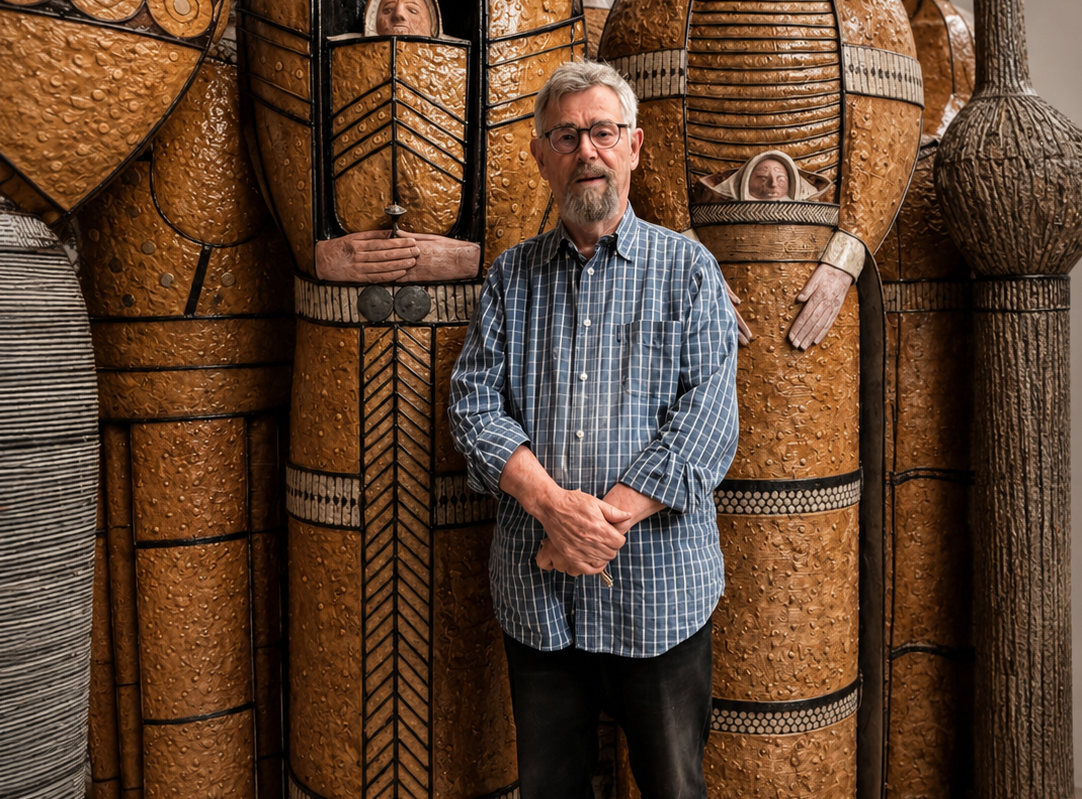
 Theodoros Papagiannis is one of the last Don Quixotes—those artists who uphold an entire cultural continuity with their work and assume a profound historical and moral responsibility towards a land that has shaped humanity’s concept of beauty like few others.
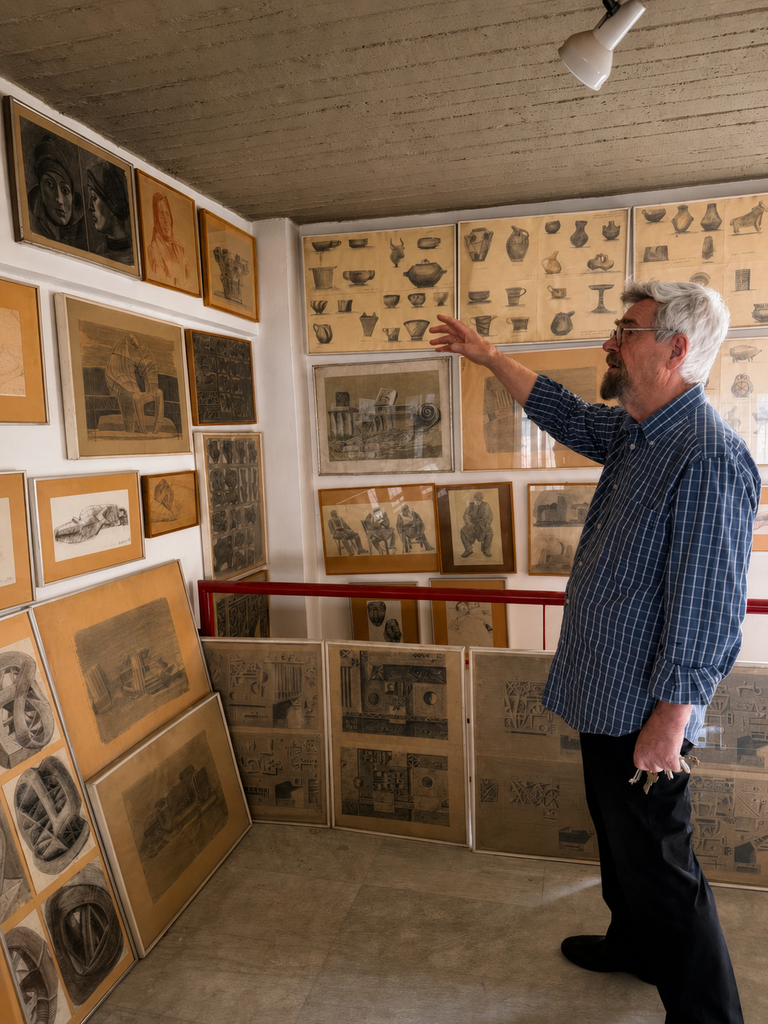
Theodoros Papagiannis surrounded by decades of personal sketches of his work. PANOS KOUGIAS/TO BHMA INTL EDITION
This is exactly the ethos that runs through “In Praise of Sculpture”, the show currently on at the Sianti Gallery. A tribute exhibition with works by eighteen artists, all graduates of the 1st Sculpture Workshop of the Athens School of Fine Arts (ASFA), staged in honor of their teacher. Papagiannis returns constantly to the concept of memory in his touchingly tender discourse. To the memory of materials, of the Greek earth, of public art, of teaching—even of the public’s everyday interactions with the art-work. In our “culturally fragmented” world, Papagiannis persists in seeking those principles that can still converse with the present. This may well be the most essential aspect of his approach. His deep conviction that art cannot bring itself up-to-date by cutting off its roots; that is has to go back to them instead, though with s new perspective.
Listening to him talk about sculpture meetings in the countryside, about children learning to look at a work of art without fear, but also about his dogged efforts to keep art a living, public experience, one thing becomes crystal clear: that after thousands of experiments with the most unlikely materials in this world, his real material has always been people.
The exhibition is entitled “In Praise of Sculpture”. Tell us more.
Sculpture has never been a random thing in Greece. It is an artform that has shown Greece in an elevated light and even contributed meaningfully to its liberation. Three years before the 1821 Revolution, the Elgin Marbles were put on show in London and made a huge impression. Ten years earlier, Greek sculptures had been exhibited at the Louvre, where they also proved massively influential. Art helped Greece free itself, and we sculptors owe it a lot. We bear a very heavy burden—at least those among us who sense this and understand it. Because there are also a lot of people who haven’t really grasped where they are or what they’re meant to be doing.
Lately, I have been studying these twenty-five volumes on Greece’s archaeological museums. I’ve been flipping through them for months and drawing whatever catches my eye. I’ve made about two hundred drawings in all, and I’m preparing to publish them; in fact, we’ve already started work on the volume. I was discussing the project recently with my friend, the poet Vangelis Chronis, and he was so enthused by it, he volunteered to write a text for the publication.
PANOS KOUGIAS/TO BHMA INTL EDITION
His love of Greece shines forth from his work. His verses contain some truly beautiful references to the Cyclades…
Yes, and not only the Cyclades. It is clear from his work how deeply he loves Greece. I have to wonder where the artists there found that wisdom—how they managed to achieve such a distillation and arrive at these forms. It’s terribly modern and something the whole world admires. But I’m not sure we admire that wisdom as much as we should.
In the catalog, the exhibition’s curator, Manos Stefanidis, writes that: “the work of art is a priori an act of love… even more so when it disturbs.” Do you think that today’s art remains “disturbing”, or has it overly acclimatized itself to the market and the image?
Manos’ phrase carries real weight. Art should be provocative—but before all else, it should provoke interest. As I see it, it should invite you to love it, not irritate you. Because if you don’t love art, you won’t go near it.
I see this in the sculpture meetings we organize with colleagues in various towns and cities around Greece. What we try to do with them is put art into the public’s everyday lives. At minimal cost, because we know our municipalities don’t really have a budget for art. There’s money for pavements and a good deal besides, but art is almost always left out in the cold. That’s why they’re always asking us to donate works to them—and many of us do.
So those meetings of ours are actually an effort to put people in touch with sculpture, to inject art into their everyday lives. And you see people who were completely unfamiliar with art until recently coming up and asking you simple, innocent questions: “What is it you’re doing in this work?” They haven’t even been trained to stand and really observe a work. And you tell them: “Look at it and tell me what you see.” And that sets a dialogue in motion. They’re hesitant at first. Afraid of saying something wrong or off the mark. But then they start to slowly open up and you can really communicate with them, engage with them. It makes sense.
How can you love art if you don’t see it around you?
The great civilizations have all had art embedded in their everyday life. In Ancient Greece, it was everywhere: in the sacred groves and temples, in the forums and public spaces. Art was part of life.
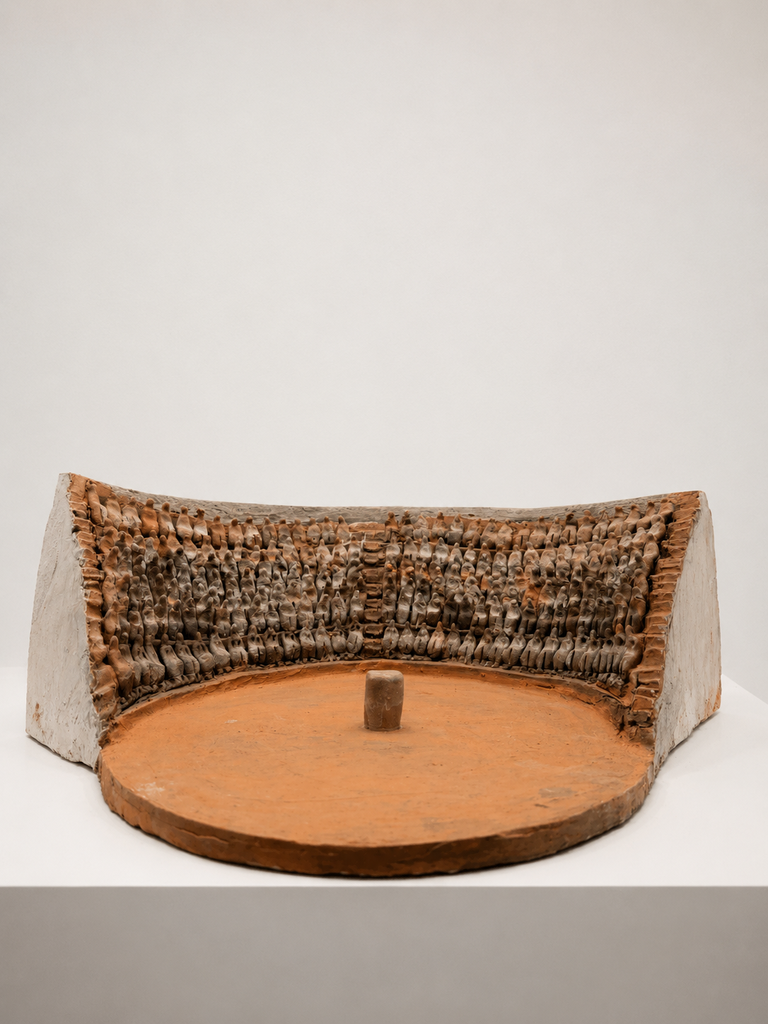
Sculpture currently on display at the “In Praise of Sculpture” exhibition at the Sianti Gallery. PANOS KOUGIAS/TO BHMA INTL EDITION
You taught for almost four decades at the ASFA. Tell me, what do you consider the greatest thing an art teacher can achieve?
Look, it’s not easy. You could say that, to a great extent, art isn’t taught. Of course, there’s a lot you can teach: techniques, theory, how to go about forging a career, how to find inspiration. But the truth is that, if the young person who comes to the School of Fine Arts doesn’t have the predisposition, meaning the talent, you can’t make them into an artist. What happens is that, from the moment someone sets foot in the school, their teacher starts to initiate them into art’s secrets.
Today, looking at the works by 18 of your students brought together here, do you recognize elements of your own style?
Listen, we always tried not to pass on our own opinions or personal styles to the students, because we believed that would be rather negative. Instead, we tried to help them discover what they had inside themselves. That’s where we focused: on helping students find their own idiom, then seeing where they went with it. I suppose we did influence some of them, albeit subconsciously—it’s unavoidable. But they took some principles away with them, which is the most important thing. As a teacher, you have to pass on certain principles to a young artist, and open up ways forward for them.
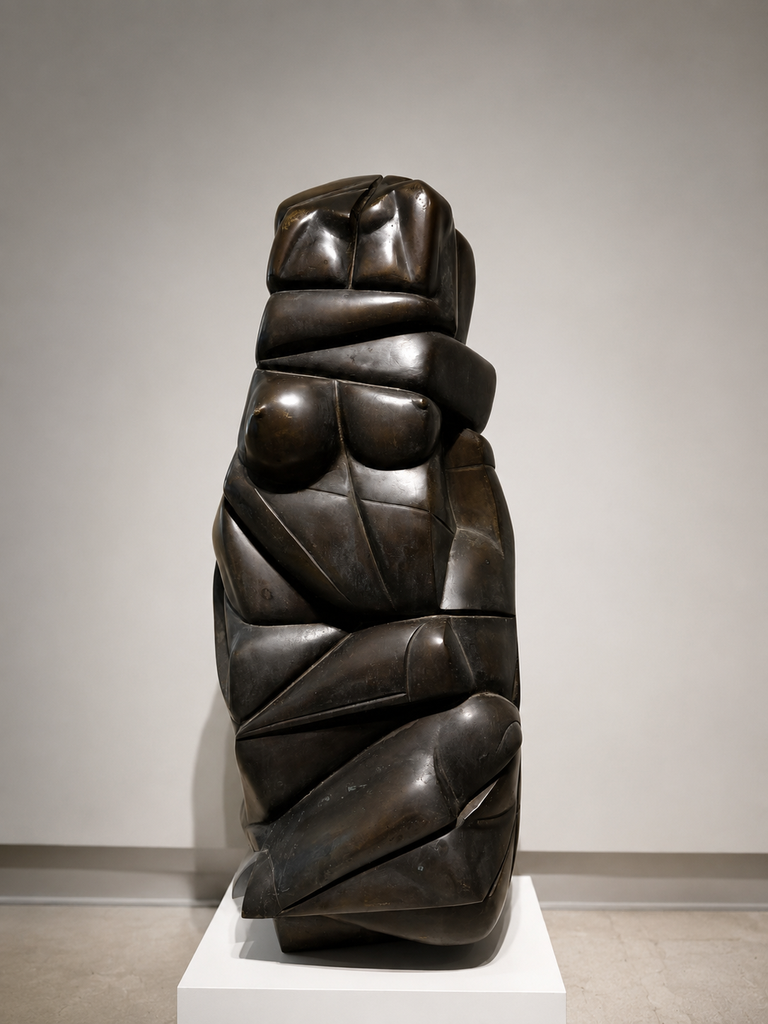
Sculpture currently on display at the “In Praise of Sculpture” exhibition at the Sianti Gallery. PANOS KOUGIAS/TO BHMA INTL EDITION
You’ve said that a teacher in an art school doesn’t only give, they also receive. What have the generations of your students given you over the years?
A teacher gets a lot back. We benefit from the freshness of the young people, their ideas. They come from different parts of Greece and each one brings something new, something different with them. When you are an artist yourself and you have reached a point where you can discern what has value from what doesn’t—in life as much as in a person—then you get something out of the process. You’re refreshed, renewed. There is a constant creative ferment in the daily life of the school.
Education is a constant give and take. It’s not a one-way street.
A lot of public sculptures can come across as decorative or “invisible” in the cities of today…
If only they were even that, but often they’re not even that. I think that, in Greece, we lack a genuine cultural policy that makes a serious attempt to integrate art into public spaces, a policy with a core vision and cohesive planning. In Spain, France, or Italy, there are policies in place that seek to give sculpture the place it deserves, and to let it serve its rightful role within the city.
Here, we operate in a much more haphazard way. A work may be installed for purely decorative purposes, or because someone has arbitrarily decided it’s a good “fit” for a particular site. I remember [Miltiadis] Evert saying this about Varotsos’ “Runner”, when he was Mayor of Athens: “I don’t know much about art, but I know I like this.” They installed it in Omonia first. But because there were a lot of demonstrations going on, and they were afraid the demonstrators would break the glass panes, they went so far as to bind it with ropes. Later on, it was moved to a site near the National Gallery and the Hilton, where it worked beautifully. Today, it’s a city landmark. One of my sculptures, a commission from the Doukas Schools, is installed a little further down. It’s a piece entitled “Monument to a Greek Teacher”, and features an aphorism by Dionysios Solomos, our national poet: “Lock Greece into your soul and you will feel every kind of greatness yearn within you”. Which also expresses my own take on patriotism.
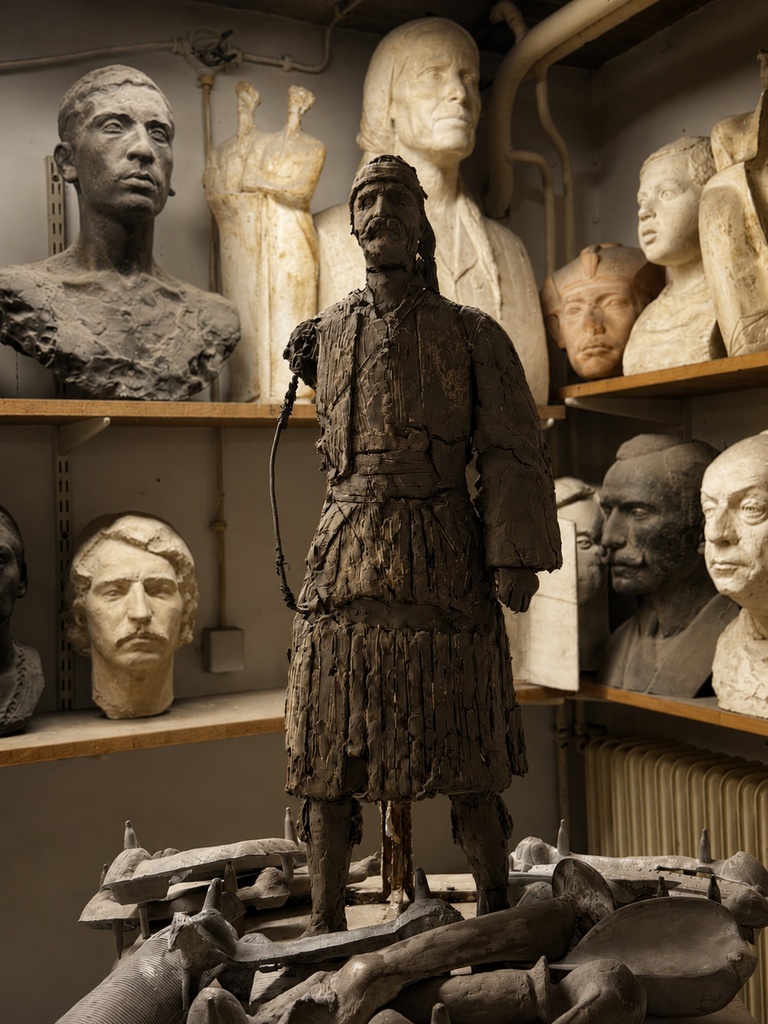
PANOS KOUGIAS/TO BHMA INTL EDITION
You have worked with both traditional and modern materials. Is there any material that you haven’t tackled yet?
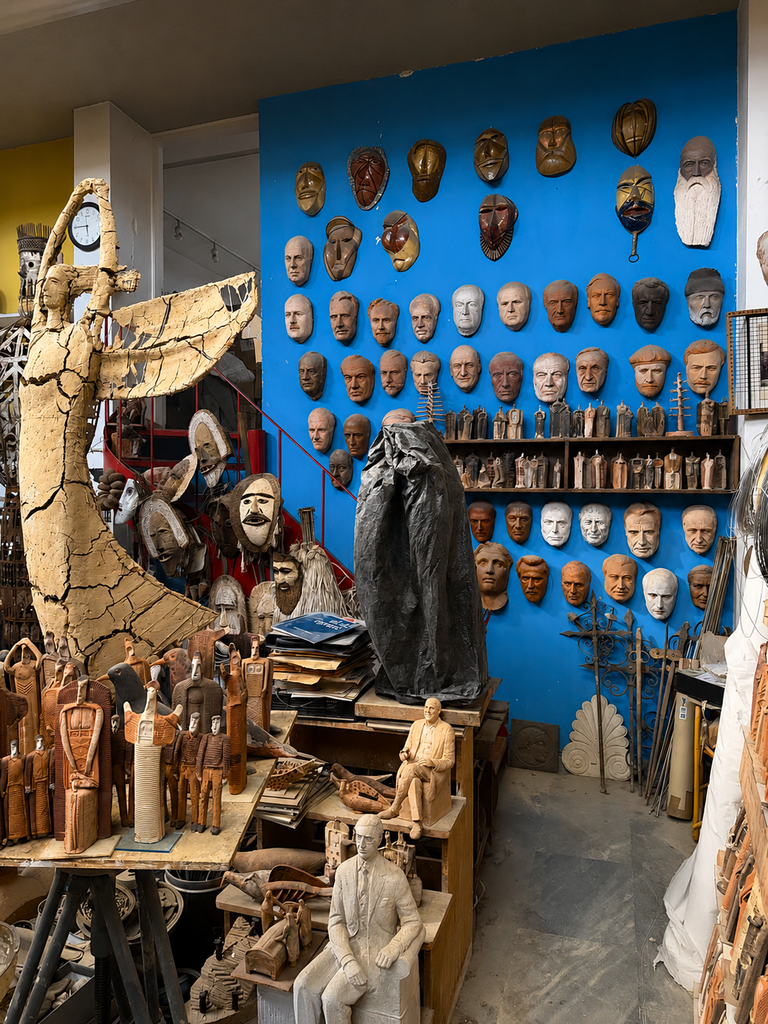
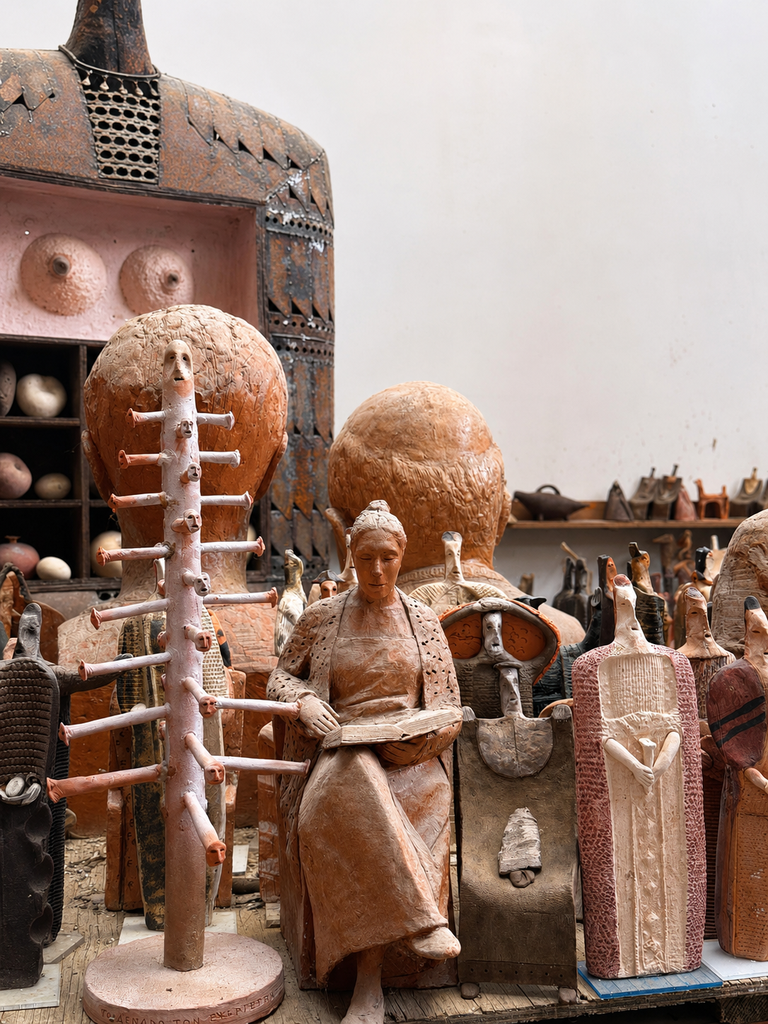
As students, we worked mainly with clay, then with plaster and, of course, with marble. Over the years we added metal, wood and other materials to our repertoire. Still, I didn’t have the opportunity to acquaint myself with a wider variety of materials during my years of study. That’s why I later applied for a Greek state scholarship which allowed me to attend a school in Paris, where I was exposed to a host of modern materials and to different techniques. On my return, I began creating sculptures as you see them today. I also worked with the charred remains of the Polytechnic. Later, I added recycled materials, which I find fascinating, because they are discarded materials, but already have a history of their own. When you use them, it’s like you’re charging your work with memories of a different kind, with the experiences, the lives of others.
I’ve used cans, decorators’ brushes, troughs, car bumpers and exhausts, driftwood, waste cardboard, rope, refrigerator components, paper pulp. All these materials have a story of their own—and it’s that which draws me to them.
Sculpture requires time, effort, space and physical endurance. Does that mean it’s out of step with our times as an artform?
The problem starts with familiarity, as I said. People just aren’t acquainted with art. I see what happens in the big museums abroad: at the Louvre, for example, children sit in the rooms with a teacher on hand to help, holding pads and drawing the works. Which slowly familiarizes them with art.
Fortunately, the museum I set up in Ioannina is visited by young children and schools, too. Melina [Mercouri] did the right thing back then as Culture Minister, when she decided to let children into museums for free. Because someone who is familiar with art will go about their work, whatever it may be, with greater sensitivity. And, later on in life, they’ll teach their children to go to museums in their turn. Today, the opposite is often the case: it’s often the children who bring their parents to my museum. But that’s something, too.
PANOS KOUGIAS/TO BHMA INTL EDITION
What would you like visitors to take away from this exhibition?
Ideally, I’d like them to really take something home with them. Because that would mean the work has left the artist and entered a space where it will be loved, and where other people will see it. You see, art acquires new dimensions when it’s loved by others. And fulfills its reason for existing, which is to spread outward, to live within people’s lives.”
So, you’d like them ‘to love art’?
Definitely. Because, as Nietzsche says—and this is a thought I return to often: “the slow arrow of beauty gradually penetrates our soul, transforming it”.
Information on the exhibition
Where: Sianti Gallery — Vassileos Alexandrou 2 & Niriidon 18 (Hilton area), Athens 11634, Greece
Dates: runs until June 6, 2026
Free admission
The exhibition explores sculpture as a public, social and political art form, bringing together artists from different generations connected through a shared artistic legacy.