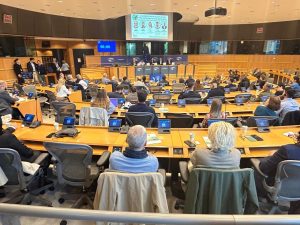
Technology can be a powerful ally in tackling climate change—especially for small, remote municipalities. This has been proven in practice for several years now by the border island municipality of Halki. This time, however, Halki is breaking new ground: it has become the first municipality in Greece to record its carbon footprint and complete a greenhouse-gas emissions reduction plan—using artificial intelligence.
Recognition for a “Green” First
For this pioneering initiative, the municipality was awarded a prize at the Bravo Sustainability Dialogue & Awards 2025. Under Greece’s National Climate Law, all 332 municipalities were required, by March 2023, to draw up emissions reduction plans. This process begins with measuring each municipality’s carbon footprint and then setting targets to cut emissions by 30% by 2030, compared with 2019 levels.
So far, roughly three in ten municipalities have launched the measurement and planning process. Still, progress has been slower than expected, given that the entire procedure should have been completed by 2024.
Halki began the process shortly before the Christmas holidays—and already has the plan in hand. Artificial intelligence carried out around 80% of the work and calculations that would otherwise have required a municipal employee. By contrast, municipalities following conventional, human-driven procedures typically need seven to eight months to complete the same task.
“We fed all emissions-related data into the AI algorithms,” explains Halki’s mayor, Angelos Fragakis. “Halki already has meters—essential for the other pioneering programs we are implementing—that record data on air quality and sea level. The system processed the information and delivered the results.”
With the support of the Greek ESG information system ESGenius and the ResNovae team, the municipality developed a modern, functional, and fully automated emissions-recording model. “It reduces the municipality’s financial burden, saves resources that can be redirected to other priorities, and enhances transparency,” Fragakis adds.
Once an emissions reduction plan is completed, municipalities are required to update their data annually. According to available information, Halki’s example is already inspiring others: five more municipalities are expected to follow suit, entrusting artificial intelligence with measuring their carbon footprint and drafting their emissions reduction plans.
Innovation Beyond Size
This is not the first time Halki has demonstrated that innovation is not a matter of municipal size, but of vision and collaboration. The municipality turned a former landfill into a high-tech park with drones and sensors monitoring air, pollution, and sea levels. A pilot system even lets electric vehicles supply power during outages, proving that small communities can lead in creating a greener, smarter future.