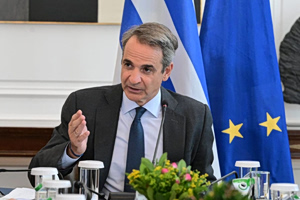
When former Italian Prime Minister Enrico Letta calls a book “essential analysis Europe cannot ignore,” it is more than an endorsement. It is a warning.
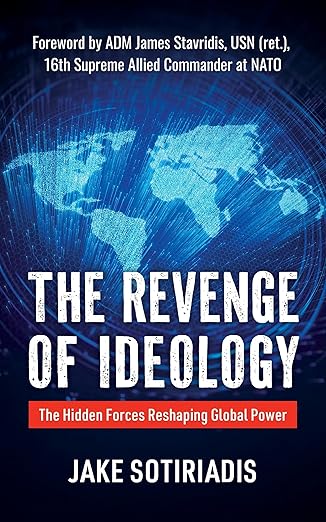
The Revenge of Ideology: The Hidden Forces Reshaping Global Power is the work of Jake Sotiriadis, a former U.S. Air Force intelligence officer who spent two decades inside America’s security establishment. At the Pentagon, he founded the Strategic Foresight team and trained senior military and intelligence leaders in anticipating the future.

An American flag is unfurled from the roof of the Pentagon in Arlington, Virginia, U.S., September 11, 2021. REUTERS/Al Drago/File Photo/File Photo
In the book, Sotiriadis contends that today’s geopolitical upheavals, from Russia’s war in Ukraine to China’s economic retrenchment, are not the product of miscalculation but of powerful ideological networks that distort nations’ strategic choices.
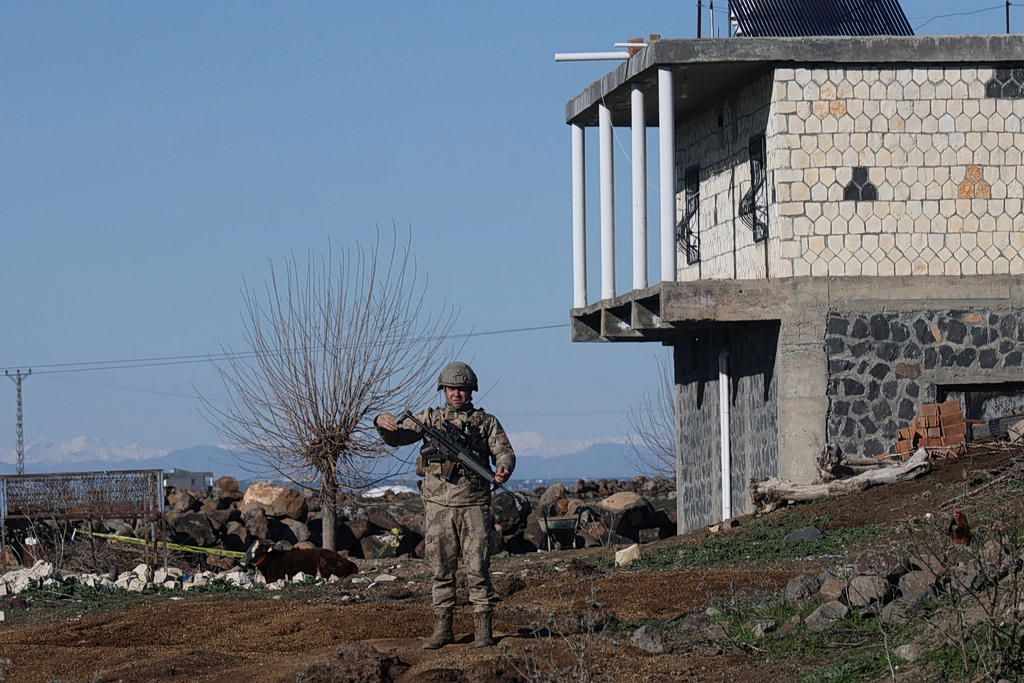
Nowhere is this grip more visible than in Turkey, a NATO ally buying Russian weapons while advancing its own vision of “Neo-Turkic autonomy.” Far from being an outlier, Sotiriadis warns, Ankara reflects the same forces destabilizing the global order.
With a foreword by Admiral James Stavridis, NATO’s former Supreme Allied Commander, and endorsements from leaders such as Enrico Letta, and former National Security Agency Director General Timothy Haugh, Sotiriadis’ book offers a framework for understanding the broader contest of ideological systems reshaping the global order.

The book’s author, Jake Sotiriadis is a former U.S. Air Force intelligence officer.
Your book argues that we are fundamentally misunderstanding today’s global conflicts. What are Western policymakers getting wrong?
We have convinced ourselves that ideology died with the Cold War, but the opposite is true. Today’s conflicts aren’t exclusively about resources, security, or even power. They are about competing visions of reality itself. When Russia invaded Ukraine, Western analysts expected economic collapse within months. Instead, Putin’s approval soared above 80% and Orthodox priests blessed tanks heading to Kyiv. We understood the economic damage sanctions would cause, but completely missed how ideology would transform those material losses into perceived victories. The problem is that ideology today isn’t just rhetoric or propaganda. It has a material structure. I call these structures ‘Ideological Power Networks.’ Think about China’s 548 Confucius Institutes, Russia’s Orthodox churches funded across 40 countries, Turkey’s Diyanet controlling Friday sermons in 85,000 mosques. These aren’t just a means of spreading ideas. They are material networks that fundamentally reshape how millions of people understand their own interests.
You write that democracies are equally vulnerable to ideological capture. Can you explain?
This is where my analysis tends to make people uncomfortable. After 9/11, the United States fell into a similar trap as Putin’s Russia today, what I call ‘hegemonic narcissism.’ This is the point where ideology so thoroughly captures a state that it pursues policies directly contrary to its material interests. America had excellent intelligence about sectarian divisions in Iraq, explicit warnings about state-building difficulties, yet Washington spent $4.8 trillion on democracy promotion through military means. We weakened our credibility, created power vacuums that Iran filled, and exhausted our military. None of this was forced upon us by enemies. We did it to ourselves because ideology had redefined what we saw as rational. The terrifying insight is that when states reach hegemonic narcissism, they literally cannot see alternatives to their own worldview. Democracies might take longer to reach this point than authoritarian systems, but when they do, the results are just as catastrophic.
Turkey represents one of your most dramatic case studies. What should Europeans understand about Erdogan’s Turkey?
Turkey’s transformation from Kemalist secularism to what I call ‘Neo-Turkic Autonomy’ shows how quickly ideology can flip allies into wildcards. When Turkey bought Russian S-400 missiles, sacrificing its F-35 partnership worth billions, Western analysts called it irrational. But within Turkey’s ideological framework, which fuses Ottoman nostalgia with strategic independence, it made perfect sense. Here is what keeps me up at night: Turkey controls Europe’s refugee flows, NATO’s second-largest military, and increasingly, the narrative about Islam in Europe through that vast Diyanet network. Every Friday, millions of Muslims across Europe hear sermons written in Ankara. With Assad’s fall, Turkey has emerged as kingmaker in Syria, potentially controlling the fate of 3.6 million refugees. That is not soft power. That is ideological infrastructure that could activate in ways we haven’t imagined.
You argue that China represents something genuinely new in ideological competition. What makes Xi’s China different?
China has created the world’s first digitally-enforced ideological system. When Beijing mandates its ‘Study Xi, Strong Nation’ app that tracks whether 100 million citizens read Xi’s speeches daily, when it operates a Social Credit System that can ban you from planes or trains for ideological infractions, this isn’t traditional authoritarianism. It is what I call ‘Neo-Confucian Communism,’ where the Party monopolizes not just power but the very definition of Chinese identity itself. What makes this especially dangerous for Europe is that China exports this model through seemingly benign infrastructure. Every Confucius Institute, every Smart City project, every 5G network comes embedded with assumptions about surveillance, social control, and the relationship between state and citizen. Europe thinks it’s getting technology; China knows it’s installing ideology.
Your framework suggests we can predict which states will make seemingly irrational decisions. What should we be watching for?
I identify three phases of ideological intensification. In the first phase, competing narratives still exist. Think of India today, oscillating between Hindu nationalism and secular democracy. In the second phase, ideology solidifies into institutions, like Orban’s Hungary or Erdogan’s Turkey. But the third phase, narcissistic phase, is where states become genuinely dangerous to themselves and others. What should we watch for? States stumbling through their own hall of mirrors as ideological power networks overwhelm strategic judgment. For example, when Turkey’s Neo-Turkic Autonomy intensifies, it’s not just Diyanet controlling European mosques but Turkish populations embracing civilizational narratives, business elites profiting from Turkic bloc integration, and military-industrial institutions materializing these beliefs into hard power. When these three elements accelerate together, states destroy their own advantages because ideological imperatives have redefined what counts as success.
Russia’s invasion shocked many. Your book suggests it was entirely predictable. How?
If you understand Russia’s ideological network, ‘Neo-Eurasian Imperialism,’ the invasion was inevitable. This network fuses Orthodox mysticism, imperial nostalgia, and civilizational opposition to the West into a worldview where Ukraine’s independence is literally impossible to accept. Here is the nuance most analyses miss: NATO expansion didn’t create Putin’s imperialism, but it absolutely intensified Russia’s pre-existing ideological framework. Every Western expansion validated core fears embedded in Neo-Eurasian Imperialism about Russia’s encirclement. We inadvertently accelerated the very network we should have been working to understand and moderate.
If readers take one insight from your book, what should it be?
The post-Cold War era definitively ended not with falling walls or new treaties, but through the accumulated weight of ideological networks we refused to see. We are not heading toward a new Cold War. We are in the middle of something far more complex, where the battle lines aren’t between democracy and autocracy but between competing visions of reality itself. The question isn’t whether more shocks are coming, but whether we will finally develop the framework to see them coming. That’s what my book provides, not just analysis of where we are, but a roadmap for navigating what’s next.