Seventeen kilometers southeast of the rural blockade of Nikaia lies Myra, a settlement of about 300 residents that “dies” in winter and only comes back to life during the summer. In the old family storage facility, 45-year-old Athanasios Meras stacks sacks of wheat and lentils. He cultivates roughly 247 acres. “Where once a family lived on 24.7 acres, today I need to cultivate ten times as much to make ends meet,” he says to To Vima.
Meras’ tractor alone costs €600 just to plow about 29.6 acres . Regarding wheat, “if you get 500 kilos per 0.24 acre once in ten years, at €0.22 per kilo, it’s a miracle. On rented land, you lose money; on owned land, you break even.” The contradiction is even greater with legumes. The country covers only 40% of its domestic lentil consumption. “We eat Canadian lentils while ours sit in storage,” he sums up.
“The work is heavy and dirty”
Meras has invested in one of the most modern mobile grain and legume cleaning units in the country. A truck-factory travels from Thebes to Evros, cleaning and sorting for farmers, agronomists, and seed companies. He employs workers, mainly Albanians, at €70–80 per day, providing housing and food. “Greeks don’t come; the work is heavy and dirty,” he notes. The local economy, from cafés to workshops, depends on whether “something remains for the farmer. When nothing remains for the farmer, it reaches no one,” he says bitterly.
From the Thessaly plain, the focus shifts to Eastern Pelion. In Zagora, where apples have become synonymous with the village’s name, the agricultural cooperative stands as one of the few Greek success stories of vertically integrated farming. Yet, even here, the picture is not rosy. Antonis Spanos, an executive of the country’s oldest active cooperative, describes high-value production—the Starkin apples of Zagora have held PDO status since 1996—but at equally high cost. “Our region requires a lot of manual labor. Tractors cannot access the slopes. On top of that, you have costs for fuel, pesticides, fertilizers. If your yield is not significant, survival becomes a major issue,” he explains.
The cooperative employs about 65 permanent staff, from forklift operators and technicians to accountants. Even so, labor shortages are apparent. Skilled technicians and drivers are not easy to find. This year, part of the workforce comes from Sudan, with legal contracts, housing, and a net wage of €60 per day.
The climate crisis has intensified the challenges. Summers are now longer, hotter, and drier, with storms more sudden. “We expected better, but the weather conditions affected the yields,” Spanos tells To Vima. Nevertheless, the cooperative remains self-sufficient, not dependent on direct subsidies. The only significant support concerns investments: “We are a group of producers. For everything we invest each year, we receive a 50% subsidy, depending on turnover. This is how we built refrigerators, sorting lines, and a truck fleet,” he adds.
In the same village, 24-year-old beekeeper Giorgos Georgoulis represents another side of modern Greek agriculture: educated, mobile, with one foot in the city and one in the village. A third-generation beekeeper and a final-year agronomy student at the University of Thessaly, he says he “was born among the hives.” “Beekeeping is a difficult profession and requires significant capital. For me, it was easier because I inherited everything from my family,” he explains. Yet the bees don’t survive on paper subsidies. “We are among the agricultural professions with the lowest subsidized income,” he says. Small supports cover hive replacement and some fuel refunds. Storm Daniel destroyed roughly 350 of his 1,000 hives. “I don’t want to go through that again,” he tells To Vima.
What keeps him in the profession? Life among the bees, without pesticides or fertilizers, the peace of the forests, and journeys from one end of Greece to the other give him a sense of freedom. His dream is to provide people with “the purest honey” and reach foreign markets with his own packaging facility. “Unfortunately, in Greece, honey suffers from a lot of adulteration,” he warns.
Behind these individual farmer stories, Professor of Agricultural Economics at the Agricultural University of Athens, Efstathios Klonaris, sees a broader picture of dependency and deadlock. “Farmers are dependent on subsidies. That’s a fact,” he says. “Since the early 1980s, much of the EU funds allocated to rural areas were spent on consumption—houses, cars, education—rather than on production. Structural problems remained untouched: small, fragmented plots, many small farms with constantly rising costs per stremma.”
“Governance is very poor”
According to recent studies, 47% of the average Greek farmer’s income comes from subsidies, and in some crops, it can reach 85% of turnover. The problem, Klonaris notes, is not the CAP itself, but the way it is applied: organic farming programs and ecological schemes that are distorted, farmers on paper declaring crops without producing them, selective political favors. “The deadlock is mainly administrative. Governance is very poor at the moment,” he says bluntly.
The solution, he argues, lies in collective structures, investments, and professional management. He cites positive examples such as Zagora, peach cooperatives in Imathia, and olive oil companies like Terra Creta and Molon Lave in Laconia. “If you don’t vertically integrate, if you don’t cooperate, nothing works. The smaller you are, the more you become prey to traders and supermarkets,” he emphasizes. He adds that a small producer alone “cannot negotiate anything. A cooperative, however, can negotiate directly with foreign chains, share the added value with producers, and leave something extra for the consumer.”
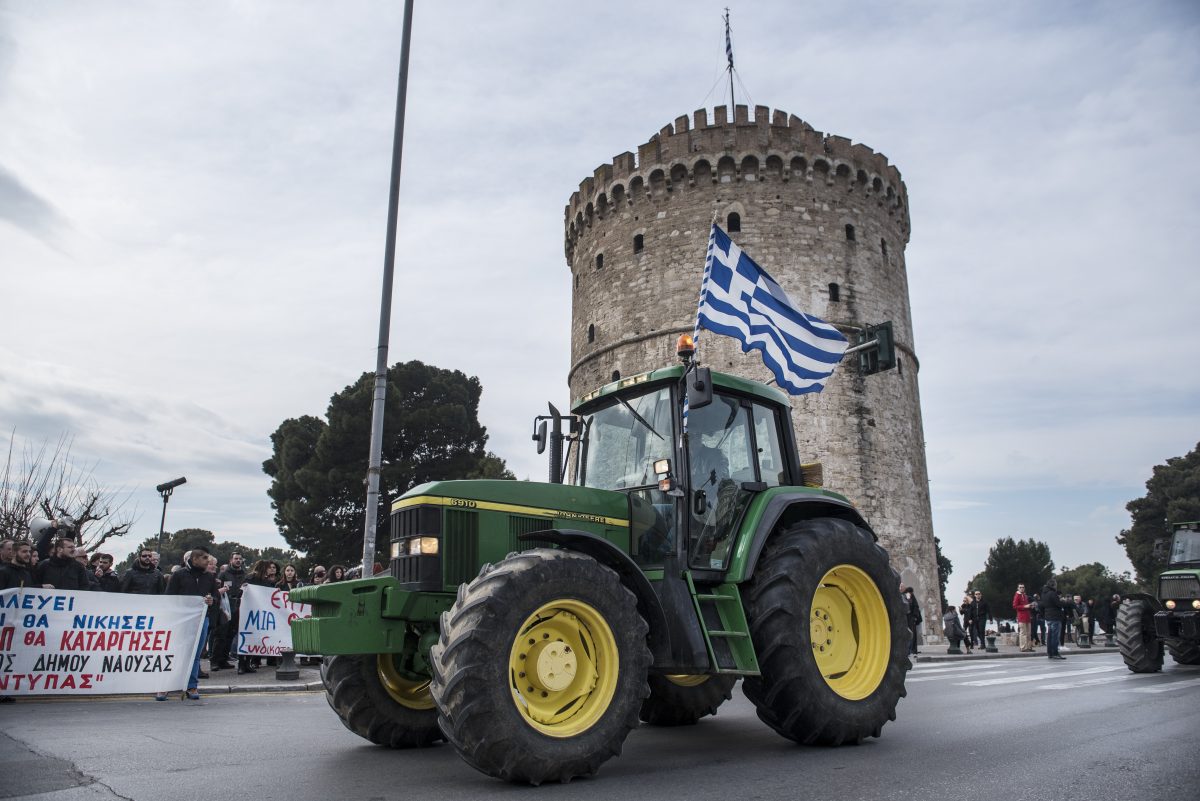
What does it mean to be a farmer in Greece today, as tractors return to the fields? It means living between the sky and Brussels, exposed to the climate crisis and a bureaucratic subsidy system that promises support but often distributes burdens and benefits unfairly. It means doing calculations where the numbers don’t add up, depending on expensive fuel and scarce labor, carrying the responsibility for whether the village school, clinic, post office, and café remain open. Yet something keeps these people on the land they inherited: knowledge and pride in their product, and the sense that without them, the countryside would empty permanently. Today’s mobilizations, behind the demands for production costs, compensation, and subsidies, also recognize them not as “eternal subsidy recipients” but as professionals who create value and keep the social fabric of rural Greece alive.