Pope Leo XIV and Ecumenical Patriarch Bartholomew I joined hands today in Nicaea (Iznik, Turkey now) to celebrate the 1,700 anniversary of an event that constitutes the bedrock of Christian dogma, the Nicene Creed.
There was no pomp and ceremony.
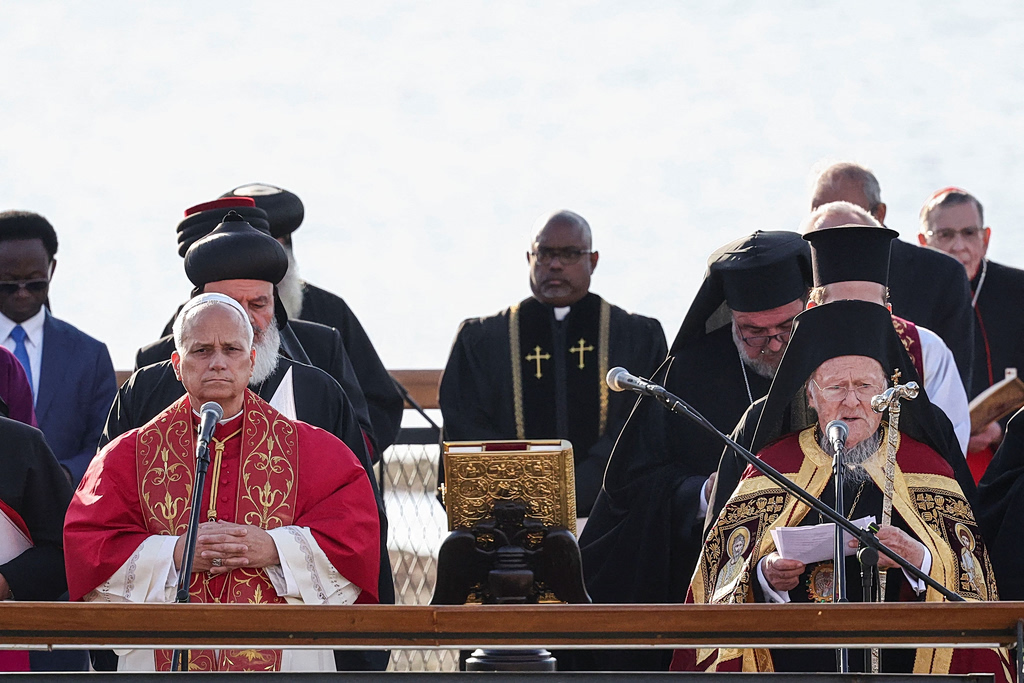
Pope Leo XIV and Ecumenical Patriarch Bartholomew I of Constantinople, the spiritual leader of the Eastern Orthodox Church, participate in an ecumenical prayer service near the archaeological excavations of the ancient Basilica of Saint Neophytos, during his first apostolic journey, in Iznik, Turkey, November 28, 2025. REUTERS/Yara Nardi
Upon their initial encounter before walking to the platform on which the simple celebrations were held, Leo and Bartholomew embraced and shared the kiss of peace, just as Pope Paul VI and Patriarch Athenagoras had done in Jerusalem in 1964.
That had been the first encounter between a pope and patriarch in over 500 years (1438), and the next year they lifted the mutual anathemas placed in 1054.
That opened the path for decades of dialogue that made today’s celebration possible.
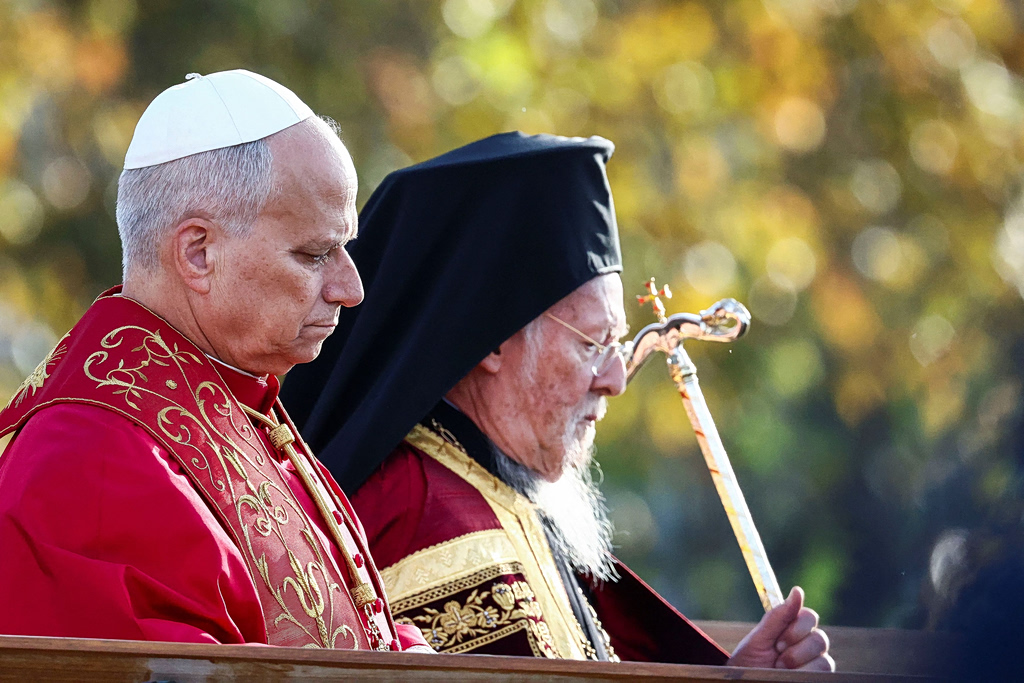
Pope Leo XIV and Ecumenical Patriarch Bartholomew I of Constantinople, the spiritual leader of the Eastern Orthodox Church, participate in an ecumenical prayer service near the archaeological excavations of the ancient Basilica of Saint Neophytos, during his first apostolic journey, in Iznik, Turkey, November 28, 2025. REUTERS/Yara Nardi
Due to the apparent strong resolve of Leo and the 85-year-old Bartholomew’s decades-long efforts to achieve reconciliation, the dialogue may possibly move at a somewhat more rapid pace.
Yet the road will be long and hard, and it will be extremely difficult to convince the faithful on both sides. Orthodox Christians have for centuries viewed the pope and Roman Catholics, and Rome has viewed the Eastern Orthodox in the same vein, as schismatics.
Common recitation of the Creed
Today, Leo and Bartholomew prayed side-by-side, along with Patriarch of Alexandria Theodoros, bishops from other Orthodox churches, and representatives of many other Christian confessions Armenians, Copts, Protestants and others.
There, all together, they recited in English the Nice Creed, the dogmatic foundation of their faith, the first seven, crucial articles of which were approved in Nicaea in 325 AD.
The quintessential meaning and symbolism of the celebration of the 1,700th anniversary of the Universal Council was to stress the need for all Christian confessions to return to the Apostolic roots of Christianity.
Leo is the successor of the first-ranking Apostle Peter, and Bartholomew of the Apostle Andrew.
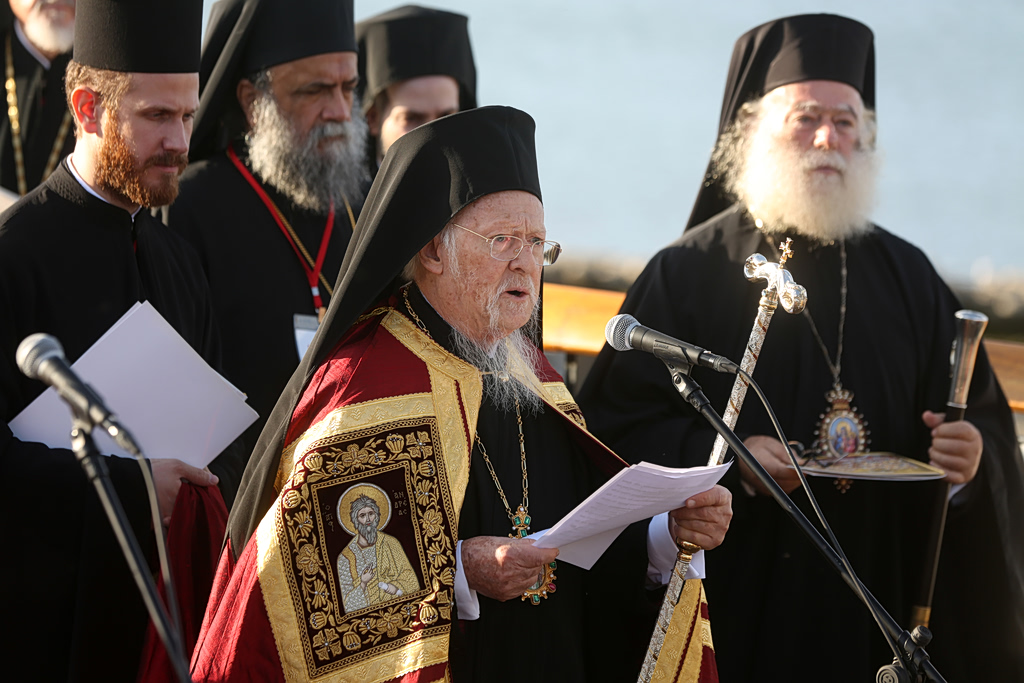
(POOL/ΑΠΕ-ΜΠΕ/ΑΛΕΞΑΝΔΡΟΣ ΜΠΕΛΤΕΣ/EUROKINISSI)
Religious and political imperative of Ecumenical Council
It was in 325 that the Emperor Constantine convened an Ecumenical Council to resolve a theological dispute that rocked his empire. It was only 12 years earlier – Constantine had not yet even been baptised as a Christian – that he and then co-Emperor Licinius legalised the faith of the much-persecuted followers of Jesus Christ and proclaimed religious toleration.
The dispute was over the most fundamental element of the Christian faith: The nature of Jesus Christ.
Arius: The priest from Alexandria that rocked an empire
An Alexandrian priest named Arius opined that Jesus as Son in the Trinity was the creation of God the Father, and not an integral part of Him, since before the beginning of time.
His view spread quickly throughout the eastern part of the empire and created such religious turmoil that it imperiled its political stability.
Constantine could not tolerate this, and the issue had to be resolved once and for all.
Who and what is Jesus Christ?
So it was, at Nicaea in the region of Bithynia – Iznik in modern day Turkey – that about 250 bishops, priests and monks from all corners of the empire drafted a document still revered and recited today by all Christian confessions that believe in the Holy Trinity (Roman Catholics, Eastern Orthodox, Armenian Orthodox, and most Protestants): The Nicene Creed, or simply “The Creed”.
The formulation arrived at was clear and simple and is effectively the constitution of most Christian churches that believe in the Holy Trinity to this day:
“I believe in one God, Father Almighty, Creator of heaven and earth, and of all things visible and invisible. And in one Lord Jesus Christ, the only-begotten Son of God, begotten of the Father before all ages; Light of Light, true God of true God, begotten, not created, of one essence with the Father through Whom all things were made.”
The disaster of the ‘Great Schism’
It was a triumph of Christian unity, a unity that was, alas, shattered eleven centuries later by the Great Schism between Eastern and Western Christianity, when Rome excommunicated then Ecumenical Patriarch Michael Cellularius, with his ambassador to Constantinople, Cardinal Humbert, placing a Papal Bull with the Anathema on the altar of the imperial and patriarchal Cathedral of Hagia Sophia in Constantinople, the greatest and most opulent Christian church, an architectural marvel built by the Emperor Justinian I (between 532 AD and 537 AD).
The Ecumenical Patriarch reciprocated, sealing the greatest tragedy in the history of the united Christian Church until that time.
Martin Luther’s Reformation, with his 95 points, came 463 years later, tearing apart the Roman Catholic Church with the establishment of Protestantism.
Bartholomew and Leo: Strong commitment to pursue unity
This is Leo’s first papal pilgrimage abroad, and that it is to visit Bartholomew carries the weighty symbolism of his determination to push forward the dialogue between the two Churches.
Yet, Leo, on this voyage above all carries a message of peace in a world torn apart by wars and hatred, geopolitical and religious: Israel-Palestinians, Russia-Ukraine, the persecution of Christians in the Middle East and Africa, to name a few.
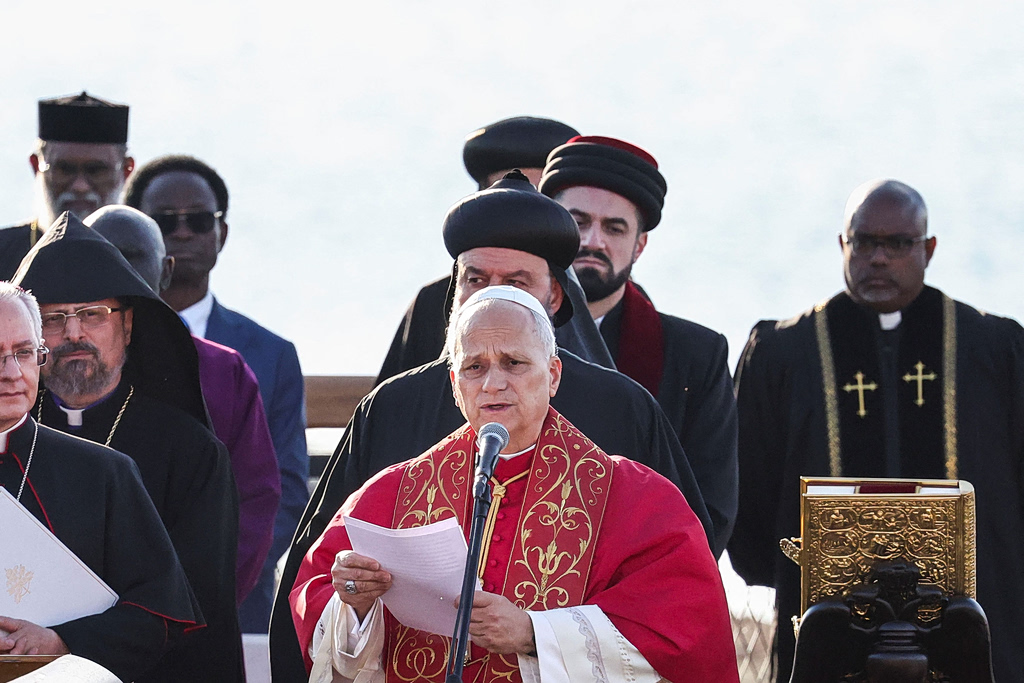
Pope Leo XIV and Ecumenical Patriarch Bartholomew I (not pictured) participate in an ecumenical prayer service near the archaeological excavations of the ancient Basilica of Saint Neophytos, during his first apostolic journey, in Iznik, Turkey, November 28, 2025. REUTERS/Yara Nardi
That his next stop is Lebanon is also highly symbolic.
From public remarks at least, there has in the past been no pope and patriarch more dedicated to placing Christian unity, based on conciliarity (collective decision-making on overarching theological and ecclesiastical issues) at the top of their agenda.
Both see this as a theological, dogmatic, and ecclesiastical imperative.
“I greet the election of the new pope, the new Bishop of Rome, with great brotherly love in Christ, and great expectations” Bartholomew said when hearing of the election on 8 May, of the new pope, Leo XIV.
Leo will attend on 29-30 November the celebrations of the feast day of Saint Andrew, whose throne all Patriarchs of Constantinople have occupied.
There have been four previous popes that established and continued this tradition of visits to the seat of the patriarchate at the Phanar, Constantinople (present day Istanbul): Pope Paul VI in 1967, Pope John Paul II in 1979, Pope Benedict in 2006, and Pope Francis in 2014.
Francis, Bartholomew agreed on Nicaea concelebration
The late Pope Francis and Bartholomew had particularly close brotherly ties.
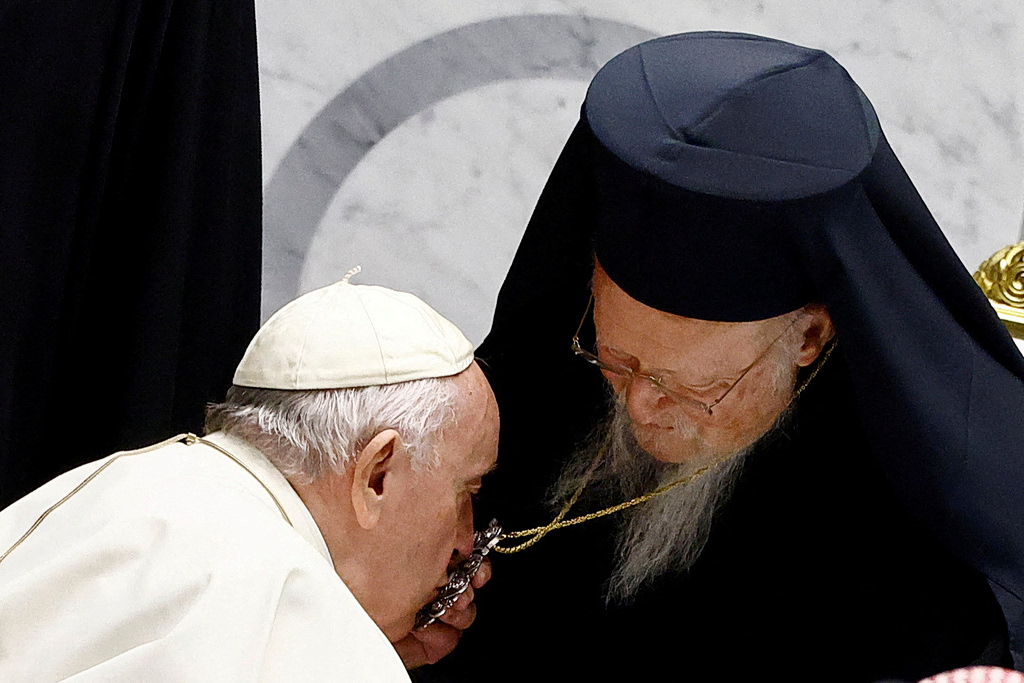
Pope Francis kisses the crucifix of Ecumenical Patriarch Bartholomew I, as the Pope holds an ecumenical meeting and prayer for peace at Our Lady of Arabia Cathedral, in Awali, Bahrain, November 4, 2022. REUTERS/Yara Nardi TPX IMAGES OF THE DAY
A champion of the rights of downtrodden migrants, Francis made two visits (2016 and 2021), accompanied by Bartholomew, to refugee camps on the Aegean island of Lesvos, a key reception point for migrants, who were kept in sordid conditions in closed camps at the time.
It was with Francis that Bartholomew agreed to the latter’s initiative to celebrate together the 1,700th anniversary of the First Universal Council.
The idea was predicated on the common apostolic lineage and tradition of the two churches, and on the importance of the collective decision-making of the united Christian Church, as exemplified by the Council of Nicaea.