Athens is not a city that respects people with disabilities. The same is true of many towns and cities across Greece. Despite the efforts made and the funds allocated from time to time, To Vima’s reporting reveals that there has never been a coherent, strategic plan to support citizens with mobility impairments, blind people, children with severe autism, or men and women living with serious chronic conditions.
Those who belong to these groups are confronted daily with a reality that not only fails to help them cope with their challenges, but actively makes their lives far more difficult—often excluding them altogether from activities that other citizens take for granted. Just days after this year’s International Day of Persons with Disabilities, To Vima revisits the critical shortcomings in infrastructure and support for people with disabilities, as well as the demands for improvement that should concern every citizen of a modern European country.
“My everyday labyrinth”
One of the most serious problems faced by people with disabilities is accessibility. Public buildings, public transport and shared urban spaces remain largely inaccessible due to narrow pavements, poor maintenance, illegal parking and obstacles such as café tables spilling onto sidewalks.
“Every journey I make is an ordeal,” says Apostolos Sakkas, who was born blind, speaking to To Vima. “I live in Neapoli, in a building where, after the lift, there are steps leading to the entrance. I go down with my cane, counting my steps. Once I’m outside, I enter a labyrinth. Pavements are narrow, often broken, frequently cluttered with café furniture. My cane constantly hits metal chairs, flowerpots, motorcycles parked on the pavement. Drivers park wherever they can—even on tactile paving meant to guide blind people.
“At the bus stop I have to ask which bus is coming. Often, when it arrives, the driver doesn’t stop properly because cars are parked in front. I have to rush, feel for the door and get on before it closes. In the metro, lifts for people with disabilities are often broken or locked. By the time I reach my destination, I’m exhausted. A journey that takes you 30 minutes takes me over an hour, filled with anxiety and fear.”
“Every slab is a trap”
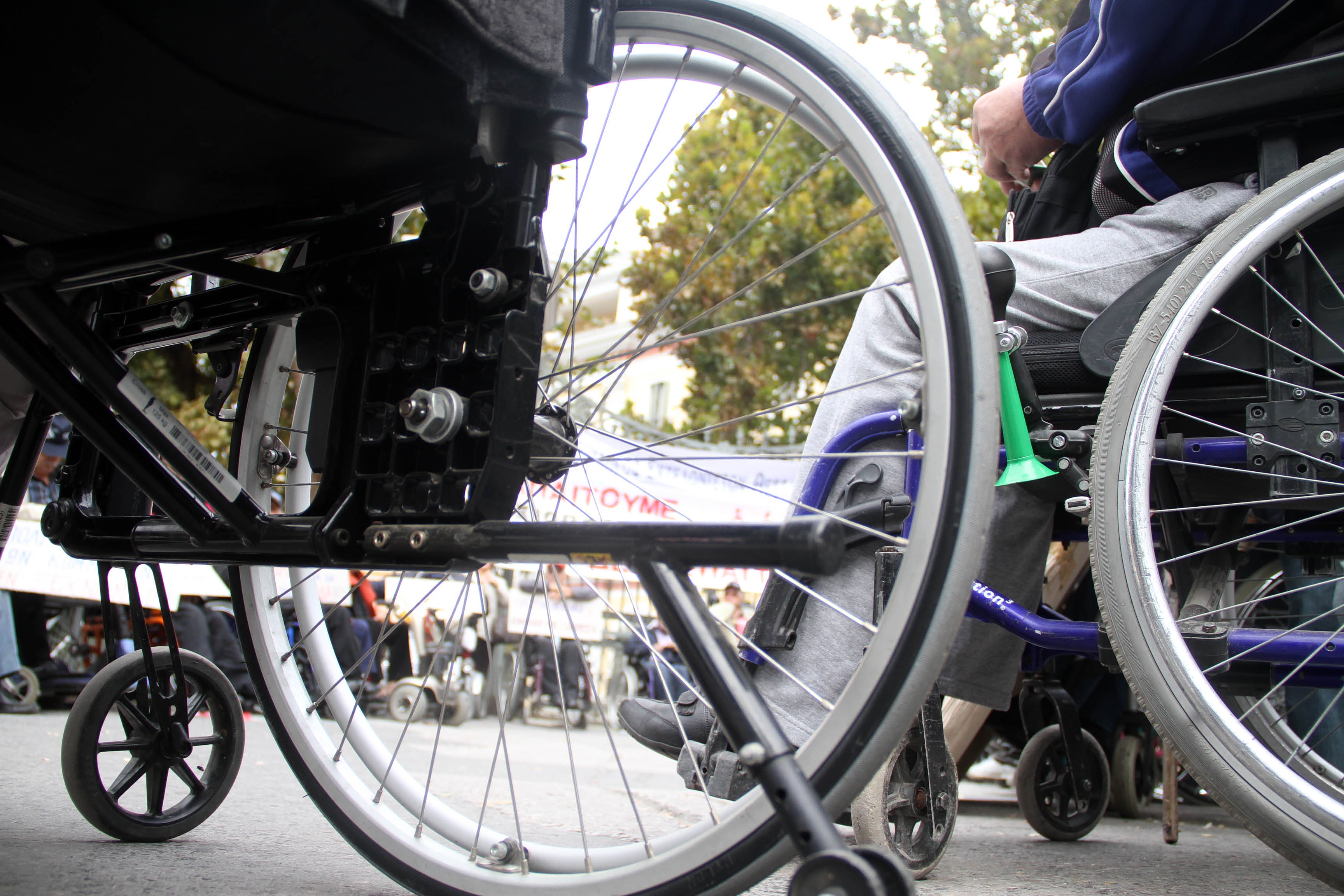
Amalia Mavridou, who uses a wheelchair, describes a similar reality. “The first obstacle is my own home,” she explains. “The lift is 70 centimetres wide; my wheelchair is 72. I have to angle it, push hard, close the door with my foot. Outside, the pavements are broken—every slab is a trap. The wheelchair drops into holes. Often passers-by help me.
“At bus stops there are no ramps, and very often the bus ramps are broken, so I wait for the next one. Many public services have no access for people with disabilities. Even going out for a coffee is a problem, as many cafés in the city centre have toilets in the basement.”
Findings from the first Disability Barometer
Last week, on Wednesday 3 December, the International Day of Persons with Disabilities, the National Confederation of Persons with Disabilities presented the findings of Greece’s first Disability Barometer, highlighting the systematic problems faced by thousands of citizens.
The data are stark:
- Poverty: In 2024, one in two people with disabilities aged 16–64 lived at risk of poverty or social exclusion—the second-worst rate in the EU.
- Exclusion from work: Only 25.3% of people with disabilities are part of the economically active population, again the second-lowest rate in the EU. For blind people in particular, employment opportunities have shrunk dramatically, notes Maria Tzevelekou, president of the Lighthouse for the Blind.
- Weak social protection: Greece records the lowest impact of social transfers on poverty reduction in the EU.
- Costly healthcare: Greece has the second-highest level of out-of-pocket health spending in the EU, with more than a third of healthcare costs paid directly by households. Eight out of ten people with disabilities or chronic illnesses are forced to cut back on basic needs such as food or clothing to cover medical expenses.
Outside Athens, often worse
In the provinces, the situation is the same—if not worse. Athanasia Mavroyianni-Kassaraki, president of the Argolida Association of Persons with Disabilities “Odysseia”, points to severe shortages in inclusive education, inaccessible schools, and understaffed special education units. Public buildings, banks and churches often lack accessible entrances or designated parking, while cafés and restaurants frequently have no accessible toilets.
“In our local hospitals there is no neurologist or dentist,” she adds. “We are forced to travel to neighbouring regions or to Athens. There are no respite care structures for families. We even had a case where a parent needed surgery and had nowhere to leave their disabled child. These are just some of the problems we face.”