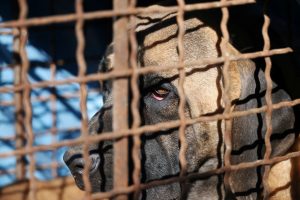
It was shortly after one o’clock in the afternoon on December 10, when a 26-year-old in Patras came face to face with a horrifying sight. Before his eyes, he saw an 89-year-old woman killing a puppy by striking it with an iron pipe. The young man reacted and reportedly threw a stone at the elderly woman, injuring her leg. At that point, she turned against him. She is reported to have struck him on the head with the same iron pipe, causing him bodily harm.
According to related documents from the law enforcement authorities, seen by Ta Nea, the elderly woman admitted her actions to the police, confessing that she had also killed a second puppy. The macabre scene was confirmed by officers who arrived at the location.
For lawyer Elena Arvaniti, this case is a clear example of how violence against animals and violence against humans are interconnected. “This is not just a theoretical statement. The connection has been proven by both science and case law,” she told Ta Nea. A few years ago, she handled the first case in Greece that led to pretrial detention for animal abuse charges.
This connection is also confirmed by Nikolaos Chryssakis, Special Secretary General for The Protection of Companion Animals at the Ministry of the Interior. Having served for over 35 years in the Hellenic Police and specializing in companion animal protection, he has authored related books.
“We are dealing with a timeless crime, based on the domination of the strong over the weak. When someone has violent instincts toward animals, they are likely to also exhibit pathological behavior toward other people,” he told Ta Nea, emphasizing that Greece has been slow to recognize the link between animal abuse and other forms of violence, such as domestic violence. “Violence against animals is the first link in the chain,” he added.
For E. Arvaniti, the “key” to understanding the phenomenon lies in childhood. “If we examine the childhoods of people who target vulnerable individuals, we often find that they initially targeted animals,” she said, noting that the only requirement for someone to move from animal abuse to violence against humans is the existence of the right circumstances—a phenomenon now also observed in Greece.
“An animal abuser is a candidate for committing all forms of violence,” Chryssakis adds, citing examples including violence against women, children, and the elderly.
In mid-October, the first specialized interactive workshops were held in Athens and Thessaloniki to train Hellenic Police officers in handling cases of animal abuse. Among the goals of the workshops was highlighting the link between violence against animals and humans. The trainings were conducted by the Ministry of Citizen Protection in cooperation with the NGO Zero Stray Pawject.
To date, over 2,000 police officers have been trained in matters of animal protection, and there are now at least two specially trained officers in every police station across the country. Since 2022, the Hellenic Police has operated a dedicated Animal Protection Unit and the hotline 10410 for related complaints.
“Violence against animals is not a closed cycle. It is a mirror of society. And the state now stands against it,” emphasized Nikolaos Chryssakis, Special Secretary General for The Protection of Companion Animals at the Ministry of the Interior.