November 19, 2025–a month since thieves entered the Louvre during opening hours and escaped with Napoleon’s jewels in a seven-minute operation. The treasures remain missing.
The theft shocked the art world, but the pattern is familiar. In 1990, two men entered Boston’s Isabella Stewart Gardner Museum and took 13 masterpieces. In 2012, a thief broke into Athens’ National Gallery and took three.
Three institutions decades apart—one relying on 1990s surveillance, one underfunded during Greece’s financial crisis, and one among the world’s wealthiest museums. All were robbed successfully. In every case, most stolen pieces remains missing.
If we still haven’t learned how to protect irreplaceable collections after all these years, what is it going to take?
BOSTON 1990
The Isabella Stewart Gardner Museum heist remains the greatest unsolved art theft in history.
The museum, founded in 1903 by American collector Isabella Stewart Gardner and bequeathed to the public, was targeted on the night of March 18, 1990. Two men dressed as Boston police officers rang the buzzer at 1:24 a.m., claiming to be responding to a disturbance. A guard let them in. The thieves then ordered him to summon the second guard from his rounds. Once both guards were together, the thieves handcuffed them, taped their eyes and mouths, and tied them up in the basement.
For the next 81 minutes, the thieves moved through the galleries, removing 13 works, including Vermeer’s The Concert and Rembrandt’s The Storm on the Sea of Galilee. Thirty-five years later, none have been recovered, and the frames still hang empty in their original locations—Isabella Stewart Gardner’s will stipulated that the museum’s arrangement could never be altered.
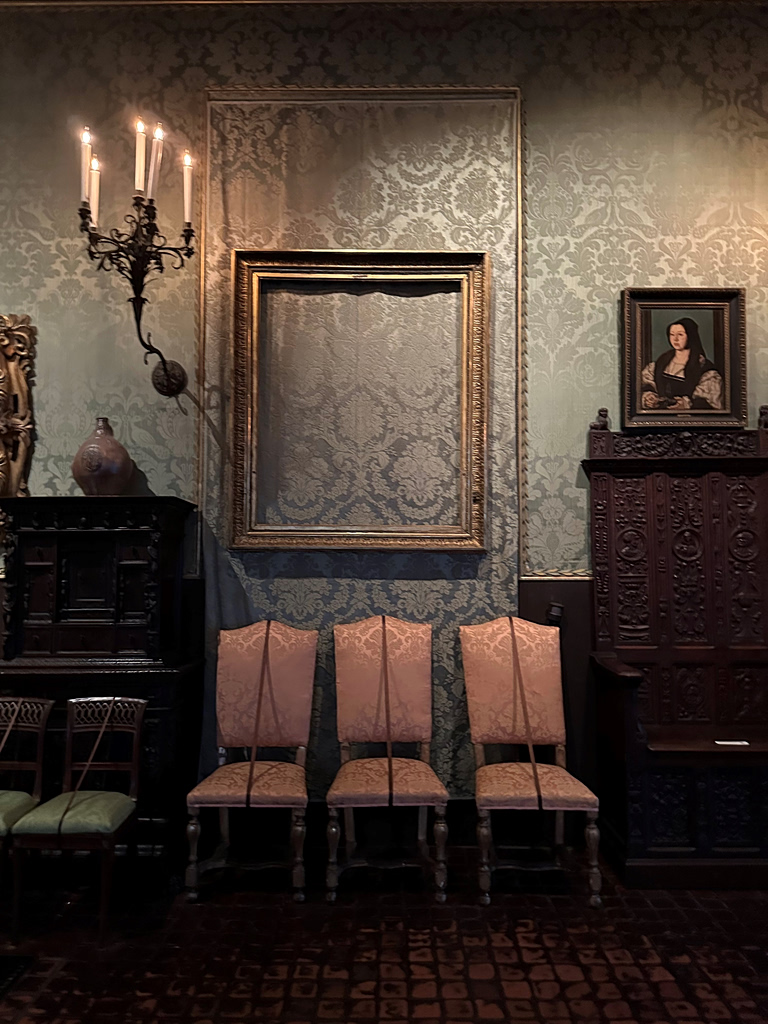
The Dutch Room of the Isabella Stewart Gardner Museum, Boston, with empty frames where stolen artworks once hung. Isabella Stewart Gardner’s will stipulated that the museum’s arrangement could never be altered; the empty frames remain as a reminder of what was lost. Photo by Theodora Tsevas.
The scale of the loss underscores the ongoing challenge of recovering these masterpieces. Anthony Amore, who joined the museum in 2005 as its director of security and lead investigator working with the FBI, has examined thousands of tips and calls in meticulous collaboration with law enforcement. “We don’t like to dwell on theories and speculation,” Amore said. “Instead, we analyze patterns and sift through evidence to ensure no potential clue is overlooked.”
The museum is offering a $10 million reward, one of the largest in history. With no surveillance footage from inside the galleries and limited evidence from that night, much of the investigation has had to rely on historical records and tips analyzed carefully for leads. “No piece of art can be replaced,” Amore said. “There are only 36 Vermeers in the world, and one of them has gone missing. It’s a tragedy for people of culture who love art.”
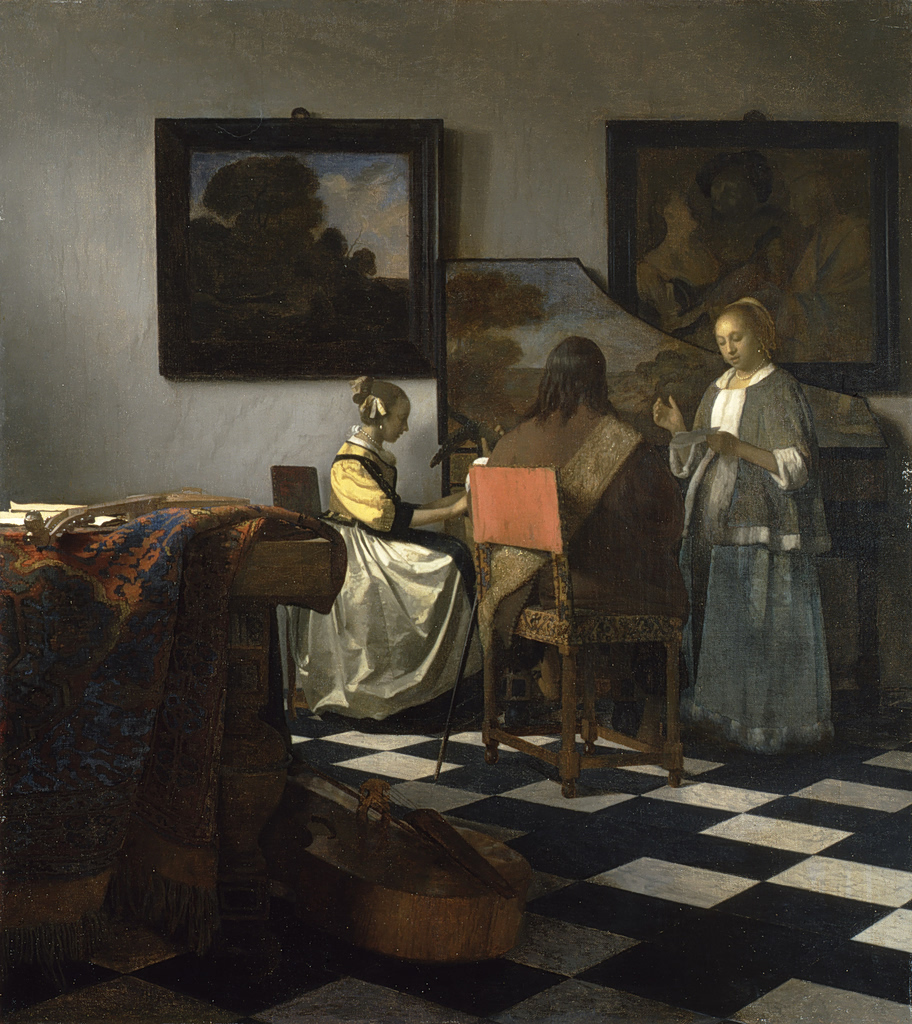
Johannes Vermeer (Dutch, 1632–1675), The Concert, 1663–1666, oil on canvas. Isabella Stewart Gardner Museum, Boston. Stolen from the Dutch Room on March 18, 1990. One of only 36 known Vermeers in existence. © Isabella Stewart Gardner Museum, Boston
The security at the time has often been blamed, but Amore disputes this. “In the early 1990s, the museum’s security cameras were considered standard, though limited to black-and-white high-resolution footage,” he said. “Back then, our security was on par with industry norms. It’s a lazy way to explain why we were robbed.”
The security systems have since been upgraded dramatically. “We now have hundreds of super night vision cameras and advanced features like predictive alerts,” Amore said. But even cutting-edge technology cannot guarantee total protection.
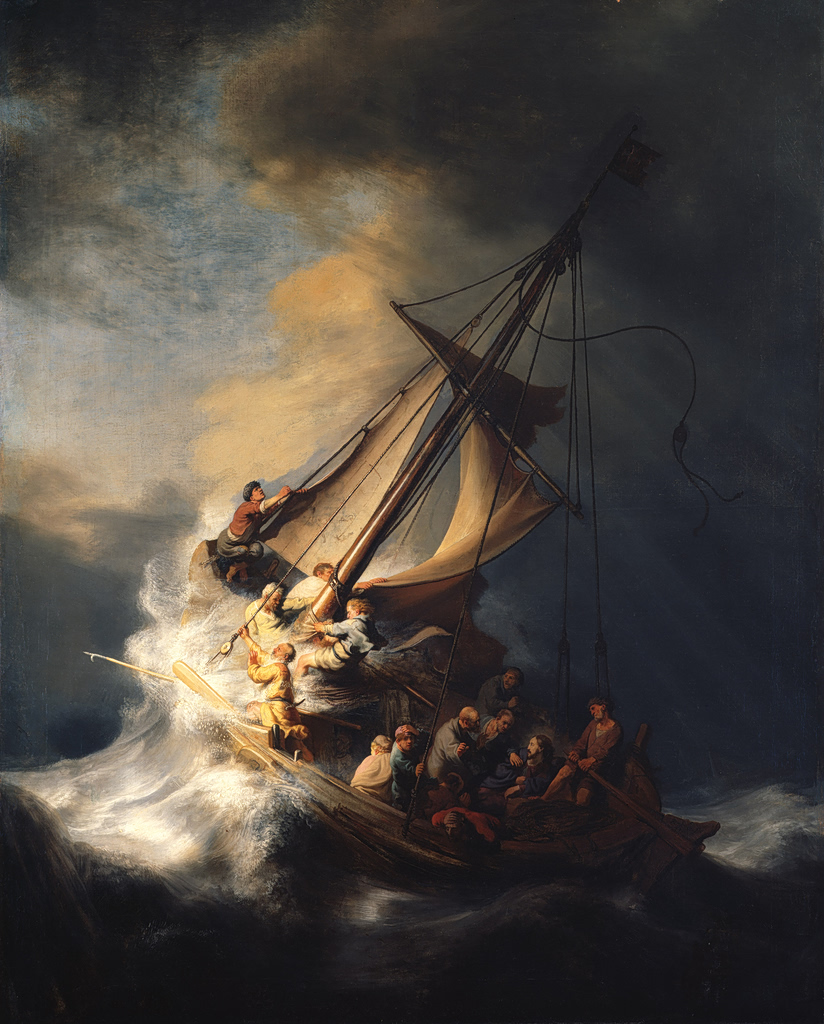
Rembrandt van Rijn (Dutch, 1606–1669), Christ in the Storm on the Sea of Galilee, 1633, oil on canvas. Isabella Stewart Gardner Museum, Boston. Stolen from the Dutch Room. Rembrandt’s only known seascape. © Isabella Stewart Gardner Museum, Boston
ATHENS 2012
The Athens theft revealed what can happen when a museum’s security system fails.
On the night of January 9, 2012, at around 4 a.m., a thief entered the National Gallery of Athens through an unlocked balcony door on the mezzanine level; the door was hidden behind a temporary plasterboard partition installed for an exhibition. One guard was responsible for patrolling 2,500 square meters by himself. The building’s alarm system triggered 150 times that night, but the private security company failed to respond. When the lone guard finally called for help, he was told no one would be coming. By the time the police arrived, the thief had fled into a nearby park with three works valued collectively at over €1 million: Picasso’s Woman’s Head, Mondrian’s Stammer Mill with Streeckerk Church, and a 17th-century drawing by Guglielmo Caccia, known as Moncalvo.
When Marilena Cassimatis, then senior curator of the National Gallery and responsible for the Moncalvo in the exhibition, arrived the next morning, the scene told its own story. “The crime scene was completely unguarded,” she recalled. “The police had already left, and nothing had been secured.” She walked to the point of entry and noticed footprints on the fallen plasterboard the intruder had stepped on, Picasso’s frame on the ground with shattered glass, and the mount from which the Moncalvo drawing had been torn. “I asked if anyone had evaluated them,” she said. “Obviously not.”
The security infrastructure was barely functional. “The cameras monitoring the middle floor were video cameras without batteries, so they didn’t work,” Cassimatis said. “The one that did work couldn’t record, because the area was not lit; it was just a black screen showing nothing.” One camera near the Picasso wasn’t even aimed at the artworks. “The employees from the gift shop had asked for it to be pointed toward them, because postcards were being stolen.”
Much of this failure reflected the severe budget cuts brought on by Greece’s economic crisis. “There were no night guards, not enough guards inside the exhibition during visiting hours, no modern cameras, no night lighting,” Cassimatis said. “The first security installed at the museum was when the Metropolitan Museum of New York came for a planned collaboration exhibition and inspected the space.”
In 2021, nine years after the theft, Greek authorities recovered the Picasso and Mondrian in a gorge outside Athens. The Moncalvo remains missing.
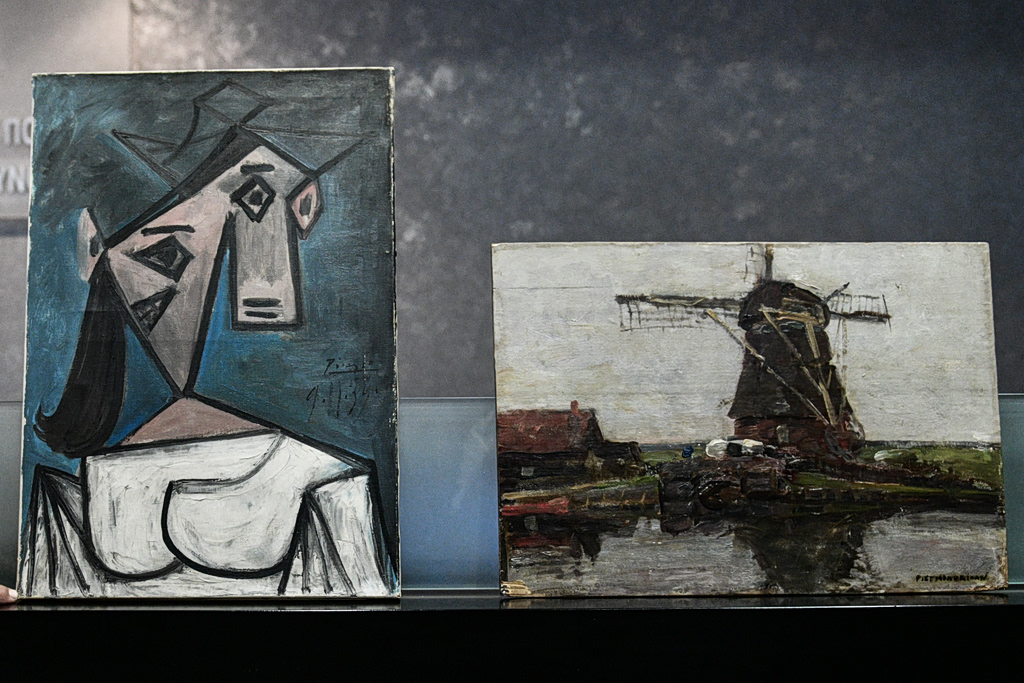
Picasso’s ‘Woman’s Head’—gifted to Greece in 1939—and Mondrian’s early landscape ’Stammer Mill with Summer House’, both stolen from the National Gallery of Athens in 2012, reunited after their recovery in 2021.(EUROKINISSI/TATIANA BOLARI)
But it’s what happened between the theft and the recovery that reveals the true depth of institutional failure, and the starkest contrast with the Gardner Museum’s relentless pursuit of leads.
FLORENCE 2019
Seven years after the theft, the Moncalvo drawing appeared online in a Florence auction catalog. Cassimatis immediately recognized it. “The work had no provenance; it was damaged at the bottom, some marks were added to suggest it belonged to a collection, strange numbers, and the stamp we used had been removed,” she said.
The discovery was made possible because Cassimatis had shared a research plan of the Moncalvo drawing on social media a few years ago. A friend saw the post and shared it with a colleague in Italy who specialized in Northern Italian works. When the drawing appeared in a 2019 Florence auction catalog, that Italian expert recognized it and alerted Cassimatis.
Cassimatis contacted the Greek authorities, who directed her to inform the director of the stolen art recovery department. She also alerted the Italian cultural heritage authorities and asked to travel to Florence to authenticate the work in person. “Can’t I go authenticate it? Can’t we appeal to get it back?” she said.
By the time she could act, the auction house had already removed the work from the catalog. The Italian police for cultural property assigned an appraiser to evaluate it, but the appraiser never examined the drawing in person or contacted Cassimatis, and the work vanished. Later, Cassimatis learned that the drawing was acquired for a negligible sum and that the Italian authorities concluded it was a copy based on a remote analysis known as “surface washing.”

Guglielmo Caccia (il Moncalvo), St. Diego de Alcala in Ecstasy, 17th c. stolen from the National Gallery of Athens in 2012; though a drawing matching it appeared in a 2019 Florence auction catalog, it was never examined by Greek officials and remains missing.
EUROKINISSI/ Greek Police
The thief caught in Athens had claimed he cut his hands on the broken glass, wiped the blood off onto the Moncalvo drawing, then threw it away. “They believed him,” Cassimatis said. His story was accepted. The Florence lead was ignored. Still, Cassimatis believed that the auction itself was a great clue for the investigation. “Who put it up for auction? We could have found out before it disappeared.”
The contrast with the Gardner Museum was stark. There, Amore investigated every tip personally. In Athens, the curator who knew the work best was blocked from verifying it, and no Greek official traveled to Florence. “Even if it seemed like a prank, no one did anything,” Cassimatis said. “Not the National Gallery, nor any other authority.”
PARIS 2025
If Athens can be blamed on austerity and Boston on outdated 1990s technology, what excuse does the Louvre have?
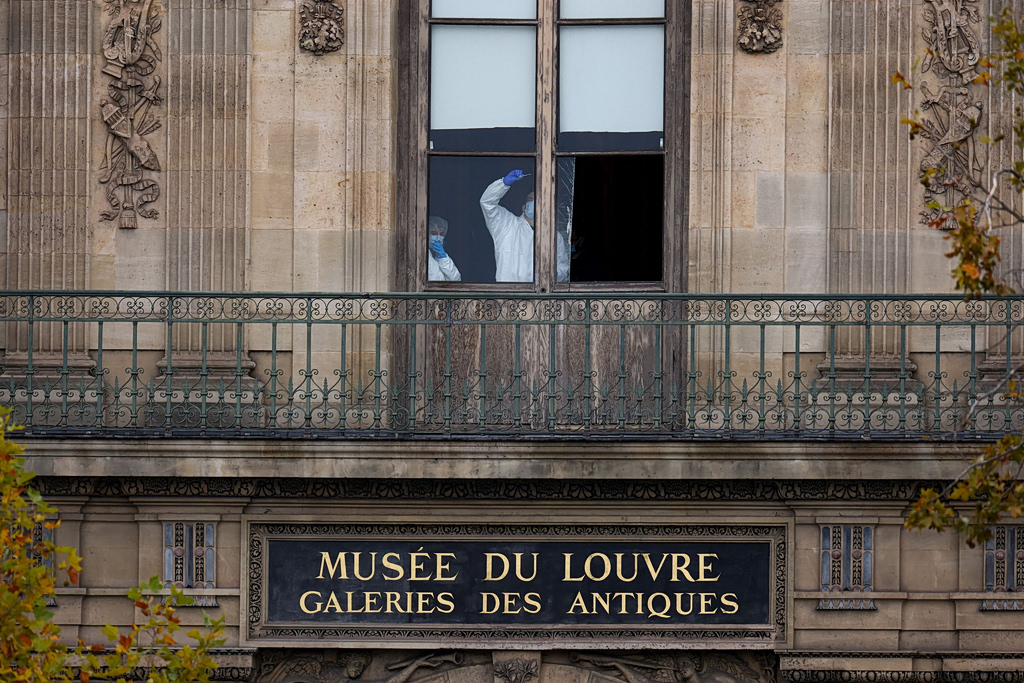
Members of a forensic team inspect a window believed to have been used in what the French Interior Ministry said was a robbery at the Louvre museum during which jewellery was stolen, in Paris, France, October 19, 2025. REUTERS/Gonzalo Fuentes
On October 19, 2025, at around 9:30 a.m., thieves entered one of the world’s most visited museums with a ladder and a truck. They accessed a gallery overlooking the Seine, an area lacking protective railings and surveillance cameras. The jewels were on the route past the Mona Lisa, where crowd flow took priority over security. Seven minutes later, the thieves left with Napoleon’s sword, scepter, and crown–items worth €88 million.
The Louvre welcomed nearly 9 million visitors in 2024. Its annual budget exceeds €250 million. On paper, it should have been impenetrable.
“The Louvre may be the museum with the highest visitor numbers in Europe, but it didn’t have enough guards or any awareness that something like this can still happen today,” Cassimatis said.

The Marie Louise necklace and a pair of earrings were among the items stolen from the Louvre museum on Octοber 19, 2025 in Paris. Credit: Wikimedia Commons
The vulnerability wasn’t technological; it was strategic. The thieves identified a blind spot where security had been reconfigured for visitor flow rather than protection. No alarms were triggered. No permits required. No one stopped them.
“More resources may help, but smart strategies are just as important,” Amore noted.
Thirty-five years after Boston, the pattern still holds. The Louvre had every advantage Athens lacked and every technological advancement unavailable to the Gardner in 1990. But it didn’t matter one iota.
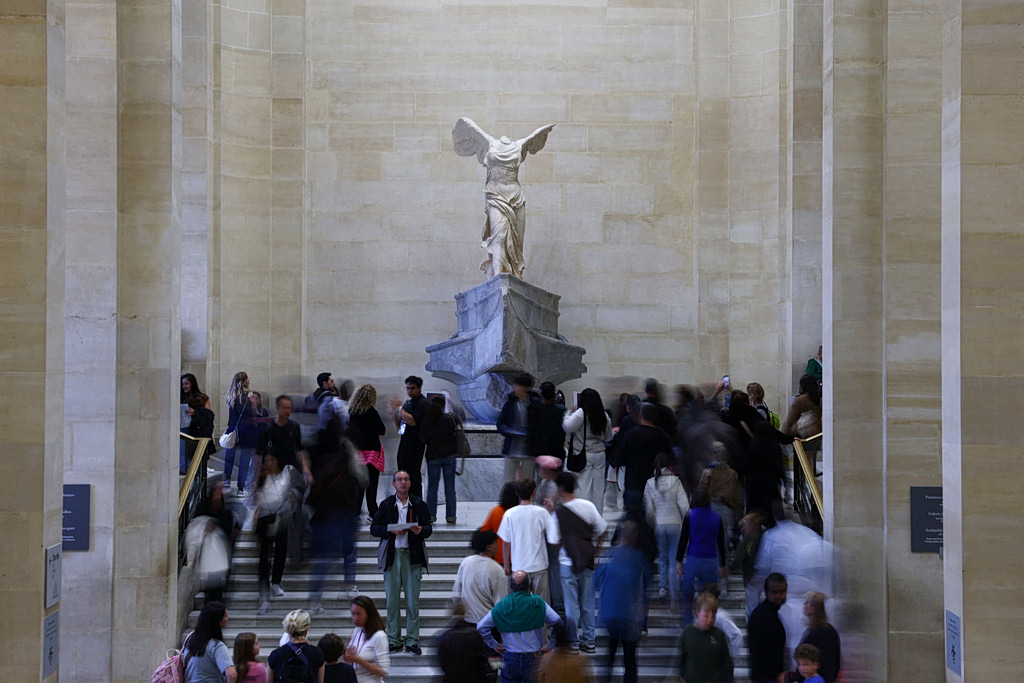
Visitors walk past the Victoire de Samothrace (The Winged Victory of Samothrace) marble statue displayed at the top of the Daru staircase at the Louvre Museum on the day it reopened to the public for the first time since last Sunday’s heist, while the Galerie d’Apollon where eight pieces of Napoleon and the Empress’s jewelry collection displayed in the gallery were stolen by thieves, remains closed, in Paris, France, October 22, 2025. REUTERS/Gonzalo Fuentes
THE PATTERN
The question isn’t why any single museum failed. The question is why the pattern persists.
“I think the most important pattern between the three is simply that determined thieves are difficult to thwart,” Amore said. “Museums and banks, and jewelers are constantly targeted by thieves and very often successfully robbed. As security technologies improve, so do the thieves. They seek the path of least resistance and, sometimes, they’re successful.”
That path exists in every museum, regardless of budget or technology. Cassimatis explains how simple it is to find: “It’s very easy. Anyone who wants to commit an armed or unarmed robbery looks up to see where the cameras are; the cameras are visible. The thief can see them.” Modern surveillance systems—AI monitoring, motion sensors, predictive alerts—can also reveal exactly how a museum operates to anyone patient enough to study them.
“The perpetrators are inside the systems,” Cassimatis said. Not necessarily as employees, but as people who understand how institutions work, where the cameras point, when guards rotate, what the response times are, and which doors are nοt monitored. In Athens, the alarm triggered 150 times. No one came. In Boston, all it took was fake police uniforms to gain entry. In Paris, a ladder and a truck were used in broad daylight. Each heist exploited institutional blind spots that technology couldn’t fix.
Technology alone has never been the solution. “A museum is a public space,” Cassimatis pointed out. “Guard training is essential. They need to be professionals. They shouldn’t be looking at their phones and shouldn’t let too many people enter together. The Louvre failed at this.” Human vigilance remains the first line of defense—and often the first point of failure.
“There are virtually no major museums that have not been victimized by thieves at one time or another,” Amore noted. “This is because there is no such thing as 100% security. More resources may help, but smart strategies are just as important.”
The Louvre had resources. Athens had none. The Gardner had industry standards. All three were robbed. The variable isn’t money or technology—it’s the fundamental reality that museums are public spaces designed to be accessible, and displaying portable objects of immense value. “Here, I’d simply reiterate that nothing is completely invulnerable,” Amore said. “There are thousands of museums in the world, and sometimes thieves can penetrate their defenses.”
What happens after a theft reveals an even sharper divide. “While statistics are difficult to come by, it is known that recognizable masterpieces are recovered far more frequently than lesser-known works,” Amore explained. “This is because they are impossible to fence, and efforts to recover them are more robust. I do believe that the Gardner works will be recovered, because of the museum’s commitment to getting them back.” That commitment matters. At the Gardner, everything is investigated. Every tip pursued. In Athens, no one followed the Florence lead when it surfaced.
Museums must balance public access with security, but Cassimatis argues their priorities have become dangerously skewed. “Visitor flow must be better organized,” she said. At institutions like the Louvre, which millions of visitors pass through annually, crowd management has trumped security vigilance, creating exactly the kind of chaos thieves can exploit. The real test for any museum is how it acts when its defenses fail.
And that is where museums succeed or fail–not in the systems they install, but in how far they are prepared to go when those systems falter.
The results speak for themselves. Technology isn’t the answer. Institutional determination is. Boston keeps searching. Athens didn’t. Paris has one month on the clock. The world is watching.

Titian Room in the Isabella Stewart Gardner Museum in Boston. Isabella Stewart Gardner Museum, Boston. Photo by Sean Dungan