“Look at them… They’re pufferfish. They’re destroying the seas and the fishermen.” Mr. Panagiotis, who runs the fish stall at the neighborhood market, spreads his palm to show three small brown fish he just picked out of the styrofoam container with anchovies. It is not the first time that pufferfish have been found mixed with other fish at a market—an incident had occurred the previous November as well, confirming that this species is steadily expanding its marine territory. Obviously, as the gill nets rise, dangerous fish get caught among the schools of edible fish. These particular ones were nano-pufferfish measuring 10–15 cm, one of the seven pufferfish species found in Greek waters—all of them dangerous and toxic. The most common is the larger Lagocephalus sceleratus.
“I’ve been fishing here for 20 years. A few days ago, for the first time, I caught a pufferfish weighing one and a half kilos in the sea below Vouliagmeni Lake,” recounts an amateur fisherman—and to prove it, he sends a relevant photo. Pufferfish are now found all over Greece. In Northern Greece, sightings remain sporadic for now, but in the Cyclades, Dodecanese, Eastern Peloponnese, and Crete, the populations detected are very large, according to Dr. Paraskevi Karachle, Research Director at the Hellenic Center for Marine Research’s (HCMR), Institute of Marine Biological Resources and Inland Waters (IMBRIW).
The pufferfish is an invasive species that, having entered the Mediterranean from the Suez Canal, continuously gains ground as it multiplies rapidly and has no natural predators. In Greece, it was first recorded in 2005. It established itself, spreads quickly, and causes problems by destroying nets, cutting longlines, and eating catches. It is dangerous because its flesh and internal organs contain a very potent neurotoxin, for which there is no antidote. There is a method of treatment using activated charcoal, but it is not always effective. This tetrodotoxin (TTX), if consumed by humans, can cause serious health issues, even death. For this reason, its sale and distribution are strictly prohibited, as is, obviously, consumption, says P. Karachle.
Additionally, pufferfish can become particularly aggressive, and because they come close to the shore and have strong teeth, they are considered responsible for attacks on swimmers, especially in Crete and Karpathos, some of which have resulted in amputations.
Interventions
The scientific community—and beyond—is seeking solutions to limit the negative effects of invasive species (such as the pufferfish) while also creating incentives for fishermen. LagoMeal, for example, is a research program by IMBRIW that has been completed with positive results, studying the production of fishmeal from pufferfish once their toxin is deactivated.
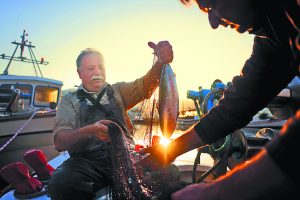
It is also being considered to implement in Crete and other regions with large populations (e.g., Dodecanese) what is already done in Cyprus: subsidizing pufferfish fishing. Discussions have already begun to address a major problem for fisheries, which simultaneously threatens biodiversity.
Harmless Ones
While the pufferfish is dangerous and toxic, the same is not true for other non-native species appearing in our seas. These are edible, nutritious, and tasty—and consuming them helps reduce their populations while increasing fishermen’s income. These include the lionfish (similar to scorpionfish), sardine-anchovy (marketed as “Parian anchovy”), the red scorpionfish (germanos), the salpa, non-native mullets, the blue crab, and Atlantic shrimp. In recent years, efforts have been made to promote the consumption of edible non-native marine species to mitigate the ecological impacts of their spread in marine ecosystems.