“The Council of Nicaea is not merely an event of the past but a compass that must continue to guide us towards the full visible unity of all Christians,” Pope Leo XIV told a 4-7 June symposium (held at the Pontifical University of Saint Thomas Aquinas in Rome) entitled “Nicaea and the Church of the Third Millennium: Towards Catholic-Orthodox Unity”.
On 28 November, Leo and Ecumenical Patriarch Bartholomew will join hands at the site of the Ecumenical Council, Iznik of modern Turkey and are expected to recite the Creed (Symbol of Faith or “Pistevo” in its original formulation, which says that the Holy Spirit is descended solely from the Father, with which it is of one substance since before the beginning of time, and not also from the Son Jesus Christ, a much later formulation of Rome that is the main theological divide between East and West.
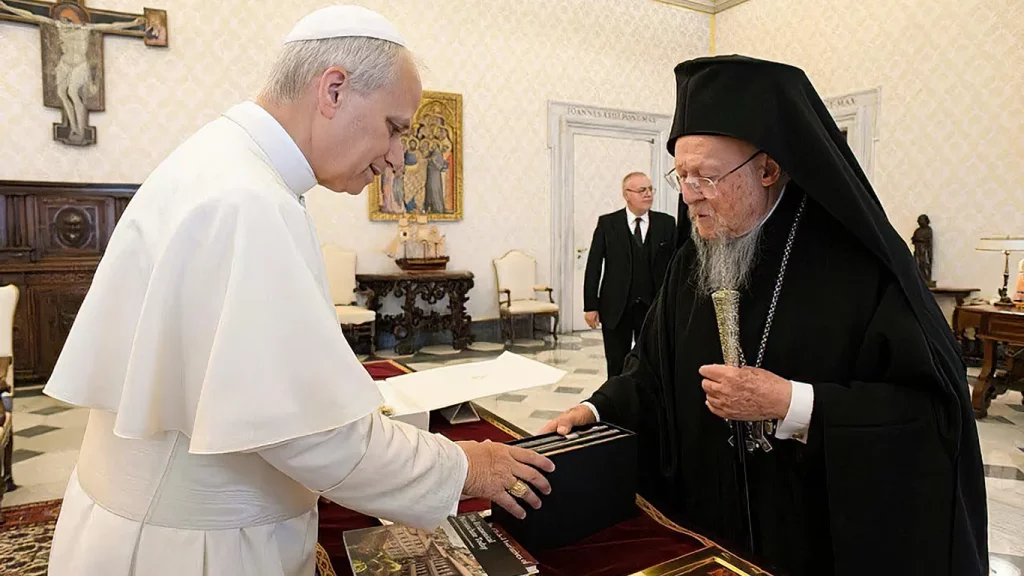
This will be Leo’s first papal pilgrimage abroad, and that it is to visit Bartholomew carries the weighty symbolism of his determination to push forward the dialogue between the two Churches.
Leo will attend on 29-30 November the celebrations of the feast day of Saint Andrew, whose throne all Patriarchs of Constantinople have occupied.
There have been four previous popes that established and continued this tradition: Pope Paul VI in 1967, Pope John Paul II in 1979, Pope Benedict in 2006, and Pope Francis in 2014.
Francis and Bartholomew had particularly close brotherly ties. A champion of the rights of downtrodden migrants, Francis made two visits (2016 and 2021), accompanied by Bartholomew, to refugee camps on the Aegean island of Lesvos, a key reception point for migrants, who were kept in sordid conditions in closed camps at the time.
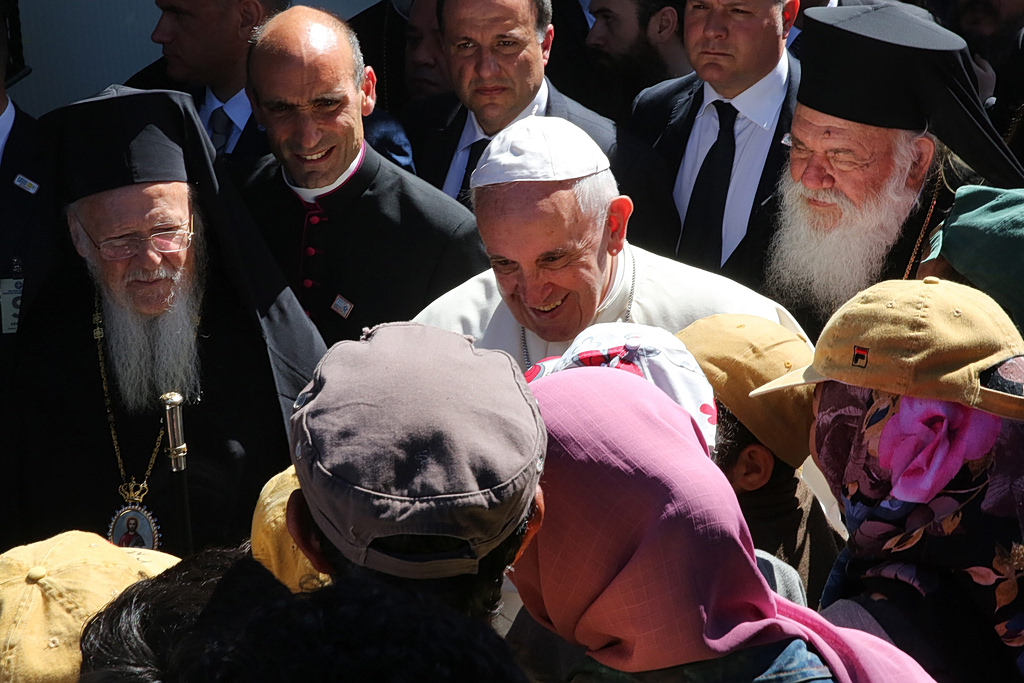
Pope Francis (C), Ecumenical Patriarch Bartholomew (L) and Greek Archbishop Ieronymos (R) arrive at the camp for refugees in Moria, on Lesvos (Lesbos) island, Greece, 16 April 2016. Pope Francis visits the Greek island of Lesbos, accompanied by Ecumenical Patriarch Bartholomew, on 16 April, in a trip aimed at supporting refugees and drawing attention to the frontline of Europe’s migration crisis. EPA/ORESTIS PANAGIOTOU
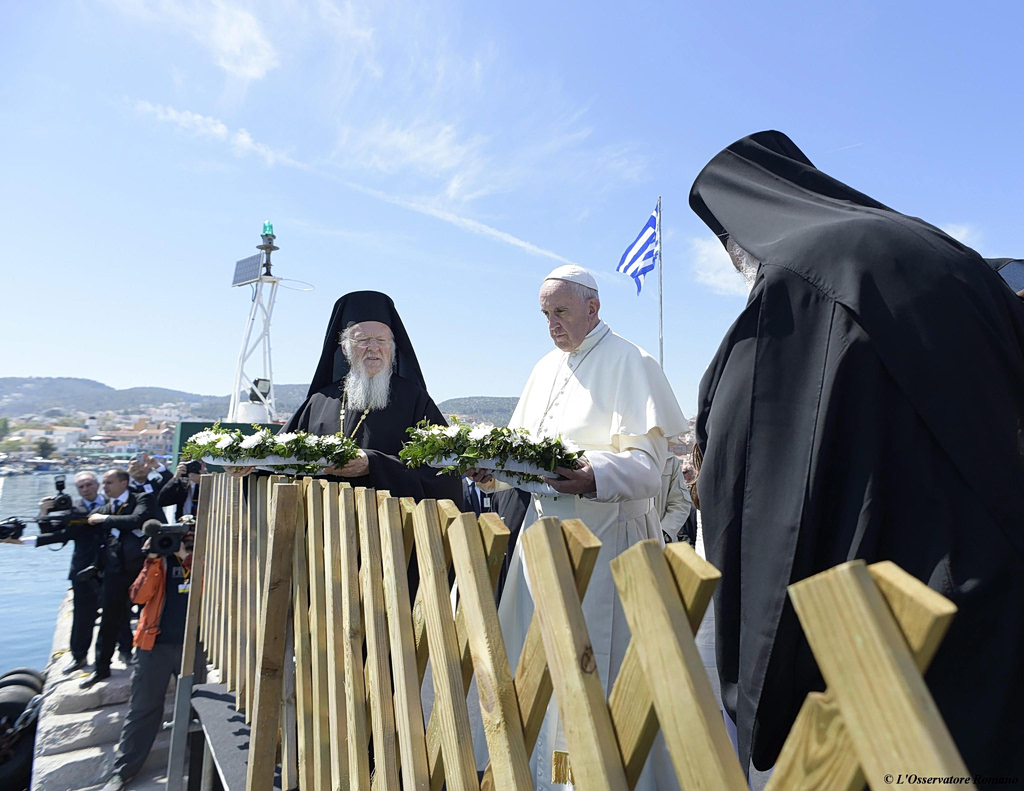
A handout image released by Vatican newspaper L’Osservatore Romano shows Pope Francis (C), Ecumenical Patriarch Bartholomew I (L), and Archbishop of Athens and All Greece Ieronymos II, (R) throw wreaths into the water at the Greek island of Lesbos, on the island of Lesbos, Greece, 16 April 2016. Pope Francis visits the Greek island of Lesbos on 16 April, in a trip aimed at supporting refugees and drawing attention to the frontline of Europe’s migration crisis. EPA/OSSERVATORE ROMANO
As a head of state, the Vatican, Leo will first hold talks with Turkish President Recep Tayyip Erdogan in Ankara, after laying the wreath required by Turkish protocol at the mausoleum of Kemal Ataturk, founder of the modern Turkish Republic.
The June Nicaea Symposium (arranged when Francis was alive) came less than a month after Leo’s election as pope on 8 May, 2025, and it was the first signal of his strong urge toward something more than rapprochement – which has already been pursued for decades in inter-church dialogues that have made notable progress in various areas – confirmed repeatedly in subsequent speeches and remarks.
It is an urge that Patriarch Bartholomew I has expressed and pursued vigorously throughout his over three decades as Ecumenical Patriarch. For most of that time the late learned theologian Metropolitan bishop Gennadios of Sasima was at the heart of that dialogue in representing the patriarchate.
Since May, Bartholomew, too, has underlined the two churches’ shared faith and the critical importance of their quest for unity, or what is theologically referred to as the “Common Cup” – sharing the same chalice and partaking together in receiving the Body and Blood of Christ.
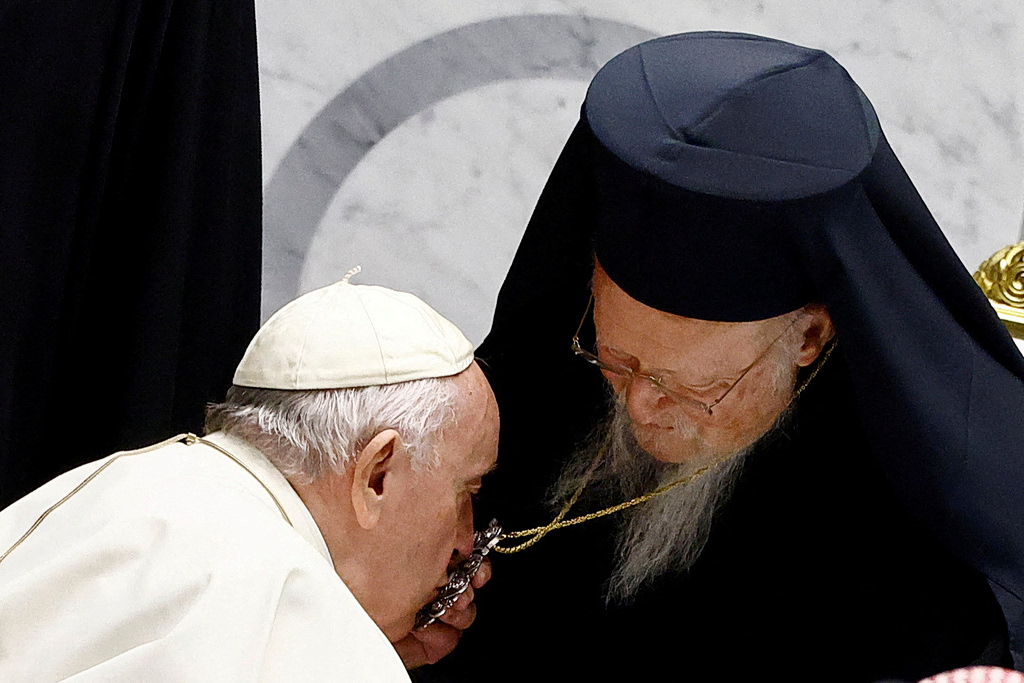
Pope Francis kisses the crucifix of Ecumenical Patriarch Bartholomew I, as the Pope holds an ecumenical meeting and prayer for peace at Our Lady of Arabia Cathedral, in Awali, Bahrain, November 4, 2022. REUTERS/Yara Nardi TPX IMAGES OF THE DAY
The decision this past year to circumvent the differences in Church calendars and have both the Roman Catholics and the Eastern Orthodox celebrate Easter on the same day is but a single (though hardly self-evident) step, but it is a major one that exposes the mutual desire to move forward cautiously but with bold determination to make the common Easter celebration decision permanent in the first instance.

Pope Francis (L) and Ecumenical Orthodox Patriarch Bartholomew I clasp each other’s hands as they acknowledge the reception from followers of both faiths after attending the Divine Liturgy in Honor of the Feast of St. Andrew the Apostle celebrated by Patriarch Bartholomew I, 30 November 2014. Pope Francis is on the final day of his three day visit to the country. EPA/TOLGA BOZOGLU
The road will be long and hard, as everyone recognizes.
Leo’s remarks regarding ecumenism – an existential and fundamental feature of the theology of the Ecumenical Patriarchate as its name indicates – demonstrates that the pursuit of Christian unity is at the very top of the agenda of his papacy, as it has been for the 85-year-old Bartholomew in his 34 years as patriarch, and for the Ecumenical Patriarchate for a full century now.
Yet, though all this may seem logical, any moves toward union – and even dialogue – are still viewed by much of Orthodoxy with deep suspicion and even great hostility.
Many of the independent Eastern Orthodox Churches and a very large portion of the faithful still view the popes as heretics, because of certain departures from central dogmas of the pre-1054 unified Christian Church, because the hegemonic role of the pope has replaced traditional Christian and Rome’s lack conciliarity, and because of the huge secular power popes have wielded as head of state (the Vatican) and for centuries as leaders of the huge territories of the papal states in Italy, administered by the popes between the 8th century and 1870.
It should be noted that achieving unity between the national Orthodox Churches – many of which arose in the context of 19th century nationalism and were eventually recognised by the Mother Church of Constantinople – was a long, arduous and ongoing affair.
The goal was articulated by Ecumenical Patriarch Ioakeim III in a 1902 encyclical calling on the representatives of all regional Orthodox Churches to deepen ties and furthered by the decisions of a 1925 “Panorthodox Synod”.
Even today some divisions bedevil Orthodox unity, most glaringly the Moscow Patriarchate’s decision to sever relations with Constantinople after Bartholomew in January, 2019 established and recognised the Autocephaly (self-rule) of the Orthodox Church of Ukraine, tearing it away from the Russian Church’s jurisdiction after hundreds of years.
The Ecumenical Patriarchate alone has the power and privilege of establishing and recognizing independent Orthodox Churches, and this is precisely what it did in the 16th century by granting Moscow autocephaly.
With all this in mind, one must underline that even if Rome and Constantinople were to agree in the future on some form of union between East and West, that in no way implies that the other independent Orthodox Churches will automatically follow suit or are required to, though it would place severe pressure upon them, including from international players which seek the isolation of the ecclesiastically expansionist Moscow Patriarchate.
For its part, the Roman Catholic Church for centuries, and until the Second Vatican Council (1962-1965, which under Pope John XXIII introduced very deep reforms, many resented by conservative elements), also viewed the Eastern Orthodox essentially as schismatics, who had to accept the supreme and absolute authority of the Pontifex Maximus of global Christianity, basically by being absorbed into the Catholic Church.
The Orthodox saw in this as a typically hubristic arrogance on the part of the Vatican, an attitude that they dreaded even before the Great Schism, which was initiated by Rome in a moment of hight drama – when Cardinal Humbert placed the Anathema on the altar of the Patriarchal Cathedral of Hagia Sophia [Church of the Holy Wisdom of God].
The hierarchical ‘pentarchy’ of the united Christian Church
It was not ever thus.
Before the Great Schism, decisions in Christian Churches were taken on the basis of conciliarity. The local Councils of bishops decided on theological and administrative issues within their territories, and many of their decisions spread further and remained part of Christian canons and dogma, even today.
At the highest levels of leadership there was a strict hierarchy, with five bishops of ancient sees comprising a solid and unchallenged hierarchy.
To dream the impossible dream
Though the union of the two Churches has for centuries seemed an impossible dream, the first step toward the unattainable occurred.
Pope Paul VI and Patriarch Athenagoras I held the first meeting in over 1,000 years of the leaders of the two Churches in 1965 in Jerusalem.
The First Ecumenical Council aimed to address theological disputes and establish a unified Christian doctrine, and its outcomes included affirming Christ’s divinity.
The Council formulated most of the Nicene Creed, which may be called the founding charter and fundamental belief system of the unified Christian Church, which was tragically split by the Great Schism of 1054.