This year’s working lunch for the jury of the European Book Prize—of which TA NEA is a member—was unlike previous ones. The winner, Spanish novelist Javier Cercas, enjoyed near-unanimous support, leaving the multinational jury ample time to speak with its president for 2025, the celebrated Ukrainian author Andrey Kurkov.
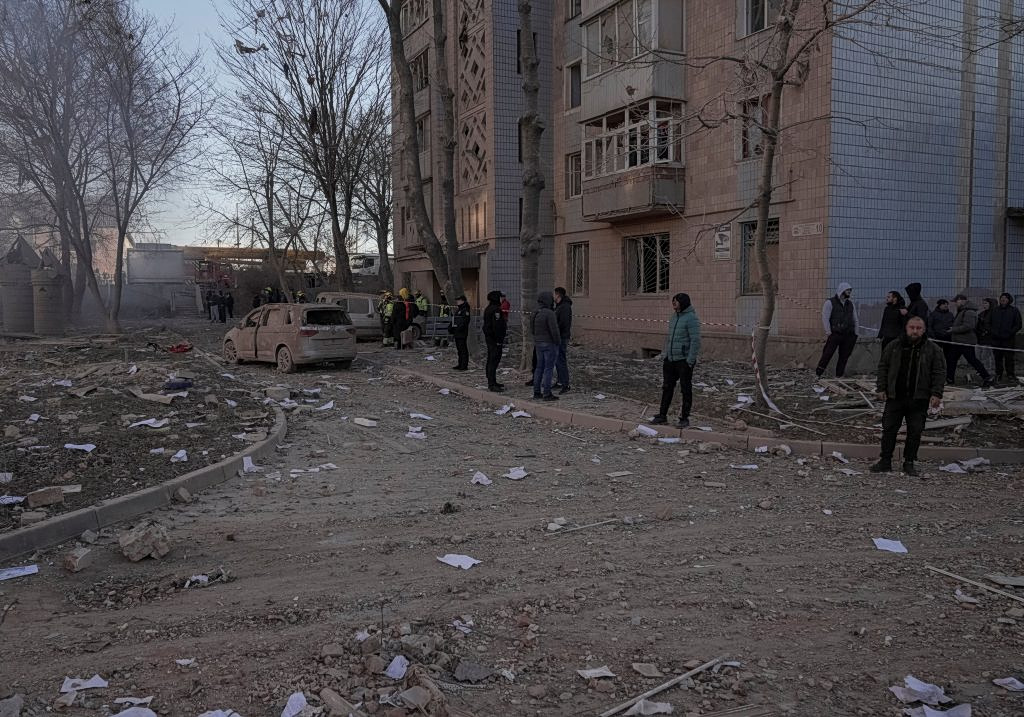
Kurkov, who speaks seven languages fluently, needed no effort to convey what he, his family, and his compatriots have lived through since Russia’s full-scale invasion of Ukraine in February 2022: the roar of bombs, the smell of fear, and the deafening silence that hope often becomes.
After the lunch, and just before leaving for Kyiv, he stayed with us a while longer to share what he felt he needed to say.
Is presiding over the 2025 European Book Prize important to you?
Yes, very much. It shows that culturally, Ukraine already belongs to Europe. Around fifteen of my books have been translated across the continent. I’m currently preparing the third volume of my diaries about life during the war, as well as the third installment of The Kyiv Ear, my detective series.
That series is set in 1919, when Kyiv fell to the Bolsheviks. Yet the atmosphere feels uncannily similar to today—so close that the fiction seems to touch reality.
Yes. It’s always the same story. When Russia invaded, I briefly felt that fiction had lost its purpose—reality had become stronger than anything a novelist could invent.
Russia’s attempt today—just as the Soviet Union once attempted—to seize control of Ukraine and absorb it as a province of a Russian empire is real and ongoing. Between 1917 and 1921, Ukraine was not only in civil war; it was fighting for its independence. When Ukraine declared independence again in 1991, Russia could not accept it. The pressure has never stopped.
Today, do you believe peace is possible?
Technically, no. Peace is impossible without a change of regime in Russia.
Those discussing peace forget that Putin rewrote Russia’s Constitution: it now lists four Ukrainian regions, including Crimea, as Russian territory.
So any peace negotiations as things now stand would be meaningless. Negotiations can only begin once Russia withdraws from those territories—meaning once it changes its Constitution.
But can Ukrainians endure this much longer?
We are tired—tired of living for long stretches without electricity, tired of drone and missile attacks, tired of shelters. But we endure.
I remain hopeful because I know Ukrainian history. Our people have survived many catastrophes. Today the situation is clearer: for the first time in eighty years, Ukrainians are united and determined to do everything to defend their country’s independence. Freedom is sometimes more important than stability.
Before the 2022 invasion, the Orthodox Church of Ukraine also declared independence, supported by the Ecumenical Patriarchate of Constantinople. How did that affect events?
The Russian Orthodox Church’s war against the Ukrainian Church is constant.
Patriarch Kirill—the head of the Russian Church—announced that the war against Ukraine is also a war against Catholicism and all Orthodox Churches not aligned with Moscow. He presents this war in Russia not only as a battle against Ukraine’s Orthodox majority, but as a fight against Western religious influence.
Ninety percent of Ukrainians are Orthodox, but they do not want to be under Kirill. After 1991, the Church in Ukraine was used as a political tool of Moscow, not a religious one. That has not truly changed. Twelve thousand Ukrainian churches are still controlled by Russia—far too many.
So, to understand Putin, one must also listen to Kirill?
Yes, of course. This is the fusion of the Russian state with the Church.
Russian priests are fully mobilized: they bless soldiers, bring icons to the front to encourage them. Meanwhile, the Russian Church is expanding in Syria, Egypt, across Africa. It has many tentacles. And when Kirill speaks of war, he likely knows exactly what he is saying.
Ultimately, who could help bring about peace?
The key may lie with Xi Jinping. China earns vast sums from this war by selling drones to both Ukrainians and Russians.
That is why Europeans must provide a counterweight to China—so that President Xi may pressure Putin. I see no other path. Putin plays with Trump the same way he plays with everyone else…