In his one year in office, US President Donald Trump has trashed, in word and in deed, the Euro-Atlantic Alliance that hugely benefited both sides, economically and geopolitically, since the end of WWII.
Feeling threatened by a strongly expansionist Russia and struggling to prop up Ukraine -committing the enormous sum of 187bn euros since the Russian invasion – the EU has been totally sidelined by Trump in talks to end the war, and is struggling to find its footing on the global stage.
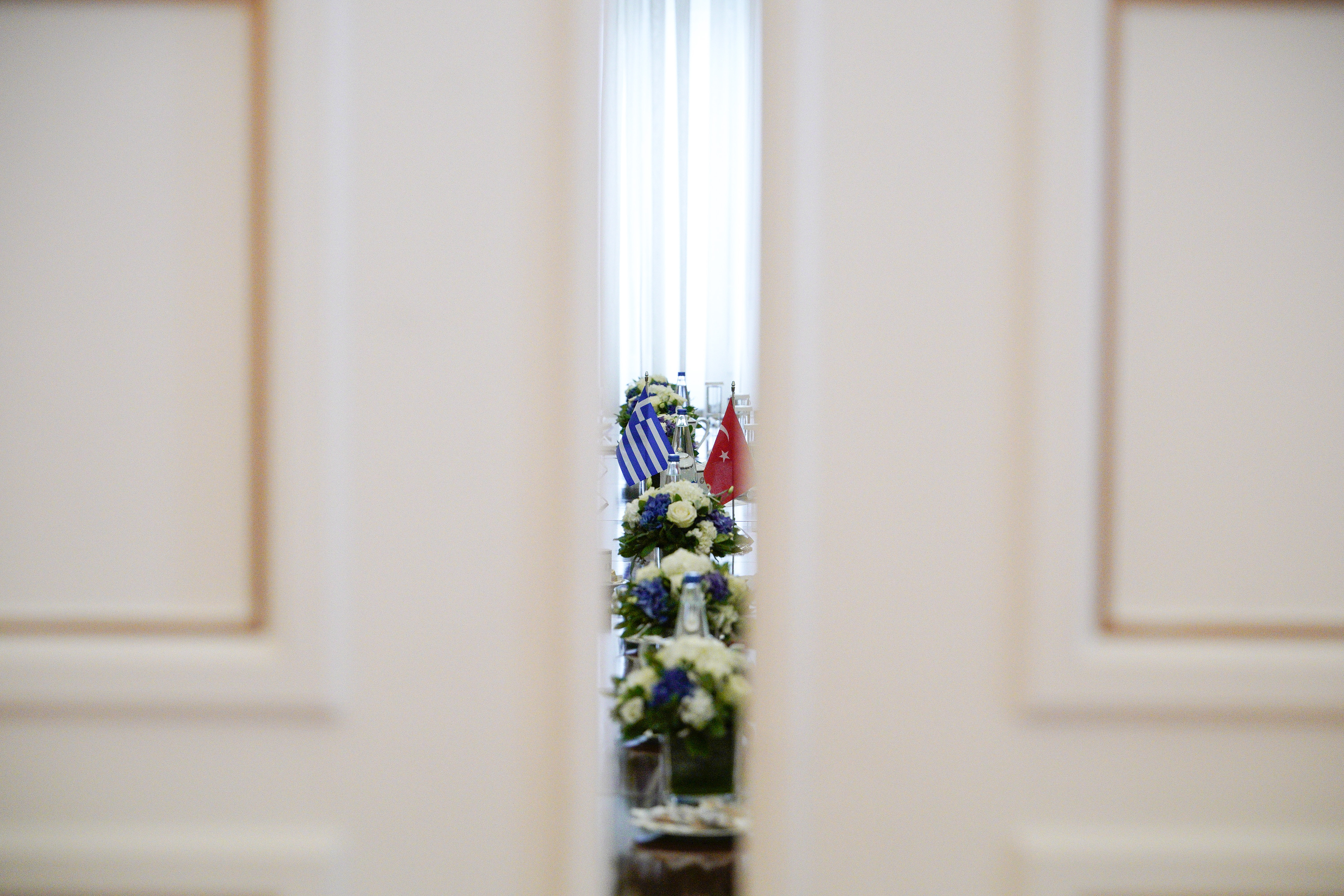
Amid such tectonic geopolitical shifts, Greece is called upon to resolve intractable, longstanding disputes with Turkey on its own, even as the keen interest of American and European energy giants in Mediterranean oil and gas deposits makes the two countries’ delimitation of their continental shelves and Exclusive Economic Zones (EEZs) more pressing than ever.
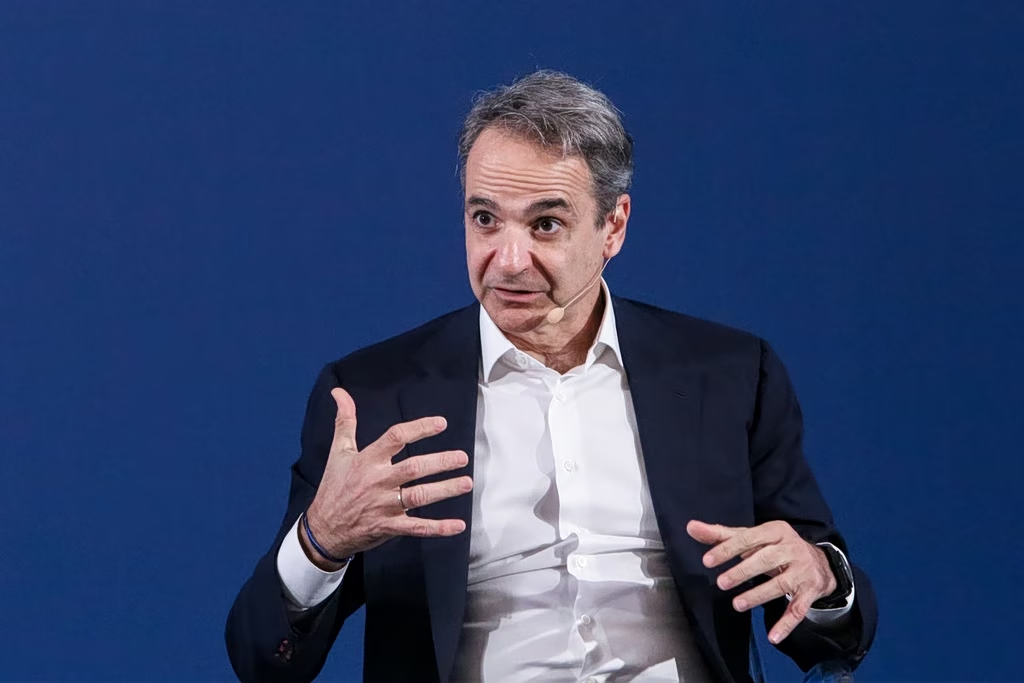
In an interview with To Vima International, Athens University Professor Emeritus Panagiotis Ioakeimidis – arguably Greece’s top expert on Greek-Turkish relations, both as an academic and for decades as ambassador and advisor to the foreign ministry (and a close associate of the late PM Costas Simitis) – outlines ways in which the two countries can pursue agreement on the exceedingly thorny issues that divide them.
At the beginning of his term, President Trump said that he does not particularly value the EU as such, but that he has good relations with specific leaders. How do you see transatlantic relations having evolved during the almost one year of his presidency?
President Donald Trump generally dislikes multilateral institutions, whether it be the EU, the UN, or the G-20. Specifically, regarding the European Union, he has famously said that “The European Union was formed in order to screw the United States [mainly in the economic sphere]. That was the purpose of it”.
In his recent National Security Strategy, Donald Trump predicts the “civilisational erasure” of Europe and calls for civilisational resistance with the support of far-right European parties! As is well known, the Union has a significant trade surplus with the US. In the year since President Trump took office, US-EU relations have gone from bad to worse. As a result, transatlantic relations are now at their lowest point since the end of World War II. President Trump imposed 15% tariffs on European imports and pressured the EU to commit to importing American natural gas (LNG). And he also “forced” EU and NATO member-states to commit to increasing military spending to 5% of GDP.
In general, the relationship of trust between the EU and the US has been shaken – irreparably, I believe.
The EU has spent €63 billion on military equipment for Ukraine, €17 billion on refugees, and much more on society. How do you interpret the fact that it does not sit at the negotiating table and has been completely sidelined on the geopolitical chessboard, and what can it do to claim the position it deserves based on its economic and political weight?
Unfortunately, the EU remains “a commercial superpower but a political dwarf.” Despite the progress made in recent years, political integration has not progressed sufficiently. The common foreign policy (CFSP) remains ineffective because, among other things, it is decided by unanimity. Only recently, following Russia’s aggression and the distancing of the US, did the Union decide to move towards a common defense by strengthening its defense capabilities. Therefore, the European Union did not have the political means to assert its presence on the international stage and in negotiations, whether it was peace in Gaza or ending the war in Ukraine. In some cases, there was a lack of the necessary political will and unity to play a more active global political role.
Nevertheless, it should not be overlooked that the Union is still saving Ukraine today. Without the EU’s multifaceted support, Ukraine would already have been handed over to Russia by President Trump (in order to achieve the end of yet another war and perhaps win the coveted Nobel Prize).
How do you view Greek-Turkish relations today and what are the conditions for delimiting the continental shelf and the EEZs of the two countries? Is it true that under the late PM Costas Simitis, the two countries were close to signing a compromise agreement to appeal to The Hague? Given the increased number of Turkish claims over the two decades since then, does this seem completely unfeasible today?
In my just-published book, entitled Beyond the Stereotypes: For A New Progressive Foreign and European Policy” (I. Sideris Publishing Co.), I attempt to describe the conditions under which the two countries, Greece and Turkey, could move forward in resolving their problems and establish a cooperative relationship between them. First of all, it is a fact that after the 2023 “Athens Declaration” adopted by the two countries, a framework of principles and rules has been created which, if respected, could contribute decisively to the resolution of problems on the basis of international law and the Convention on the Law of the Sea (UNCLOS 1982), even though Turkey is not a party to the latter.
Furthermore, it is important to maintain the so-called calm waters and promote a positive agenda, including the convening of the Supreme Cooperation Council in early 2026, as announced by Prime Minister Kyriakos Mitsotakis.
However, we must address the main, core issues of the Greek-Turkish dispute, namely the delimitation of the EEZ (Exclusive Economic Zone) and the continental shelf, as a matter of immediate priority. Time is not on our side. It is working in Turkey’s favor.
In 2003-2004, during the first period of exploratory talks under PM Simitis, the two countries had indeed come very close to an agreement on resolving their differences by referring the EEZ/continental shelf issue to the International Court of Justice in The Hague (ICJ). Unfortunately, this agreement was abandoned in March 2004 by Athens with the change of government.
Today, a resolution is more difficult as the number of Turkish claims has increased and because the internal political conditions in each country are less favorable. Nevertheless, we must proceed with the first step of delimiting territorial waters after negotiation. In other words, as I write in an analysis published this year, “How to resolve the Greek – Turkish Conundrum” , the delimitation of territorial waters cannot be achieved through a unilateral decision, but rather through an agreed solution between the two countries and a differentiated regime of territorial waters. Otherwise, it will never happen.
At the same time, it is of great importance for Greece to formulate a visionary, long-term strategy for Turkey’s relationship with the European Union. Greece’s long-standing interests are served by Turkey’s deeper integration with the EU on the basis of specific conditionalities. Turkey’s isolation from Europe is detrimental to Greece. This must be understood by the country’s political class.
The Turkish-Libyan maritime memorandum blatantly violates Greece’s rights under international law, and seems to show that Athens is one step behind. The EU’s denunciation of the agreement fell on deaf ears. Is there any way to overturn it or at least limit its deleterious impact?
5The Turkish-Libyan maritime zone delimitation memorandum (2019) is completely illegal. It violates international law, the Convention on the Law of the Sea, and blatantly violates Greek rights. Its rejection by the EU cannot lead to its abolition. Only if the two countries decided to cancel it or refer it to the International Court of Justice (ICJ) would it be abolished.
Of course, much will depend on the outcome of the talks between Greece and Libya on the legal delimitation of maritime zones, which have already begun. If they reach a positive outcome, they could also cover the illegal Turkish-Libyan delimitation.
How do you view the difference in approach to foreign policy between Costas Simitis and Prime Minister Kyriakos Mitsotakis?
The late Costas Simitis was a great political leader who worked to maximise Greek interests and protect Greek sovereignty through an approach to problem-solving that made dynamic use of the European Union (particularly the December, 1999, EU summit at Helsinki that opened the way for Turkey’s accession process). [that, on turn, effectively was the starting point for Cyprus’s accession in 2004]
His major achievement in foreign policy ultimately was Cyprus’s accession to the EU.
As a close associate of Mr. Simitis, I can say that I have the impression that the current prime minister belongs to the Simitis school of thought, with inevitable differences mainly regarding the role of Europe in resolving foreign policy issues (Greek-Turkish relations, EU-Turkey relations, etc.).
P.K. Ioakimidis is an emeritus professor at the University of Athens (EKPA), former ambassador and advisor to the Ministry of Foreign Affairs, and a member of the advisory committee of ELIAMEP. His new book, entitled “Beyond Stereotypes. New Progressive Foreign and European Policy,” has just been published by I. Sideris Publications.