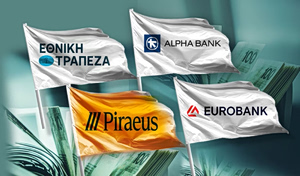
The country’s four largest systemic banks will provide debt relief, financial aid and loan payment suspensions for affected families, individuals and businesses.
Greek lenders are accelerating the use of artificial intelligence to automate customer service, introduce AI agents, and enhance digital banking, while maintaining that human advisors will remain essential for more complex financial decisions
Greek Finance Minister Kyriakos Pierrakakis says the country's banking sector has emerged from years of crisis in a strong position and now has a unique opportunity to channel available liquidity into investment, growth and broader economic inclusion.
A wave of bancassurance deals is transforming Greece’s insurance market, as major banks deepen partnerships and acquisitions to boost revenues and close the gap with European peers.
Piraeus Bank, Alpha Bank, and Optima Bank were affirmed with stable outlooks. Eurobank and National Bank of Greece were also affirmed, but their outlooks were revised to negative from stable.
The average interest rate on fixed-rate home loans with a duration of up to five years fell to 2.95%, down from 3.13% in January, dipping below the 3% threshold for the first time since early 2017.
Ongoing conflict in the Middle East is driving market volatility and shifting investor behavior, as inflows into Greek mutual funds slow and demand rises for safer assets such as bond and liquidity funds.
German lender keeps “buy” rating on Greek and Cypriot banks, citing strong fundamentals, resilient economic growth and limited exposure to Middle East risks despite recent market volatility.
Moody's said the broader economic environment is expected to stay supportive, with growth continuing to be driven by investment
Greece’s third-largest lender by market value expects to raise its dividend per share from €0.40 in 2025 to €0.80 by 2030 as part of its new five-year strategic plan, aiming for steady shareholder value growth and expanding loan activity.
Greek banks are reassessing three-year operational plans amid the U.S.–Iran conflict, with potential impacts on credit growth, profitability, and dividend policies if global energy prices and inflation spike
Eurobank is identified as Bank of America’s top pick for 2026, driven by three key catalysts: the potential upgrade of Greece to a developed market, Bulgaria’s entry into the eurozone, and Cyprus joining the Schengen area.
The success of bank digitization is particularly evident in consumer lending. According to sources, nearly seven out of ten consumer loans granted last year were issued exclusively through banks’ digital channels.
According to UBS, Alpha Bank offers the strongest earnings-per-share growth but the lowest ROTE, while Eurobank stands out as an attractive regional growth story supported by successful acquisitions.
Deutsche Bank said the potential upgrade of Greece to Developed Market status by MSCI could draw a broader pool of international investors.
Banks will operate as normal on New Year’s Eve, while all branches will remain closed on Thursday, January 1, due to the public holiday. Customer service at bank branches will resume on Friday, January 2
The final bank holiday of the festive season will be Tuesday 6 January, marking the Feast of Epiphany.
JPMorgan’s strategy for Greece includes overweight positions in 10-year bonds, as well as trades reflecting expectations of steeper yields
Goldman Sachs notes that valuations in the sector remain attractive, as Greek banks trade at roughly 1.2 times the 2026
Citigroup forecasts net profit for the third quarter at €221 million (excluding charitable donations for school reconstruction) and reported net profit at €193 million.