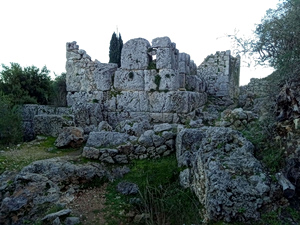
There are islands that win you over from the moment you arrive with their beaches, others with their nightlife, and others with that perfect, almost staged image of a Greek summer. And then there is Tinos. An island that does not try to impress you. It lets you discover it.
The more you explore it, the more you understand that its real charm lies inland. In its villages, in the pigeon houses that emerge among the dry-stone walls, in the marble doorways, the small squares beneath plane trees and the little chapels that seem to have grown from the hillsides. In the wind that blows almost constantly and has sculpted not only the landscape but, in a way, the character of the place.
Tinos is an island worth exploring on foot and by car, without a plan. Take a road simply because you like the direction it is heading. Stop in a village you had not marked on the map. Sit down for a coffee and end up staying for lunch. Because here, the journey is often more interesting than the destination.
An Island With Many Faces
For most Greeks, Tinos is inextricably linked to the Virgin Mary. And for good reason. The Church of Panagia Evangelistria, one of the most important pilgrimage sites in the Greek Orthodox Church, draws thousands of people to the island every year, particularly around August 15, the Feast of the Dormition of the Virgin Mary. The sight of pilgrims walking up the broad avenue toward the church is perhaps Tinos’ most recognizable image. But behind it lies an entire island waiting to be discovered.
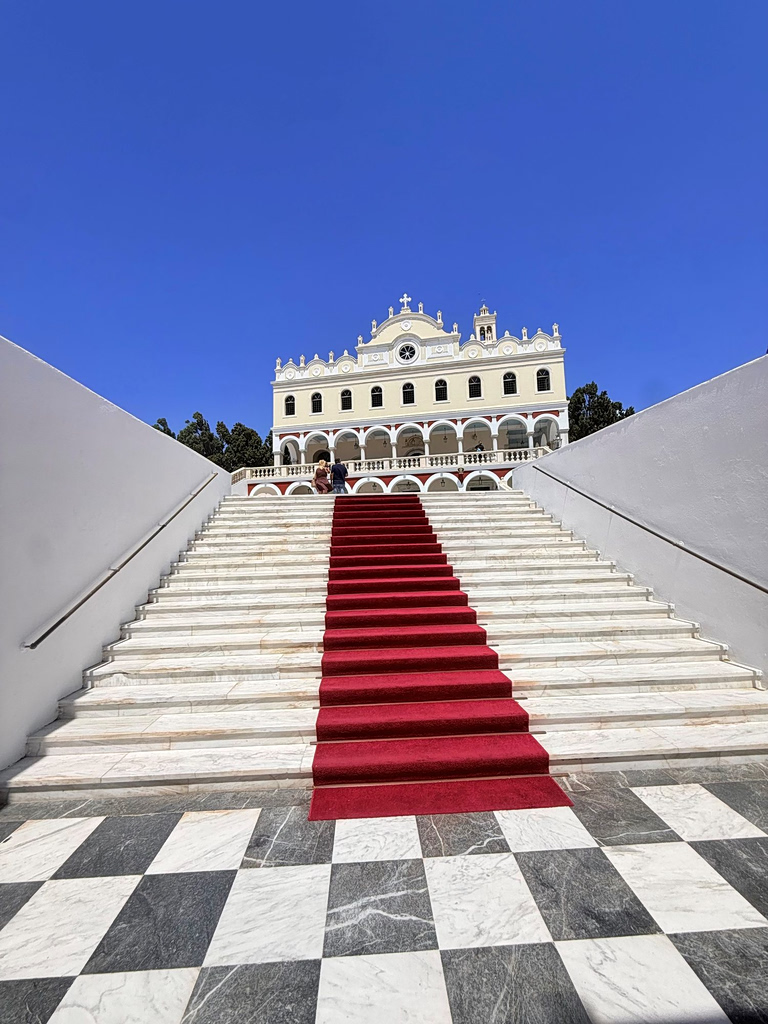
Panagia of Tinos. Photo Credits: Marina Vernicos
All it takes is leaving Chora, the island’s main town, and beginning to climb toward the interior. The landscape changes quickly. The roads narrow, the hillsides fill with terraces, and the distinctive dry-stone walls cut across the land like lines on a vast natural canvas.
Then the villages begin. More than 40 of them, each with its own personality, but all connected by a shared aesthetic: stone, marble, whitewashed buildings, narrow alleyways, arches and architecture that seems designed to protect people from the powerful wind.
Pyrgos, an Open-Air Museum of Marble
If I had to choose one village that captures Tinos’ relationship with art better than any other, it would be Pyrgos. Here, marble is everywhere. On facades, fountains, doorways, steps and courtyards. It is not a symbol of luxury but a natural part of everyday life.
Pyrgos has a long tradition of marble craftsmanship and is closely associated with major Tinian artists. It was also the birthplace of Giannoulis Halepas, one of the most important figures in modern Greek sculpture. His home now operates as a museum and is worth a visit.
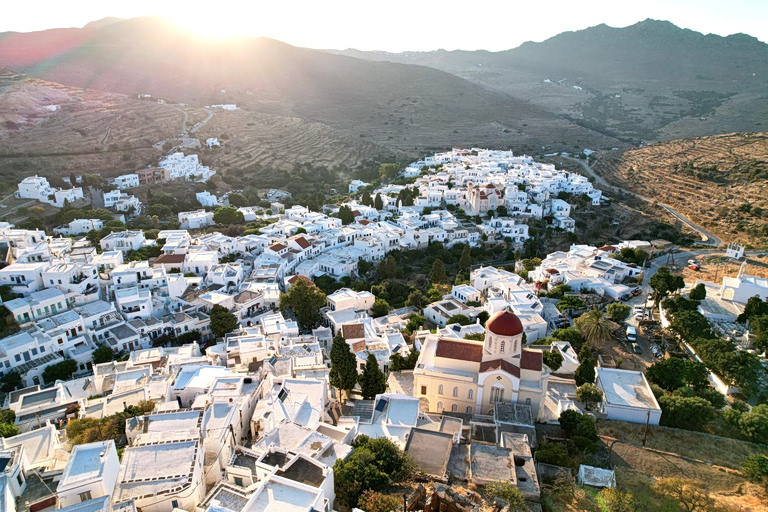
Pyrgos, a village with a long tradition of marble craftsmanship. Photo Credits: Marina Vernicos
In the central square, beneath the large plane tree, time moves at a different pace. Coffee, dessert, conversation and people coming and going. It is one of those places where you can sit down for 20 minutes and get up two hours later. A little farther away, at Panormos, the sea returns to the landscape and reminds you that, however much Tinos draws you into its interior, you are still in the Cyclades.
Volax, a Landscape That Looks Otherworldly
And then there is Volax. Of all the landscapes on Tinos, perhaps none is more surprising. Huge, rounded granite boulders are scattered across a wide area around the small village, creating a setting that looks almost otherworldly. You walk among them and wonder how they got there. The scientific explanation is connected to the geological evolution and erosion of the granite, but the landscape is so unusual that legends were inevitable.
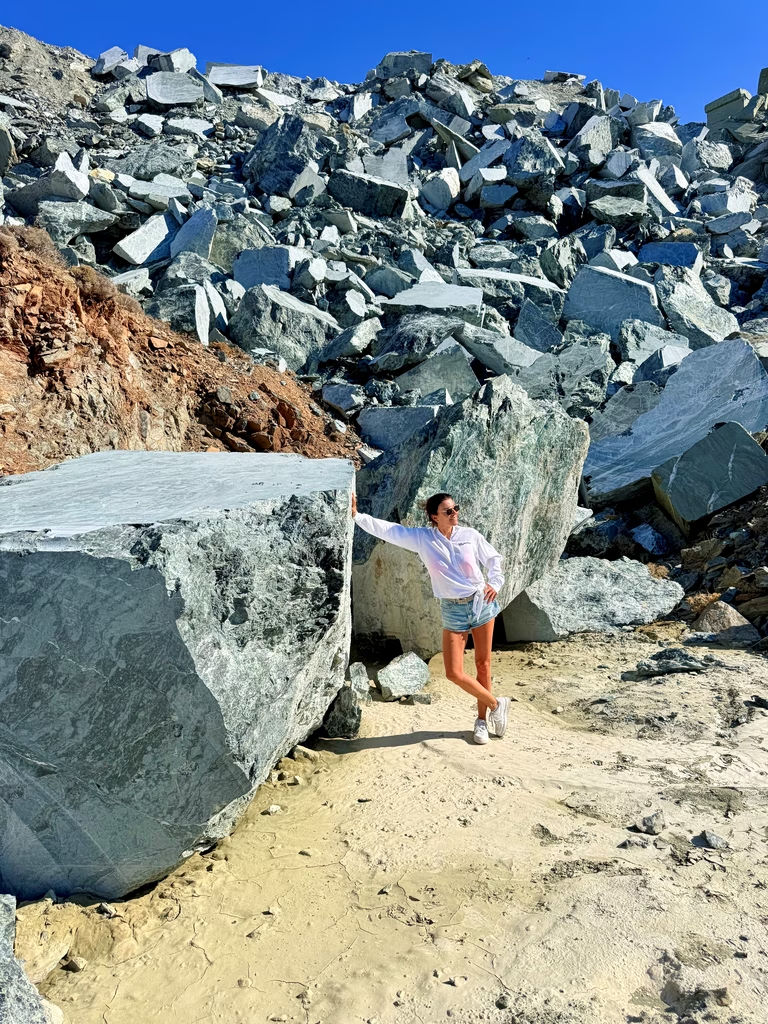
The imposing boulders at the marble quarry in Pyrgos. Photo Credits: Marina Vernicos
Volax, however, is not only about its otherworldly rocks. It is also a small, beautiful village with narrow streets and a long tradition of basket weaving. It is worth exploring without rushing, taking in the details and allowing the landscape to draw you in.
For a photographer, it is a true paradise. The changing light constantly transforms the textures and shadows across the rocks. In the morning, it is one landscape; in the afternoon, another.
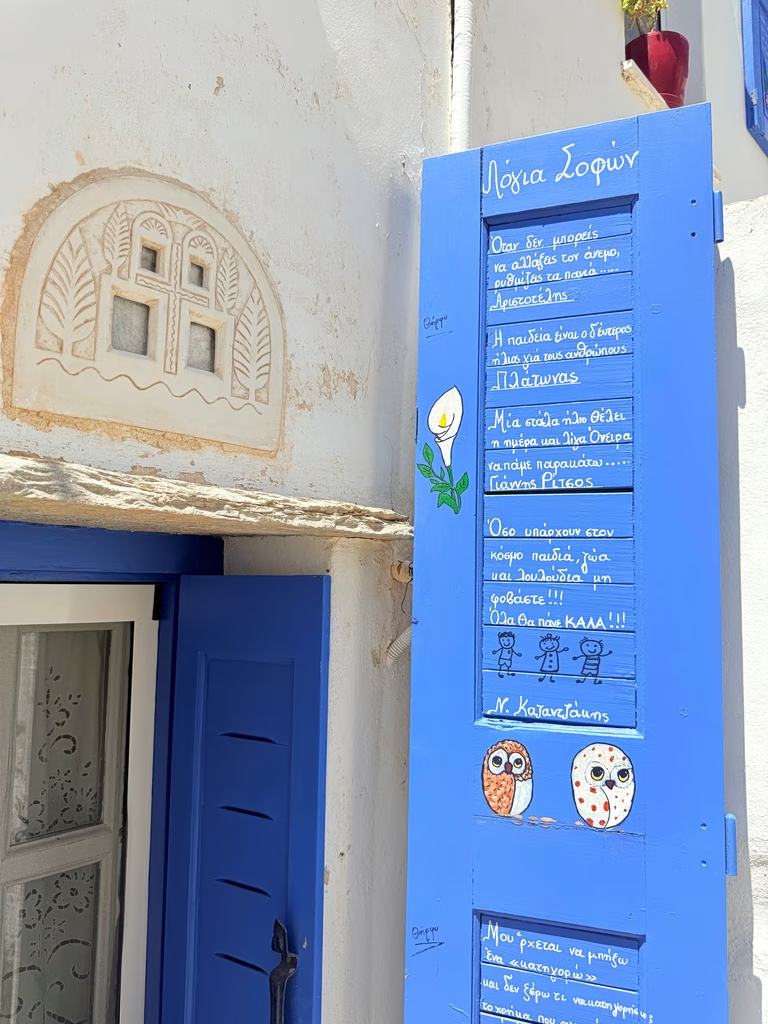
Philosophy, literature and marble craftsmanship meet in the settlement of Volax. Photo Credits: Marina Vernicos
Isternia, the Balcony of the Aegean
Isternia is one of those villages that makes me stop and look every time. Built amphitheatrically on the hillside, it offers one of those views that are difficult to capture in a photograph. The Aegean stretches out before you and, when visibility is clear, the Cyclades appear on the horizon like small shadows against the blue.
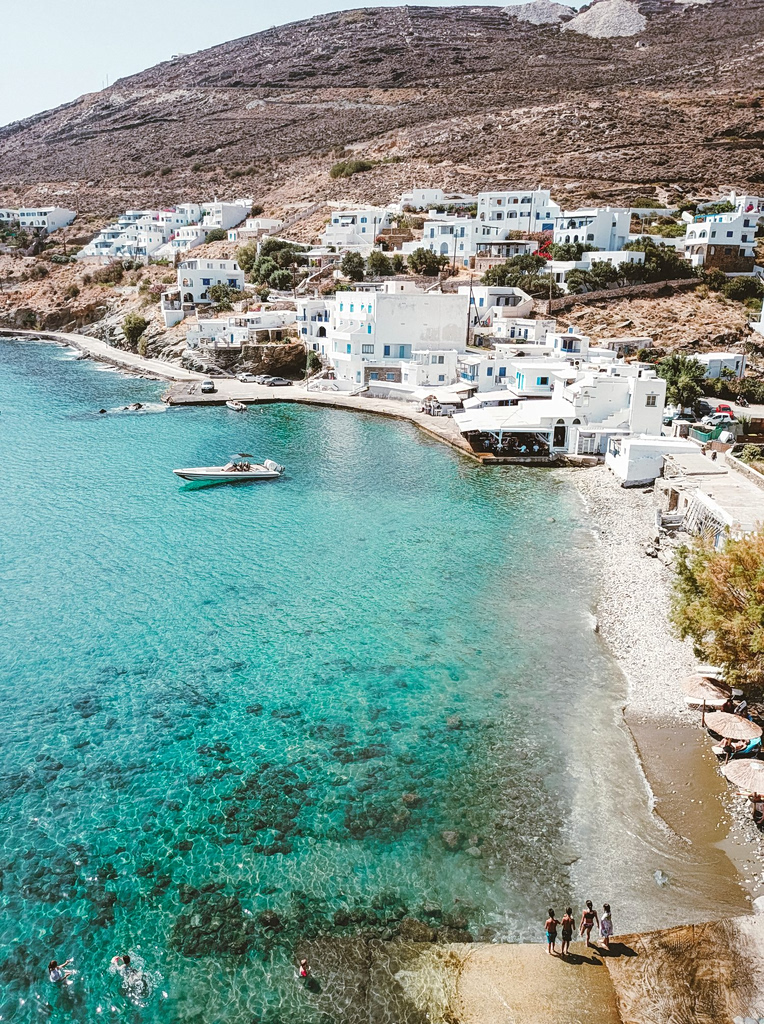
The essence of summer at Isternia Bay. Photo Credits: Marina Vernicos
Here, too, marble takes center stage. The village has a long tradition of marble craftsmanship, and it is visible everywhere: in the churches, the details of the homes, the courtyards and the old architectural features.
As you descend toward Isternia Bay, the scene becomes more summery. Sea, tavernas and that simplicity we increasingly seek out on Greek islands.
Kardiani, Between Green and Blue
Kardiani has a different feel. Built on the hillside, it seems to gaze permanently toward the Aegean. Greener than many other parts of the island, with flowing water, arches, steps and narrow passages, it is a village that must be discovered on foot.
Here, Orthodox and Catholic traditions coexist, one of Tinos’ distinctive characteristics. The presence of the two Christian communities has left a strong mark on the island’s history and architecture.
In Kardiani, you do not need to do anything specific. The best thing is to lose yourself in its narrow streets and, every now and then, see the sea suddenly appear between the houses.
The Villages Worth Seeking Out
Tripotamos, Dio Choria, Tarampados, Kalloni, Komi, Kampos, Falatados, Steni, Arnados and so many other villages create a network of small worlds.
In Tarampados, you will find some of the island’s most impressive pigeon houses. They are not simply agricultural structures. They are genuine examples of folk architecture, with geometric designs that transform their facades through elaborate patterns.
Pigeon houses are one of Tinos’ most distinctive symbols. Hundreds are scattered across the island, many built in the 18th and 19th centuries. Seen from a distance among the terraces, they look like small white jewels set into the landscape.
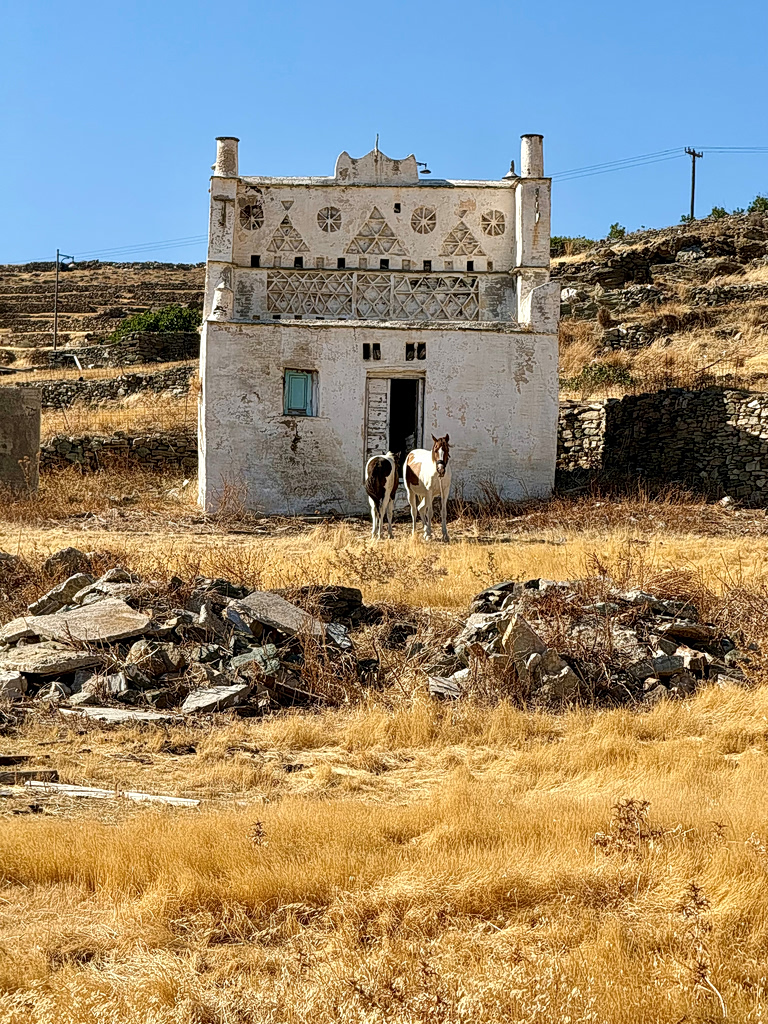
One of the hundreds of pigeon houses, examples of folk architecture. Photo Credits: Marina Vernicos
And then there are the little chapels. Countless small churches, some white and others built of stone, perched on peaks, hillsides and secluded corners. Sometimes there is nothing around them. Only the wind and the Aegean.
Marble as a Way of Life
You cannot talk about Tinos without mentioning the island’s relationship with marble. In its northern part, particularly around Pyrgos and Isternia, the quarries are part of the area’s history and identity. The distinctive Tinian marble, white but also featuring striking shades of green, has traveled far beyond the island’s borders.
Seeing the quarries up close, you understand another, wilder side of Tinos. The enormous cuts in the mountains, pieces of marble and different shades of stone create an almost cinematic setting. Here, you understand that Tinos’ artistic tradition did not emerge by chance. For centuries, its people had one of nature’s most beautiful materials in their hands and learned to transform it.
The Beauty of Imperfection
What I love most about Tinos is that it is not “perfect.” The wind can be strong. The roads are winding. In many places, the landscape is wild and bare. It does not look the same around every corner and it does not try to make itself easy for visitors. Perhaps that is exactly why it remains so authentic.
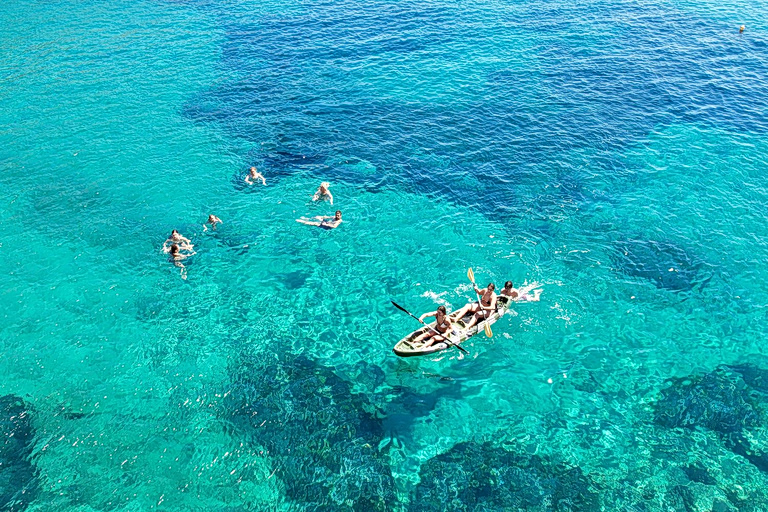
Photo Credits: Marina Vernicos
There are moments when you are driving and see nothing around you but stone, dry-stone walls and sky. And suddenly, around a bend, an all-white village appears. A few minutes later, you see a church on top of a hill. And a little farther down, a beach opens up before you. Tinos is constantly changing its face.
An Island for Every Season
Perhaps that is also why Tinos is not limited to summer. In spring, when the landscape turns green and the island fills with wildflowers, it is ideal for walking along the old paths connecting the villages. In the fall, it takes on a different sense of calm. And in winter, when the winds grow stronger and most tourist elements disappear, perhaps its most authentic version is revealed.
Because Tinos is not only about beaches. It is architecture, sculpture, religious tradition, gastronomy, geology, history and nature. It is its people. It is the craftspeople who continue to carve marble. It is the older people who sit in village squares and the younger ones who return to create something new without changing the old.
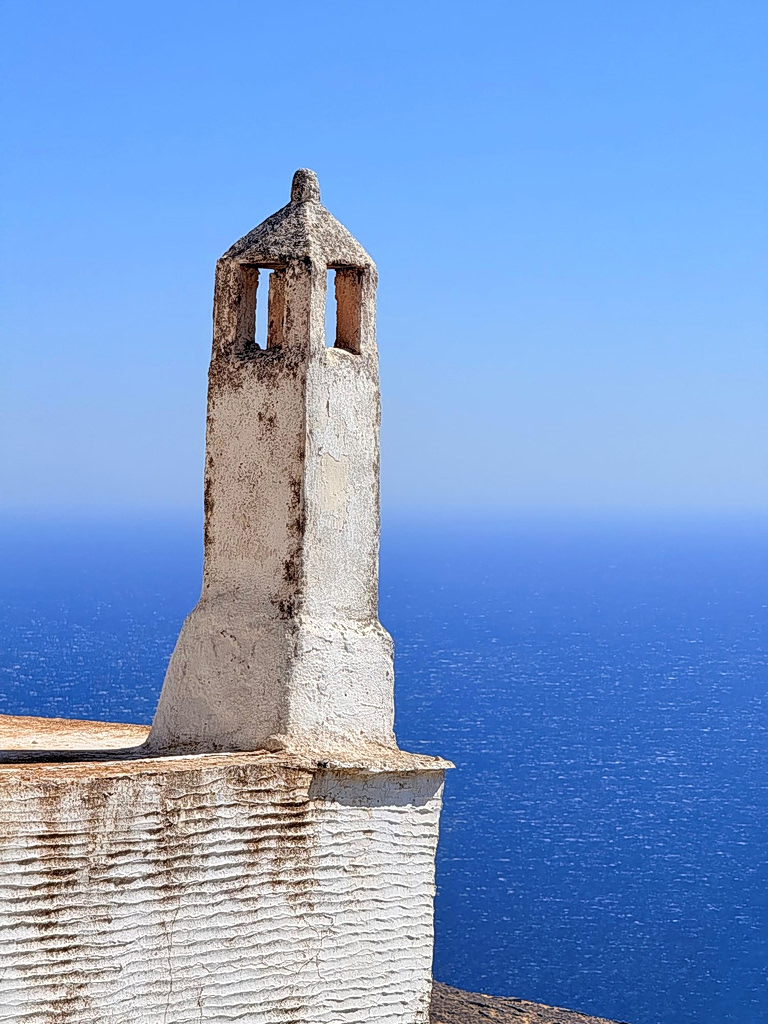
A chimney in the mountain settlement of Isternia. Photo Credits: Marina Vernicos
And above all, it is the light. That unmistakable Cycladic light that falls on white and marble, passes through the arches and, just before sunset, makes everything seem more vivid.
The Tinos You Carry With You
When I leave Tinos, I never remember just one image. I remember the view of the Aegean from Isternia. The enormous rocks at Volax. The marble of Pyrgos. The arches of Kardiani. The pigeon houses among the dry-stone walls. A little chapel in the middle of nowhere. The wind. And perhaps that is ultimately its greatest charm: it does not offer you a single image to take home. It offers you dozens.
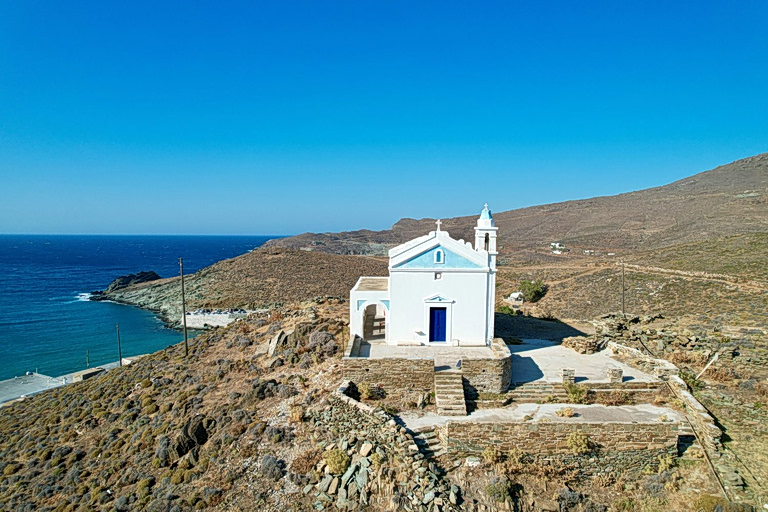
More than 1,000 churches and chapels can be found across the island. Photo Credits: Marina Vernicos
It is an island that requires time. You cannot truly get to know it in a weekend, and certainly not by staying only in Chora. You have to get in the car, follow the roads into the mountains, walk through the villages, stop in the squares, look at the details of the houses and let the wind mess up your hair. Because Tinos is not simply an island you see. It is an island you discover. And every time you return, it reveals something you had not noticed before.