 Μake us preferred on Google
A poll conducted by Metron Analysis for Mega Channel puts ND at 24.9% in voting intention and 30% in its extrapolation of the result. A separate poll by Pulse, presented on SKAI television, places ND at 30% in voting intention after allocating undecided voters. The figures reflect different polling methods and should not be treated as directly equivalent.
Both polls point to a competitive race for second place between the newly created Greek Left Alliance (ELAS), led by former prime minister Alexis Tsipras, and main opposition socialist-social democrat PASOK, with several smaller parties shown as entering Parliament.
The Pulse poll also identifies the economy and the cost of living as the main factors shaping voters’ choices, suggesting that household finances will be central to the campaign ahead of the next national election.
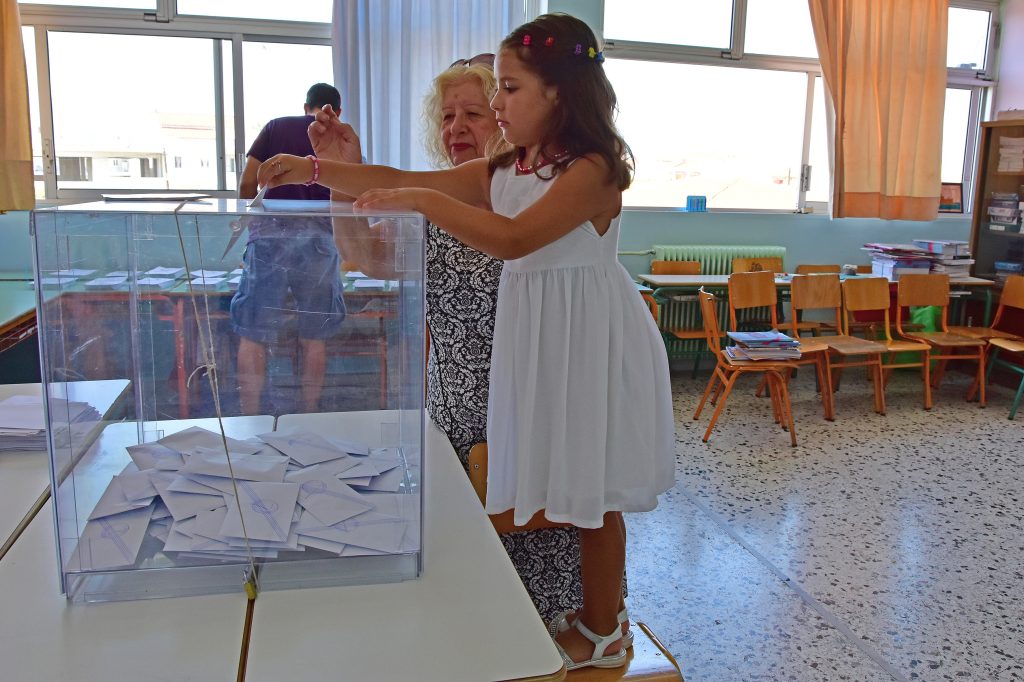
The five year-old Zoi stands on a chair to cast her grandmother’s Anna ballot at a polling station in the town of Nafplion, about 136 kilometers (85 miles) southwest of Athens , Sunday, Sept. 20, 2015. Greeks were voting Sunday in their third national poll this year, called on to choose who they trust to steer the country into its new international bailout. (AP Photo/Vangelis Bougiotis)
Metron Analysis: ND leads with 30% in estimated vote
In the Metron Analysis poll, conducted for Mega, ND recorded 24.9% in voting intention, down from 25.1% in September. Its estimated vote share stood at 30%, a decline of 0.2 percentage points from the previous month.
The Greek Left Alliance came second in voting intention at 12.4%, down 0.7 percentage points, while PASOK rose 0.3 points to 10.8%, keeping the contest for second place close.
The remaining parties recorded the following voting-intention shares:
Greek Solution: 5.2%, down 0.7 percentage points
Communist Party (KKE): 4.8%, down 0.2 points
Course of Freedom: 4.7%, down 0.2 points
Voice of Reason: 4.4%, unchanged
Hope for Democracy: 3.3%, down 0.3 points
Another newcomer, the Alliance of Greeks, a nationalist party reportedly supported by convicted Golden Dawn cadre Ilias Kasidiaris, remained just below the 3% threshold for parliamentary representation in voting intention.
Undecided and otherwise unallocated votes accounted for 11.6%, including 8.2% undecided voters and 2.2% who declined to answer, according to the poll. Abstention stood at 3.7%, while blank or invalid ballots accounted for 2.7%.
The estimated-vote figures presented a somewhat different picture, with 10 parties projected to clear the 3% threshold. ND led with 30%, followed by ELAS at 15% and PASOK at 13%. Greek Solution stood at 6.2%, the KKE at 5.8%, Course of Freedom at 5.7%, Voice of Reason at 5.3%, Hope for Democracy at 4%, the Alliance of Greeks at 3.5% and MeRA25 at 3%.
The poll also revealed differences in voter retention based on the 2023 parliamentary election. PASOK had the highest reported retention rate, approaching 80%, compared with 68% for ND. SYRIZA retained just 9.3% of its previous voters, with a reported 60.8% moving to ELAS.
Pulse: ND at 30%; voters favor single-party government
The separate Pulse poll, presented on SKAI, also put ND at 30% in voting intention after allocating undecided voters. ELAS followed at 16.5%, a gap of 13.5 percentage points, while PASOK ranked third.
Pulse projected that at least nine parties would enter Parliament, with a 10th close to the threshold. The Alliance of Greeks was also projected to win parliamentary representation in this survey, according to the report.
On the question of government formation, 43% of respondents favored a single-party government, compared with 36% who preferred a coalition. Another 13% said they saw no difference between the two options, while 8% declined to answer. The findings suggest that support for a single-party administration remains stronger, although a substantial share of voters favors cooperation between parties.
The Pulse poll also asked respondents whom they considered the most suitable candidate for prime minister. Incumbent Kyriakos Mitsotakis led with 29%, followed by Alexis Tsipras at 16%. The option of “none” ranked third at 11%, while PASOK leader Nikos Androulakis received 8%.
The economy and the cost of living emerged as the principal factors influencing voting decisions, regardless of how respondents had voted in previous elections. The findings suggest that voters will focus on the parties’ economic programs and their ability to provide greater security for households in the present and future.