In the history of humanity, very few moments can truly be called “turning points.”
Yet the dawn of October 1st, 331 BC, on the plains of Gaugamela, was not merely the beginning of a battle, it was the death certificate of an entire empire and the birth of a new world.
There, the Macedonian commander Alexander III, at just 25 years of age, achieved what had seemed unthinkable for centuries: the definitive destruction of the Achaemenid Persian Empire.
The Sole Master of Asia
The Persian Empire was no ordinary state. It was the greatest superpower antiquity had ever known, stretching from Thrace to India. Many had tried to shake it, but only one managed to conquer it completely.
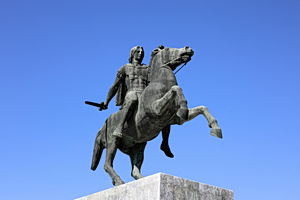
Alexander the Great Statue in Thessaloniki, Greece
While the Granicus opened the gates of Asia Minor and Issus delivered control of the Mediterranean, Gaugamela was the showdown that decided the crown of Asia.
Alexander was not seeking a simple victory — he sought total dominance. Refusing Darius III’s tempting peace offers after Issus, which offered him half the empire’s territory, the Macedonian king proved that his vision had no borders. For him, the world had no room for two suns.
Strategic Genius Against Overwhelming Numbers
At Gaugamela, Alexander’s military brilliance shone more brightly than ever before.
Darius had carefully chosen the battlefield: a vast plain, artificially levelled to give full advantage to his fearsome scythed chariots and the enormous bulk of his army, numbering hundreds of thousands of men.
Alexander, with significantly fewer forces (approximately 47,000 men), had to find a way to break through an endless human line.
His genius showed on three levels:
The oblique phalanx: Rather than attacking head-on, Alexander arrayed his army at an angle, forcing the Persians to shift in order to outflank him. This manoeuvre created a gap in the Persian line.
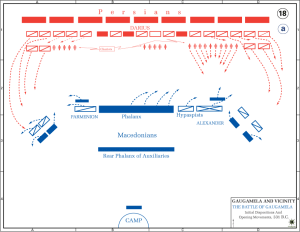
Map of the Battle of Gaugamela. US Military Academy / Public Domain
Composure and patience: Despite the pressure on his flanks, Alexander waited for the right moment. When he saw the breach open in the Persian centre, he did not hesitate. He formed a wedge with the Companion Cavalry and the Foot Companion Phalanx and charged directly toward Darius.
Psychological warfare: The objective was not to kill every Persian soldier, but to cause panic in the leadership. The sight of Alexander charging unstoppably toward him forced Darius to flee. The king’s flight triggered the collapse of the morale of an entire army.
The Legacy of a Victory
The Battle of Gaugamela was not merely a military triumph, it was the key that unlocked the legendary cities of the East. Babylon, Susa, and Persepolis fell into his hands. Alexander was no longer a Greek invader, but the rightful heir to the Achaemenid throne.
The significance of the battle reverberates throughout world history: it marked the beginning of the Hellenistic Age.
Greek civilisation, language, and thought were carried deep into Asia, creating a cultural blend that influenced humanity for centuries.
Alexander at Gaugamela proved that History is not written by the many, but by those who have the boldness to imagine the impossible and the genius to make it reality.
It was the moment “the Great” truly earned his title, leaving behind an empire that no one before or after him managed to tame in such a manner.