 Μake us preferred on Google
 Professor Diederik Vandewalle spoke exclusively to the International Edition of TO VIMA about the current state of affairs in Libya. Widely regarded as one of the foremost experts on the country, Professor Vandewalle is among a select few scholars to have visited Libya regularly over the past forty years. His deep and nuanced understanding of the region is perhaps best reflected in his acclaimed History of Modern Libya, first published in 2006.
You have followed Libya’s political evolution closely for decades. How would you describe the current state of Libya’s situation and what prospects, if any, do you see for national reconciliation?
I would say that the situation in Libya currently is as unstable as it has been ever since the overthrow of the Gaddafi government in 2011. And what we have seen in Libya is, of course, a country splitting up into two competing governments, one based in the west and one based in the east. And as a matter of fact, what we have really witnessed is the use of oil money that accrues to Libya to keep a number of groups in place, so to speak, keep them paid. What is really interesting in Libya is that every single group, whether or not they’re in favor of the government or against the government, profits from the oil money that flows into the country. And that has maintained this kind of instability and, frankly, the unwillingness to come to any kind of compromise and to think seriously about a national reconciliation. I would argue that particularly the emergence of Khalifa Haftar, the strongman in the eastern part of the country, has probably exacerbated the situation even more, even though I think there is also very little agreement in the west on what a national government truly should look like. So to answer the second part of your question, what is the prospect of the reconciliation in Libya, I would argue that at least for the foreseeable future, and we should remember that we are now 14 years after the removal of Gaddafi, that even at this point, the chances for reconciliation are very dim for the country.
You have been field director of the Carter Centre’s mission in Libya, what are the most pressing challenges you have seen and you have faced on the ground this period?
I think obviously the most pressing issue is this whole issue of reconciliation and whether or not Libya can find a solution whereby the two sides agree and create a kind of unitary government, which I think is highly problematic. But then of course the one issue that has caught global attention, international attention, and particularly the attention of the European Union of course, has been this incredible problem with migration that finds its origin in Libya. And the reason it finds its origin in Libya is of course because there really is no stable government that can provide any kind of direction for a migrant policy. And so these migrants come to Libya because for all practical purposes there’s a vacuum of power so to speak and they use Libya as a springboard to go toward Europe. And that of course has major implications not just for Libya and again both sides, both the West and Eastern Libya are profiting in some ways from that migration. But of course the bigger problem has really been for Europe.
And what has added to all of this, and again it’s a major issue, is that there are a number of international actors, particularly Russia on the Eastern side, on the Khalifa Haftar side, that have supported some of these groups, whether it’s the West or the East. And so because of that, the willingness to compromise is even less than if this would be purely a Libyan solution. So these are kind of two or the three major issues that I see are still continuing to haunt Libya today.
How would you characterize the role of international actors in Libya’s stalled political process? Have their interventions helped or hindered efforts at building a unified government?
It’s a really interesting question because of course the original intent of the intervention in 2011 was that international intervention would eventually stabilize the country. And what we’ve seen very quickly, you know, reflecting what Barack Obama said about the intervention of the United States in Libya, that it was the biggest mistake of his administration, what we’ve seen is that the international actors have become the major destabilizing force in Libya. And so you have the Russians having stepped in, you have the United Arab Emirates having stepped in, you have Turkey and so on. So all of these have supported different factions and again have lowered the willingness of the local actors to really come to any kind of compromise among themselves. So again, in terms of one of the challenges that you asked me about is there will need to be an international reconciliation, so to speak, an international agreement that will involve all of these different partners, the European Union as well as the United States, Russia certainly as well, and these actors will need to find a solution for Libya. So the big problem for Libya in a sense is that we can no longer think of a solution for Libya as a purely Libyan solution. It is really an international problem that needs to be solved, of which Libya is only the country that is at the heart of all of this.
Turkey has emerged as a major power broker in Libya since the 2019 Memorandum of Understanding. How do you think Ankara managed to gain such influence and consolidate power in the Libyan theatre?
My impression is that, thinking back to when I was in Libya, even before the Gaddafi government fell, was that the Turkish government had a large number of economic interests in Libya and very deliberately cultivated a somewhat cozy relationship, even with the Gaddafi regime at the time, and then extended that to the current administration in Tripoli, the Baba administration at this time. So it started off as a purely economic relationship. It’s very transactional in many ways, I think. But of course, then it became overlaid with a number of other issues, cultural issues, issues having to deal with Islam and so on. So a number of overlapping interests that Turkey shares with the government in Libya that have consolidated the position of the Turkish government through its business community and part in Libya.
Do you believe that Libya’s alignment with Turkey on maritime matters reflects genuine national interest, or is it more a product of Turkey’s leverage over the Tripoli government?
I think this is purely, again, a transactional issue between Turkey and Libya. I don’t sense anything really much beyond that. Turkey has made clear what its intentions are. Libya has made clear what its intentions and what its interests are. But I don’t think there is any kind of framework there for larger cooperation that would go beyond providing Turkey access to what it wants in Libya at this point.
What is your assessment of the recent Libyan note verbal to the United Nations asserting maritime claims up to Crete? How do you interpret its legal and geopolitical implications?
It’s a very interesting development. It’s very surprising because in a sense, first of all, Libya doesn’t really have the ability to even extend its military power to protect what it sees as an economic zone. So my hunch is that this is also part and parcel of this cooperation with the Turkish government, but that it really doesn’t go much further beyond that. And certainly, Libya cannot hope that the international community would even come to recognize the aspirations that the Libyans have in that regard.
Given the increasingly assertive Turkish and Russian presence in Libya, what risks do you see for further regional destabilization, particularly in the Eastern Mediterranean?
It is an issue in part because if indeed Russia were to have a larger and more persistent presence in Libya, including, of course, perhaps the establishment of a kind of a semi-naval base or whatever on Libyan territory, that of course would very dramatically draw in the United States and of course also the Europeans who would be very worried by that kind of development. I think the Russians are perfectly aware of that as well and why we’ve seen a kind of a careful calibration in the Russian attitude toward Libya. Yes, support for the Haftar government, but on the other hand, not an unconditional support for what the Haftar government wants to do. So my evaluation at this point is that both sides, that means both the West and Russia, are really carefully watching what is happening here and would be very careful in crossing a threshold that would bring in the other side to a larger extent than it is right now.
Greece, Italy and Malta have raised concerns about surging migration flows and the EU’s perceived loss of influence in Libya. Are we witnessing the onset of a new refugee crisis in the region?
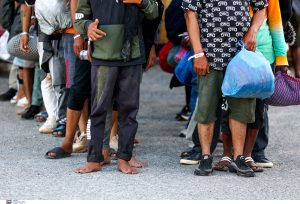
I don’t think we’re witnessing a new migrant crisis, we’re witnessing an ongoing migrant crisis. If you think of just this year, 2025, roughly 25,000 migrants have left Libya, of which roughly half, about 12,000, have been turned back. Roughly 200 people or perhaps more have already died in 2025. What is happening, of course, is a very interesting development. If you think of the migrant patterns since 2011, initially a lot of the migrants came out, left from the western part of Libya. As the western government, the internationally recognized government, was able to reach a number of agreements with the Europeans, and remember that the Europeans at this point have literally spent hundreds of millions of euros to keep the migrants away from Europe on the Libyan side, in conditions that are quite inhuman in many cases. That has worked to some extent, but what has happened lately over the last few years, I would say the last five, six years or so, is that those migrant patterns have shifted toward the east, toward the territory controlled by Khalifa Haftar. Hence, of course, why Crete and Italy and so on have seen a lot more migrants than they traditionally have. That is why countries like Crete, the island of Crete and so on, are upset at the Europeans, because in a sense what they are arguing is that the policies of the Europeans have really shifted the migrant problem from western Libya into eastern Libya, and that, of course, to their disadvantage. My hunch is there’s not a new crisis, there is already an existing crisis, and that crisis will persist as long as the major underlying issue, and that is the lack of the vacuum of power that exists in eastern Libya, as well as in western Libya, is not really addressed by either the government in Tripoli, or by the warlord Haftar in the eastern part of the country. Again, as I mentioned earlier, I don’t see that really happening very soon.
What would be your advice to Greek diplomats, and what happened last week with the European delegation was it like a surprise to you?
The reason they had to leave was because they went from Tripoli and wanted to get into Benghazi, and that was the real problem, because what Haftar was doing was playing a high-stakes diplomatic, or what he thought was a high-stakes diplomatic game, and that is, he said that if the Europeans wanted to talk to him about migrant issues, that they would have to deal with him and what he calls his government. Now, the government of Haftar, what he calls his government, is not internationally recognized. So, the Europeans and the European delegation that went could not sit down with Haftar and his so-called government, because implicitly, that would be recognizing, or at least in the estimation of Haftar, would be recognizing Haftar’s government as legitimate internationally, which is not true at all, because the international community only recognizes the Tripoli government. So, what happened was that when the delegation travelled on the way to Benghazi, when it became clear that they would not sit down with Haftar and his so-called government, then Haftar immediately said, in that case, you are now persona non grata. He said you have entered Libya illegally, and you have shown disregard for Libyan sovereignty, all of which, of course, is the figment of his imagination, because he is not in charge of Libyan sovereignty. He cannot say who is legitimate in Libya or not. Again, this was a diplomatic game that Haftar tried to do, but it indicates a very important issue, below that, and that is that this migration issue is a very powerful issue that Haftar can use vis-a-vis Europe. In this case, it backfired, but I’m sure we’ll see new delegations going in, and sooner or later, this issue will have to be and Haftar will either have to compromise or this whole migrant issue may fall apart.
What would you say to the Greek diplomats right now?
I would say keep negotiating. Frankly, I think there will need to be some pressure put on Haftar, perhaps through Russia, to make sure that this kind of diplomatic stunt that he attempted is not repeated, and so that would be my advice. Try to involve other actors who can persuade Haftar to actually negotiate and not play these silly diplomatic games with the European Union.
What tools or strategies should the European Union adopt if it is to play a more constructive and stabilizing role in Libya and the wider central Mediterranean? And do you think that the EU’s approach to Libya has been too narrowly focused on migration control at the expense of supporting long-term governance and security reform?
No, I don’t, actually. I think the Europeans, both by themselves and through the United Nations and so on, have been involved from the beginning, that is, since 2011, with issues of governance and so on. But these issues have frankly not gone very far at all. Many of them, including border patrols and so on that the Europeans have suggested and we’re helping the Libyans with, have kind of collapsed over time. And so the migrant issue, by default, has become the only one that has kind of remained very relevant. The Europeans, as I mentioned, have thrown an enormous amount of money at it. But I think your question is very appropriate, because the underlying issue, once again, is that the migrant issue can only be solved if Libya really has a legitimate government that enjoys power over the sovereignty of the entire territory of Libya. And so the Europeans, in a sense, have tried, I think at this point, just about anything they can. The migration issue by default is the only one that really remains intractable at this point.
How likely is it that Libya’s rival factions will reach a sustainable power sharing agreement without foreign interference?
I think highly unlikely, if not impossible. I think there will need to be substantial and consistent pressure by outside actors, particularly by Russia on the Haftar government, to reach a compromise with the Western government, the Beba government in Tripoli. For reasons that you’ve also pointed out, the fact that Russia is interested in expanding its presence in the region, we should not expect a real solution to the Libyan issues very soon into the future.
So from what you’re saying, I can understand that you may expect a wider escalation of the current situation and probably no solution in the near future, and probably only by interference, Libya can find a realistic road map for a democratic transition…
I think what we’re likely to see is what I would almost describe as a low-level conflict between the two sides. In terms of that translating into any move toward what you just called democracy, that I think is very, very far off. Remember, Libya has tried national elections twice. The results of that really didn’t lead anywhere. And to expect that Libya, and particularly because of the makeup of Libya, with its tribal backgrounds and the infighting between the cities and the two sides, East versus West, to think that we will come up, or that the international community will come up with a constitution that creates a kind of a Westminster-type democracy in Libya is, at least in my mind, pure lunacy.
Who do you think right now is, in terms of the international actors, who do you think is the most influential one? Is it Russia or Turkey?
I think both of them actually are quite powerful. I would kind of rank their influence equal. It would certainly rank them far above what Europe and the Western United States, in particular, can really contribute to helping to solve the crisis in Libya.
As someone who has studied Libya for a very long time, you have to understand the dysfunction and the lack of legitimacy and the lack of thinking about creating a modern state in Libya, coming out of a long tradition that goes back literally hundreds of years in Libya, and to think that we can, and the hope that the United Nations at one point, the hope that the United States had when they intervened in 2011 and so on, that we could create this kind of modern democratic country on the shores of North Africa by advocating for elections and by intervening is again a chimaera, in my mind, a pipe dream. What is really needed in Libya is a very long process at this point, after already 14 years of a status quo more or less, but a very long process of pressure by a number of international actors to really have Libya move forward and overcome the internal divisions that exist.