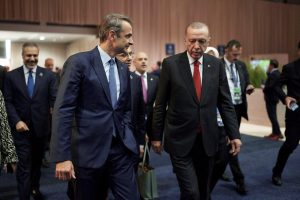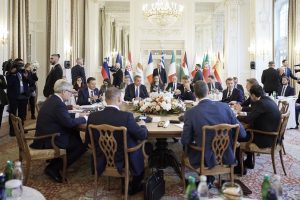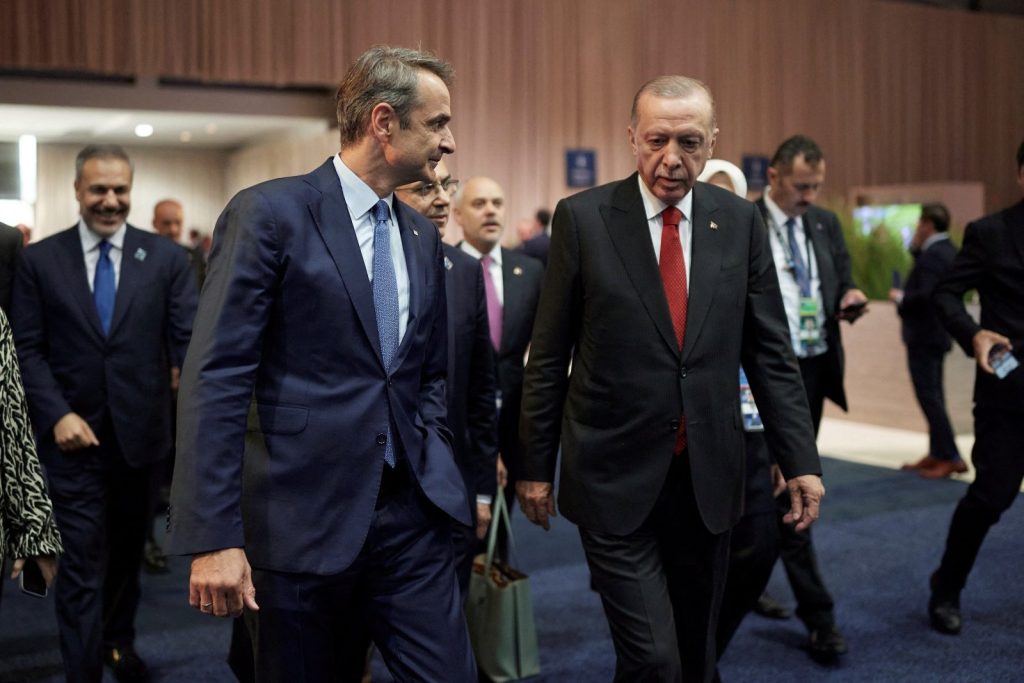

Until a few weeks ago, no one at the Maximos Mansion or the Ministry of Foreign Affairs believed that a meeting between Kyriakos Mitsotakis and Recep Tayyip Erdoğan would serve Athens’ interests. The session of the Supreme Cooperation Council – postponed month after month for at least a year – seemed like a forgotten matter. After all, as widely acknowledged, the Greek-Turkish dialogue has weakened, and a key element has disappeared: a substantive agenda of topics for discussion.
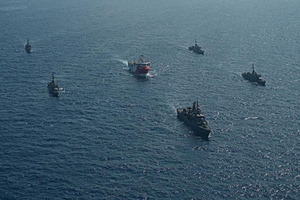
Simultaneously, the public acknowledgment by Foreign Ministers Giorgos Gerapetritis and Hakan Fidan (November 2024) that no common understanding could be identified regarding the resolution of the major dispute – namely the delimitation of maritime zones – led to the sidelining of political consultations as an alternative to exploratory contacts. The diplomatically improper cancellation, by the Turkish side, of the one-on-one summit in New York last September, combined with Athens’ initiative to map the farthest potential limits of the Greek Exclusive Economic Zone (EEZ) and, primarily, with Chevron’s participation in the blocks south of Crete, brought the Aegean gap between the two sides back into focus.
But what suddenly changed that led Kyriakos Mitsotakis to describe, during his discussion with Yiannis Pretenteris (at Vima’s conference), the conditions as “mature” for the Supreme Cooperation Council (SCC) to take place in the first quarter of 2026?
“Normality” and Concern over External Intervention
“This is the logic of normalcy between two neighboring states despite differences; there shouldn’t need to be any exceptional reason for talks to take place, even at the highest level,” diplomatic sources told Vima, rejecting the notion that the atmosphere in Greek-Turkish relations has changed, but clarifying that even if the SCC convenes, nothing “spectacular” is expected. “It is possible that some ‘low-politics’ agreements could be advanced. The main thing, however, is to convey the message that structured dialogue continues,” they added.
The Prime Minister, of course, highlighted as a primary goal the maintenance of open communication channels without concessions so that, in case something “unexpected” occurs, “some people must be able to pick up a phone, communicate, and defuse any crisis that may arise.” Yet, beneath Mitsotakis’ words lies Athens’ concern over two possibilities: first, a return to the era of uncontrolled tensions; second, the potential for external intervention – presumably by the United States – to resolve differences, bilateral or multilateral, in the Eastern Mediterranean, not based on International Law but on the logic of the strong, which Donald Trump seeks to impose globally.
“The truth is that most in the government would not want to confront an American initiative,” a parliamentarian with long experience in Greek-Turkish relations told Vima, adding that “such a thing is not going to happen tomorrow morning.” Clearly, the situation in the region is extremely complex, the differences have centuries-old historical roots, so approaches dominating public discourse lately (see Tom Barrack, U.S. ambassador to Ankara) appear overly simplistic. Athens’ position on third-party involvement has been repeatedly expressed and is summarized in the statement that “Greece and Turkey address their issues bilaterally.” As a veteran diplomat reminds, “the Turks also prefer direct dialogue.” It is well known that Ankara has never welcomed the internationalization of Greek-Turkish disputes.
Maintaining the Balance
If Athens is indeed concerned about third-party intervention, then the attempted revival of dialogue with Ankara, as well as the initiative to create the 5×5 framework in the Eastern Mediterranean – which remains dormant – function positively in signaling a generally dialectical message. According to reliable sources, the Maximos Mansion believes that, since a wide cycle of initiatives and pending issues has now been closed relatively smoothly, talks with Turkey can be revived.
The Maritime Spatial Planning and the delimitation of the park in the Southern Cyclades were initially completed, Ankara appears to remain outside the SAFE program, American interest in transforming Greece into an energy hub was framed by two agreements, the Greek median line south of Crete was adopted by Chevron, the cable project is “frozen” until new investors are found, and developments on Cyprus depend on the balance of relations between Ankara and the new Turkish Cypriot leader, with Turkish intransigence a constant factor.
Regarding each of these issues, Turkey has expressed its longstanding revisionist positions without escalating tensions, let alone bringing them to the field. In Athens, the goal is to maintain this balance, partly because they know that amid general instability there are always chances of uncontrolled escalation, and mainly because the Greek prime minister faces a series of internal challenges and the last thing he wants is another confrontation with Ankara. After all, 2026 is, in practice, a pre-election year, with the ruling party constantly shaken by internal disputes like the OPEKEPE issue, unable to rise again in the polls even near the threshold for a majority.
Commitments on the “casus belli”
Regarding the substance of legal and diplomatic matters, nothing indicates that even minimal progress could be recorded, except for yet another acknowledgment – this time at the leaders’ level – along the lines of “we agree to disagree.” This was confirmed during Fidan’s recent speech to the Turkish National Assembly, where Ankara’s position on a “comprehensive solution of differences” in the Aegean and Eastern Mediterranean was presented. However, in a summit, references to major issues that determine the maintenance of “calm waters” are unavoidable.
Kyriakos Mitsotakis has publicly committed at least three times to raise the issue of lifting the casus belli with the Turkish president, directly connected to Ankara’s broader participation in the European defense autonomy project. Erdoğan, for his part, is certain to raise Athens’ and Nicosia’s (through veto threats) attempts “to block, under the same criteria,” the redesign of the European security architecture and, consequently, the expansion of Turkey’s geopolitical footprint. Energy issues and their implications for maritime zones will also be central in public statements. Erdoğan’s well-known stance is that “no project will proceed without our approval,” while Athens responds that “we take no permission from anyone on matters related to the exercise of our sovereign rights.”
As is clear, both the conduct of the SCC and the “choreography” of the public appearances of the two leaders require thorough and, above all, careful preparation, since the discussion can easily derail, producing the opposite of the desired outcomes. It is worth noting that Erdoğan’s invitation to Mitsotakis has remained open over the past months. Fidan hinted at this a few days ago, and the Turkish ambassador to Athens had openly stated it on the anniversary of the founding of the Turkish Republic. Thus, the ball is in the Greek court.