Europe is experiencing its largest wave of digital infrastructure investment in history, driven almost entirely by the boom in artificial intelligence (AI) and cloud computing demand. Cumulative investment in European data centers is expected to exceed 170 billion euros, with annual construction and equipment spending now running above 25 billion euros.
At the same time, Europe’s traditional hubs, known as FLAP-D (Frankfurt, London, Amsterdam, Paris, Dublin), are facing serious power grid saturation and strict zoning limits. This is pushing investors toward new geographic fronts: southern Europe (Madrid, Milan, Marseille and Athens), which offers faster permitting, grid availability and key undersea cable connections.
Another alternative is Scandinavia (Norway, Sweden and Finland), which has abundant green energy from hydro and wind power along with natural cooling potential due to the climate. A third option is eastern and southeastern Europe (Poland, Romania, Bulgaria), where the market is defined by lower land and construction costs and where these countries are seen as emerging AI hubs.
Greece is at the center of data center growth, developing into a regional digital hub for southeastern Europe, the Middle East and North Africa.
According to a Reuters report, European AI data center builders are looking at less conventional locations away from major cities, where they can take advantage of cheaper energy and land along with faster connection times.
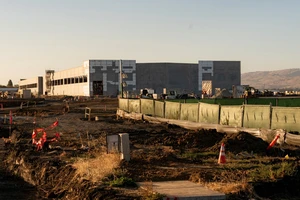
JLL, one of the world’s largest commercial real estate and property services firms, released data on planned hyperscale data centers expected to come online quickly over the next two years. These centers, which don’t need to be as close to end users, will be located more than three times farther from major cities compared with those built over the past three years.
JLL did not disclose the names of the companies developing these centers, though the world’s largest firms, including Meta, Google and Microsoft, are investing globally.
Some locations are running out
Between 2026 and 2028, the average distance of sites from a major hub will be 175 kilometers, compared with 46 kilometers for projects delivered between 2022 and 2025, as power and land in cities like London and Frankfurt grow scarce.
Projects in undeveloped areas now account for 39%, compared with just 8% of completed projects, according to JLL data. At the same time, the share of projects in city center locations is expected to fall to 5% from 13%, with the rest moving to industrial sites or suburban areas.
The shift is largely driven by AI training facilities, which require massive amounts of electricity as well as water for cooling.
“The deciding factor is increasingly where sufficient power can be secured, not simply where demand exists,” Asad Nuri, JLL’s head of data centers for Europe, the Middle East and Africa, told Reuters. “Data centers are moving to where the power is, not the other way around.”
JLL estimates that the world’s four largest cloud service providers will spend 725 billion dollars in 2026, a 77% increase from 410 billion dollars in 2025, mostly on AI infrastructure and data centers.
By 2030, AI workloads could account for roughly half of global data center capacity, the firm added.
Of the nine proposed data centers with capacity above one gigawatt across Europe, only one is planned near a major city, Paris, while the rest are scattered across areas from rural Spain to northern Sweden, according to data from DC Byte, which tracks early stage projects.
While the core markets of Frankfurt, London, Amsterdam, Paris and Dublin remain the largest and continue to see demand, they face growing land shortages, zoning restrictions and long waits for grid connections.
“Europe’s core markets will remain critical because business demand isn’t going to decline,” Martin Jensen, president of JLL’s EMEA data centers division, told Reuters. “AI infrastructure requires an entirely different scale of power and land,” he added.
According to JLL, the cost of grid connected land averages 2.36 million euros per megawatt of IT load in core markets, 978,000 euros in cities considered secondary, including Copenhagen, Warsaw and Milan, and 512,000 euros in tertiary areas such as Bordeaux, where costs can drop as low as 200,000 euros.
Amsterdam remains the most expensive market at around 2.7 million euros per megawatt, followed by London at 2.6 million euros and Frankfurt at 2.5 million euros.
Strict rules and digital sovereignty
Alongside all this, two major challenges must be considered for building new data centers: strict European regulations and EU decisions on digital sovereignty. The European Union imposes strict sustainability guidelines. New centers are required to use nearly 100% renewable energy, while mandatory heat recovery for heating nearby towns or greenhouses is expanding.
This trend could mean investment in disadvantaged regions where governments are trying to boost employment and growth, but builders also risk facing pushback from residents worried about shrinking natural resources and competition for energy and water.
At the same time, European governments and the EU are strengthening the build out of domestic infrastructure, known as AI Factories, so that citizens’ and businesses’ data is stored and processed within European territory.
Greece’s data center outlook
Greece is at the center of data center growth, developing into a regional digital hub for southeastern Europe, the Middle East and North Africa. Its geographic position, combined with the arrival of new undersea fiber optic cables, makes it a natural data entry point into Europe.
Microsoft is running its nearly 1 billion euro “GR for Growth” project to build a cluster of three large data centers in eastern Attica (Spata and Koropi). Digital Realty holds a leading position in the domestic market, continuing to expand its facilities (Athens 3 and 4 in Koropi) and investing hundreds of millions of euros, including a new data center in Heraklion, Crete. France’s Data4 has also moved forward with a data center in Attica, while Italy’s Sparkle has operated in the country for years.
Google has announced plans to develop a cloud region in Greece. Public Power Corporation (DEI) has entered the sector aggressively through a joint venture with UAE giant DAMAC, building a data center in Spata, while also planning a massive data center in western Macedonia. Lancom is expanding its Balkan Gate facility in Thessaloniki and building a new center in Heraklion, Crete, a key interconnection point, while international firms such as Apto Data Center are moving forward with investments worth hundreds of millions in Attica.
At the same time, as part of the European EuroHPC network, Greece is developing its new national supercomputer “Daedalus” at the Lavrio Technological Cultural Park, which forms the core of Greece’s Pharos AI Factory. It is infrastructure specifically designed for training large AI models.