 Μake us preferred on Google
 The fallout and ‘next-day’ analyses of the much-anticipated Trump-Erdogan meeting at the White House, which was heavily viewed via a livestream broadcast around the world, mostly revolved around what both leaders said they were going to discuss, although two hours of talks afterwards failed to yield clear agreements or even final resolution of several obstacles in US-Turkey ties.
For instance, Turkish President Recep Tayyip Erdogan and his administration have vigorously tried to overturn a US decision – based on Senate-passed legislation and thus federal law – to kick out Turkey from the F-35 program.
US President Donald Trump, on his part, called on Turkey to stop buying Russian oil, among other things.
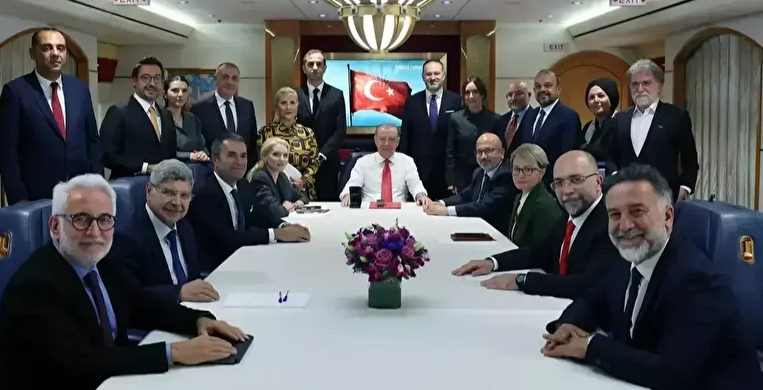
In his more-or-less now customary “regal” briefing to highly attentive reporters and editors gathered around a boardroom table on his presidential plane – as it flew back to Istanbul – the long-time Turkish leader said he and Trump “shared understanding” on how to achieve a ceasefire in Gaza and ultimately peace “all across Palestine”, as he said characteristically, without mentioning Israel in the sentence.
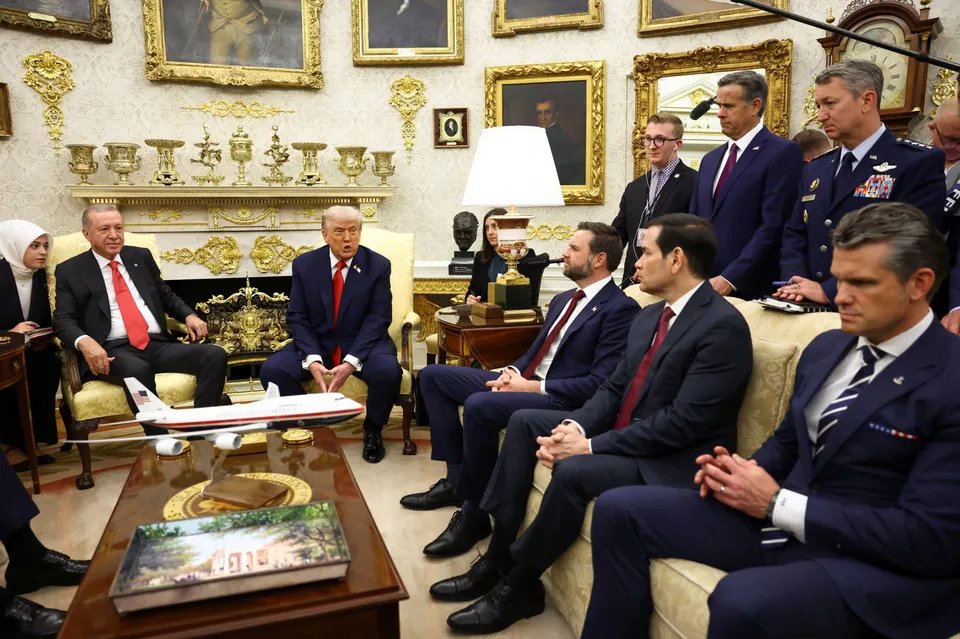
Most of his comments were immediately posted by the state-run Anadolu Agency and then widely disseminated to Turkish mass media.
“We explained how to first achieve a ceasefire in Gaza and across all of Palestine; and then move toward lasting peace. There was a shared understanding on this,” Erdogan said, seated at the head of the executive table in a 500-million-dollar Boeing 747-8 gifted to the Turkish presidency by Qatar in 2018.
The word “Boeing” was also a prominent buzzword throw out at the meeting, as Erdogan pledged that Turkish Airlines, half of whose shares is owned by the Turkish state, will pick Boeing for gigantic order of passenger planes.
A day later the national carrier announced a deal to buy up to 225 jets from the Seattle-based multinational.
The order includes 150 confirmed aircraft to be delivered between 2029 and 2034, with an option for 75 more, the company said in a statement, without giving a figure of the cost.
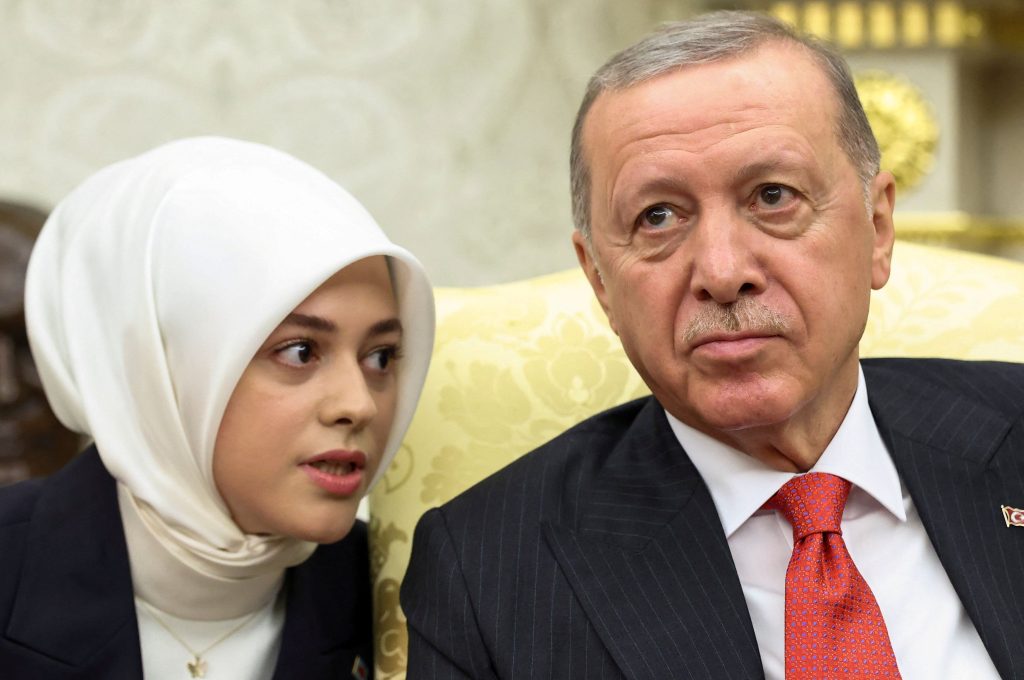
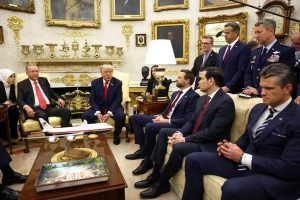
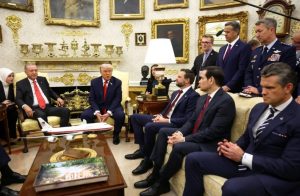
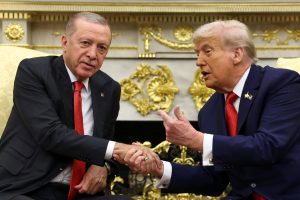
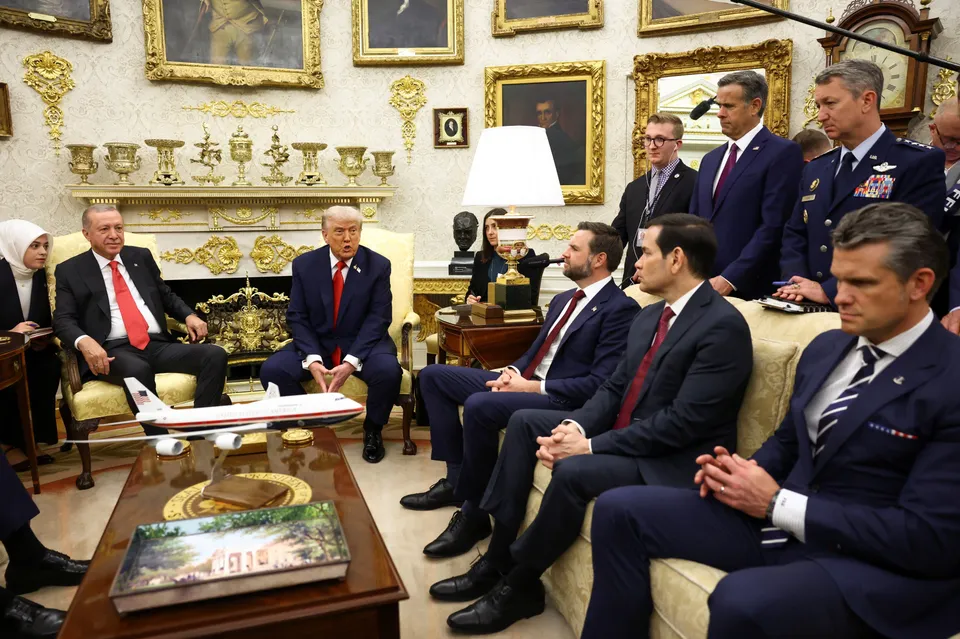
Turkey’s President Recep Tayyip Erdogan listens to an interpreter during a meeting with U.S. President Donald Trump at the White House in Washington, D.C., U.S., September 25, 2025. REUTERS/Kevin Lamarque
Other “goodies” brought to the White House to accompany Erdogan’s first appearance in the Oval Office in six years included a previous day’s elimination of Turkish tariffs on a series of US goods – imposed in 2018.
Turkish Energy and Natural Resources Minister Alparslan Bayraktar, meanwhile, signed a 20-year deal worth a whopping 43 billion dollars that reportedly committing Ankara to purchase huge volumes of LNG shipped from the United States, a prospect that means a substantive attempt to “diversify” from Russian energy, which Turkey imports on a massive scale. The same minister signed an MoU with US Secretary of State Marco Rubio over cooperation in the nuclear energy sector – another development that hints at Ankara’s volition to consider nuclear energy partners beyond Russia, which is building a nearly completed nuclear power plant in Akkuyu, in southeast Turkey near the Mediterranean coast.
In referring to Gaza, the ardently pro-Palestine Erdogan said “…We discussed the humanitarian disaster in Gaza and the situation in Syria. I support President Trump’s vision for global peace. We reached a consensus on the need to stop the bloodshed.”
On the flight back to Istanbul, Erdogan told Turkish journalists that his talks with Trump held “in a sincere, constructive, and productive atmosphere…As you know, my relationship with Mr. Trump has been very good since the past,” he added.
Additionally, he said that “progress was made on multiple fronts, particularly bilateral trade, humanitarian crises, and regional security,” without giving specifics but only a figure: bilateral trade volume to reach 100 billion euros.
Eyeing a bigger ‘slice’ of the Med
In a comment directly aimed at regional neighbors, especially but not limited to Greece, Erdogan said “…our stance on resources in the Mediterranean is clear. We will take our fair share of these resources and work together with our neighbors based on the principle of win-win.”
As such, he cited a rapprochement with Egypt, pointing to growing cooperation with Cairo in the form of recent naval exercises and regional diplomacy.
On Libya, Erdogan said: “The peace achieved between the two conflicting sides in Libya through Türkiye’s mediation has been a source of hope not only for the Libyan people but for the entire region.”
Finally, he again returned to divided Cyprus, as he had during his address to the UN general assembly earlier in the week, flatting rejecting a federation solution.
“The chapter on a federation is closed for us. No one can drag us back into federation debates with word games.”
“The Turkish Cypriots will never accept being a minority on the island. The only realistic solution is the recognition of two separate states on the island,” the Turkish president said, referring to the Turkish Cypriot pseudo-state that Ankara militarily occupies.
Turkish media
The conservative daily Yeni Safak reiterated Erdogan’s post-meeting statement that talks with Trump were held “in a sincere, constructive, and productive atmosphere.” “As you know, my relationship with Mr. Trump has been very good since the past,” he added.
Erdogan also praised the White House hospitality. “At the White House, we were received very well by Mr. Trump and his delegation, and we are leaving satisfied. It was a beautiful visit that cannot be tarnished by any slander.”
“The trade volume between Türkiye and the US and its potential are clear. We have a target of $100 billion. As leaders, we have the political will to activate this,” he said.
Pro-government Sabah cited Erdogan statement of holding “very productive programs, contacts and meetings” during his five-day visit before returning to Türkiye. “Türkiye will continue to be the voice of conscience around the world,” he wrote, adding a Turkish flag emoji alongside a video showing images from his meetings in New York.
Practically all of the Turkish media also cited Erdoğan’s promise that his goverment was “ready to do whatever is necessary” regarding the reopening of the Ecumenical Patriarchate seminary on the island of Halki, although Daily Sabah referred, mistakenly, to its location as being in Istanbul.
FM Fidan
In a “blander” reaction by Turkish Foreign Minister Hakan Fidan, as relayed by the state-run Anadolu, the more than two-hour-long meeting between Turkish President Recep Tayyip Erdogan and his US counterpart Donald Trump was “quite productive and successful,” Türkiye’s foreign minister said Thursday.
The meeting addressed the joint steps that Ankara and Washington will take in the upcoming period as two allies and friends, Hakan Fidan wrote on the Turkish social media platform NSosyal.
Stressing that the focus was on areas of regional cooperation, Fidan added: “We will continue to work to strengthen our relationship with the US based on mutual respect and in line with our respective interests.”
His remarks came after Erdogan and Trump held a bilateral Oval Office meeting followed by a working lunch earlier Thursday.
The Turkish president departed from the US following the meeting.
Trump, pointing out Erdogan: “nothing changes, you see? Nothing changes.”
Erdogan has been ruling Turkey since 2003 pic.twitter.com/cArYL2lllF
— Ragıp Soylu (@ragipsoylu) September 25, 2025