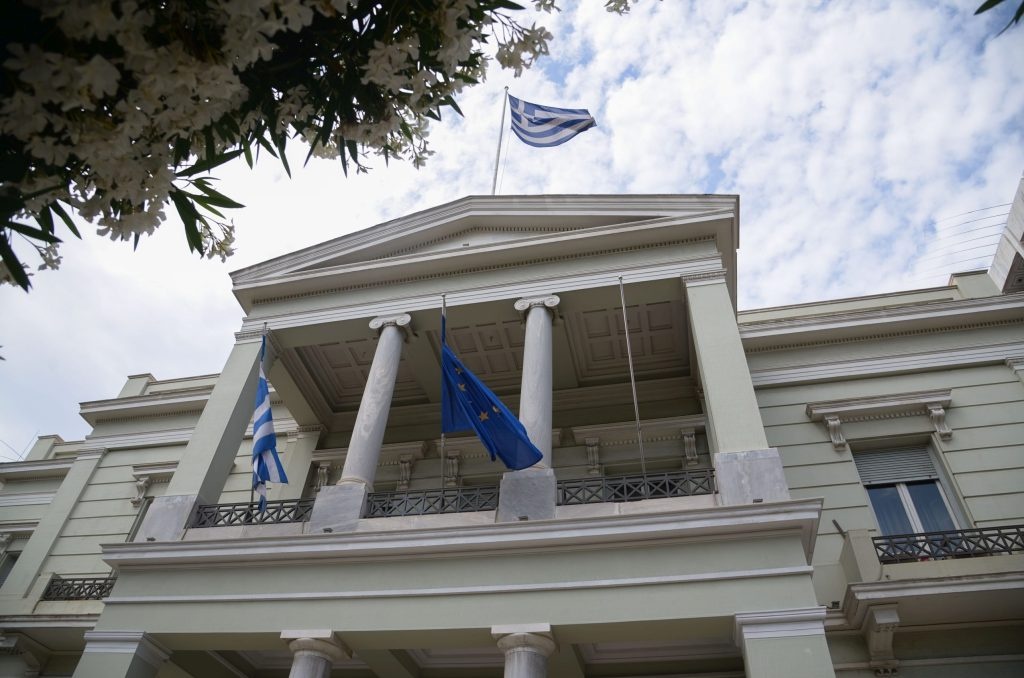
Athens, at least unofficially, on Wednesday evening angrily reacted to same-day comments by Russian foreign ministry spokeswoman Maria Zakharova affecting Greece and Cyprus, among others, which she bundled together in what she claimed were Helsinki Accord violations by the West.
Zakharova cited what she called “…the role of Greece’s military junta in the Cyprus crisis of 1974”, describing it as an “attempt to annex the island”. She also cited a dispute between Greece and its immediate northern neighbor, today’s Republic of North Macedonia, over the one-time Yugoslav province’s name.
She cited other instances of “Western hypocrisy”, as she said, to deflect sharp criticism of Russia and its invasion of Ukraine, made by the Finnish foreign minister.

Spokeswoman of Russia’s Foreign Ministry Maria Zakharova speaks to the media after a joint press conference of Russian Foreign Minister Sergey Lavrov and OSCE Secretary General Feridun Sinirlioglu in Moscow, Russia, Tuesday, March 11, 2025. (Maxim Shemetov/ Pool Photo via AP)
“Everyone should know that the Turkish military invasion in Cyprus in 1974 constituted a flagrant violation of the Republic of Cyprus’ sovereignty and territorial integrity and has led to an illegal occupation, to this day, of approximately 37% of Cyprus’ territory, a humanitarian tragedy of Greek Cypriots displaced from their homes, those enclaved (in the occupied territories) and those missing,” diplomatic sources in Athens stated, while reminding that the Helsinki Final Act was signed in August 1975.
The same sources said all democratically elected Greek governments since the restoration of democracy in the country (August 1974) have condemned the junta-engineered July 15, 1974, coup against the then Makarios government in Nicosia.
The same sources emphasized that the international community has repeatedly expressed a view on Cyprus as an issue of invasion and occupation, in direct violation of the United Nations Charter and UN Security Council Resolutions.
Zakharova was also quoted as saying that “…until 2018, Greece blocked international initiatives that were intended to foster cooperation with the Republic of Macedonia (due to an unresolved dispute over its name),” she said, using the disputed name that Athens did not recognize.
The 2018 Prespa Agreement between Athens and Skopje fully normalized relations between the two south Balkan neighbors by compromising over the formal name used – in all instances – today for the latter state, namely, Republic of North Macedonia.