The European Union is accelerating its contentious trade agreement with South America’s Mercosur bloc, framing the move as a strategic necessity in an increasingly competitive global economy.
European Commission President Ursula von der Leyen announced Friday that Brussels will proceed with the provisional application of the deal, arguing the EU must secure what she called a “first-mover advantage” at a time of “sharp competition and short horizons,” according to Politico.
“I’ve said before, when they are ready, we are ready,” von der Leyen said in a statement, adding that “a first-mover advantage has to materialize,” Reuters reported.
Yesterday, Uruguay and Argentina became the first Mercosur countries to ratify the Agreement.
When they are ready, we are ready ↓ https://t.co/pJlaknyXDk
— Ursula von der Leyen (@vonderleyen) February 27, 2026
The decision sets up a high-stakes political battle across Europe, as the agreement still requires final approval from the European Parliament and faces legal scrutiny that could delay its full ratification for up to two years.
What provisional application means
Under normal EU procedure, trade agreements are approved by member states and the European Parliament before entering into force. Provisional application allows certain elements, including tariff reductions, to take effect earlier.
Last month, EU lawmakers voted to refer the agreement to the Court of Justice of the European Union, a step that could freeze final ratification while judges review the case.
Despite that referral, the European Commission is pressing ahead. As Politico reports, the move has triggered backlash from critics who say it bypasses Parliament’s authority and risks undermining the bloc’s own decision-making norms.
The Commission had already received approval from EU countries in January to implement the deal once Mercosur members completed their own ratification processes. Argentina and Uruguay ratified the agreement Thursday, with Brazil and Paraguay expected to follow, Reuters reported.
A landmark trade pact
The agreement, which was concluded in January after roughly 25 years of negotiations, would create a free trade area spanning 720 million people.
It includes Argentina, Brazil, Paraguay and Uruguay and is considered the EU’s largest trade deal in terms of potential tariff cuts. Reuters reported that it could eliminate around €4 billion ($4.7 billion) in duties on EU goods exports.
Supporters, including Germany and Spain, argue the pact is essential to offset business losses linked to U.S. tariffs and to reduce reliance on China for critical minerals, Reuters reported. Backers also contend the EU must act quickly as the United States, China and the United Kingdom deepen engagement with South America.
Mounting opposition
France swiftly reacted to the Commission’s announcement.
French President Emmanuel Macron described the decision to fast-track the agreement as “a bad surprise” after von der Leyen confirmed the EU would provisionally apply the deal.
“For France, it’s a surprise, a bad surprise, and for the European Parliament, it’s disrespectful,” Macron told reporters after meeting Slovenian Prime Minister Robert Golob at the Elysee Palace in Paris.
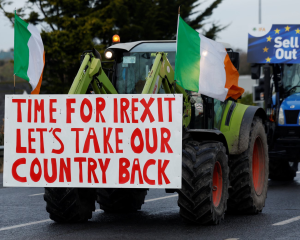
France has been among the most vocal opponents of the agreement, arguing it would expose domestic farmers to unfair competition. French agricultural groups have long warned that increased imports of lower-cost beef, sugar and poultry could threaten their livelihoods, a concern echoed in previous protests, according to Reuters.
French farm lobby FNSEA criticized the Commission’s move, saying, “Our farmers will not be sacrificed,” and condemning what it called “an unacceptable denial of democracy,” Politico reported.
The issue is also splitting opinion within the European Parliament.
Bernd Lange, chair of Parliament’s International Trade Committee, welcomed the Commission’s action. “We are in an exceptional situation,” he said, noting that Parliament can only vote after the court review, while “international trade rules are constantly violated by others.”
Decision @EU_Commission to go ahead with provisional application #EU #Mercosur is the right one. Many in@Europarl_EN agree.
We are in an exceptional situation where EP can only vote after ECJ. At the same time, international trade rules are constantly violated by others. 1/2
— Bernd Lange (@berndlange) February 27, 2026
EU Trade Commissioner Maroš Šefčovič defended the approach earlier this week, telling lawmakers that Parliament itself had chosen to refer the deal to the court. “You could have voted on this agreement. You decided to send it to the European Court of Justice, which I fully respect,” he said, as reported by Politico.
Proud to see the EU-@mercosur agreement moving into provisional application.
Key for 🇪🇺 businesses to seize new opportunities.
Key for the strength of rules-based trade.
Key for our credibility as a reliable partner.We continue to work closely with @EUCouncil and @Europarl_EN. https://t.co/7LpxxTjK8k
— Maroš Šefčovič🇪🇺 (@MarosSefcovic) February 27, 2026