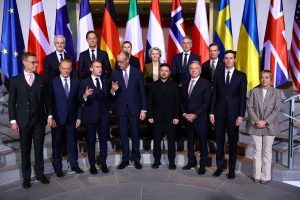
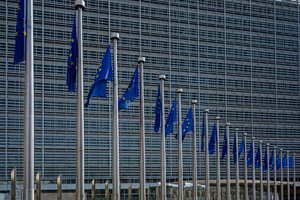
The European Council meets in Brussels on Thursday 18 Dec., with four key items on the agenda: Ukraine’s financing needs for 2026–2027, the next Multiannual Financial Framework, EU enlargement, and the broader geo-economic outlook.
With Ukrainian President Volodymyr Zelenskyy present, the summit’s central focus is funding for Kyiv over the next two years. Leaders are expected to follow through on earlier commitments to meet Ukraine’s urgent economic, military and humanitarian needs. The IMF estimates total requirements at 135.7 billion euros for 2026–2027.
The European Commission has outlined two main options to cover about 90 billion euros of that sum. The first is EU joint borrowing backed by the EU budget, a move requiring unanimity and facing strong resistance from several member states, including Germany, while Hungary has voiced outright opposition.
Gaining ground instead is the so-called “reparations loan,” which would rely on frozen Russian assets held in the EU. This option could be approved by qualified majority and would not directly burden national budgets.
Ukraine would repay the loan only if Russia pays compensation; otherwise, sanctions would remain and the assets stay frozen. Around 210 billion euros from Russia’s central bank reserves are immobilized in the EU, most of it managed by Belgium-based Euroclear.
Belgium has raised concerns over legal and financial risks, seeking firm guarantees and burden-sharing from partners. Greece and Italy, meanwhile, want assurances that any guarantees would not count against national spending targets under EU fiscal rules. Several countries, including Belgium, Italy, Bulgaria and Malta, have also called for exploring lower-risk alternatives.
Talks continued late into Wednesday night, with most member states leaning toward the reparations loan, provided safeguards and solidarity mechanisms are in place. European Council President Antonio Costa has signaled the summit could be extended until an agreement is reached, while High Representative Kaja Kallas stressed that leaders will not leave without a decision. Germany’s chancellor warned that failure would damage Europe for years, calling the moment a test of EU unity.
Beyond Ukraine, leaders will hold an initial strategic debate on the EU’s next long-term budget for 2028–2034, aiming for agreement by the end of 2026. They will also review progress on enlargement, described by Costa as a geostrategic investment, and discuss geoeconomic pressures, competitiveness and strategic autonomy. Issues such as the Middle East, defence, security and migration are also on the agenda, though expected to be addressed briefly.