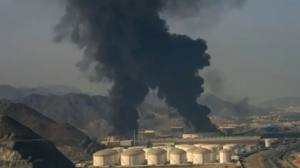
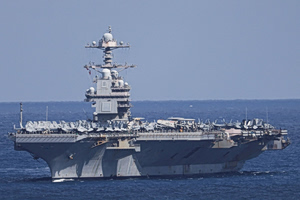
As war in Iran disrupts global energy flows and pushes prices upward, Europe is once again confronted with the cost of its dependence on imported fossil fuels. The moment carries a certain irony: the same geopolitical instability that strains economies and political cohesion also reinforces the case for accelerating the green transition. “The only way we can be strategically independent is for us to be harmonized, electrified,” Elina Bardram of the European Commission’s Directorate-General for Climate Action (DG CLIMA) tells To Vima International Edition.
Speaking in Athens during her official visit as Head of the European Climate Pact, Bardram offers a sober assessment of Europe’s position—caught between intensifying climate impacts, geopolitical pressure, and a transition that is advancing, but not fast enough.
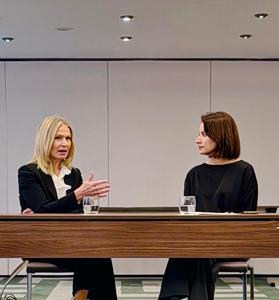
Elina Bardram, DG CLIMA in conversation with Deputy Chief Editor of tovima.com in Athens.
Greece, Europe, and the world are experiencing severe weather stemming from climate change with increasing frequency, such as extreme heat, drought, fires and floods. From the perspective of DG CLIMA, can you give us an indication of where the world stands in its efforts to slow global warming?
I think where we stand today is better than where we stood before the Paris Agreement. The Paris Agreement was groundbreaking in that it brought us from action by a few countries with legally binding commitments under the Kyoto Protocol to action by all. All countries now contribute to the global effort to the best of their abilities through the so-called nationally determined contributions. Before Paris, we were on a business-as-usual pathway that was dangerously close to four degrees by the end of the century. Now we have managed to change that trajectory quite a bit, but it is also evident that we are not keeping pace. Our efforts fall short of what would be required to remain within the temperature thresholds enshrined in the Paris Agreement, notably pursuing efforts to stay within 1.5 degrees and keeping temperature increase below 2 degrees centigrade compared to pre-industrial levels.
Many scientific reports show that we are now looking at a reference scenario of somewhere between 2.8 and 3.2 degrees by the end of the century. That requires quite a bit of readiness and preparation.
At the same time, decarbonization is working and it is gaining ground. We see electrification in the big economies and emerging economies at a pace that was never foreseen. Solar power surpassed fossil fuels in electricity production for the first time last year, and that is testament to the fact that the transition is ongoing. The question is how quickly we can double our efforts and really come to terms with the emerging science.
So what are the key priorities right now for the Union?
I think our key priorities are twofold. On the one hand, we need to redouble our emissions reduction efforts. We have just agreed at leaders’ level on the 2040 target of at least 90%, which includes some international credits for the participating sectors. Getting the legal framework in place for delivering that target is going to be super important for investor predictability, for consistency, and for long-term decision-making. Our industry has made really good headway in decarbonizing, and now staying the course is going to be an important signal. We are happy that the agreement has been reached, not only for business but also because now it is about implementation.
That is the first priority. The second priority, and this relates to your first question, is that:
it is inevitable that physical climate conditions will get worse before they get better, and we need to prepare our societies and economies to be better able to withstand those adverse physical conditions in which we raise our children, do business, and ensure that logistics and service chains remain operational. That means tackling the risks of wildfires, droughts and floods before they occur, building resilience by design so that we do not end up with disasters.
You speak frequently about adaptation and resilience. Can you tell us more about how this translates at the local level, and whether and how the EU is able to support that transition?
I think a lot of the resilience and adaptation measures need, by definition, to be deployed at the local level because this is where the impacts are felt. We already have very exciting initiatives in place, such as Mission Adaptation and Mission Cities, which empower and equip the local level to take measures, build technical capacity, and think ahead in terms of scenario planning so that they can develop pathways for societal resilience and have a clear vision for planning purposes. We support this with different climate models, decision-making tools, and pilot projects that can then be scaled up at the local level.
From the EU perspective, it is also important that planners at all levels of governance—Union, regional, local and national—have a shared view of the probable reality in which we need to operate, so that anticipatory planning becomes the norm rather than the exception. Whether we like it or not, we cannot have credible policies for the future on the basis of a history that is no longer there.
Two of the challenges, at least within the Greek context, are access to reliable data specific to regional and local levels, and financing for adaptation and systems resilience. Is there anything the EU is working on to address these two sticking points, which are key for local communities?
In addition to the policy framework we are preparing for the end of the year, we are going to be working on a set of tools that facilitate decision-making, based on an underlying scientific model that will be the same across the EU. But the way it translates to the local level must be context-specific, because we cannot simply say that the EU is going to warm at a certain average rate and then expect the implications to be the same in Greece as they would be in Sweden. So the model has to be sophisticated and granular enough to take into account local context and physical conditions, and yet simple enough to allow for easy access to decision-relevant information in a format that can be processed regardless of whether the user is a private citizen or a policymaker.
And how about financing? Is that something within the power of the EU, or is it left to the local and regional levels?
I think all levels are involved, and it is also important to bring in the private sector, because we will be counting on public-private partnerships and different instruments. The challenge is too big for any one entity to tackle alone. In the current MFF proposal, the multiannual financial framework proposed by the Commission, we have already introduced an earmarking principle, and we have also introduced a principle of resilience by design. That means funds are programmed in a way that takes into consideration climatic circumstances, and beyond that, other threats and vulnerabilities, because there is not going to be enough public money to spend on policies that cannot be verifiably robust in the long term.
So there will be instruments, but more importantly all instruments will be shaped by an awareness of the conditions in which they need to operate. Whether it is an agriculture project or a transport project, the element of resilience by design—taking climate conditions into account—is going to be a design feature.
You mentioned the MFF, which always involves very difficult negotiations at the EU level. Considering the challenging geopolitical environment and new intensified focus on defense and security, how strong are the headwinds against the EU’s green agenda, and how feasible do you think it is for adequate funding to be secured in this next MFF phase?
We should not be naive or immune to geopolitical realities. It is clear that they affect public perception and political priorities, and that there are very legitimate concerns and priorities being raised. But it is also important to see that our decarbonization agenda is not in contradiction with, or in competition with, those priorities.
If you look at it clearly, much of the vulnerability of EU industry and EU society is due to our longstanding dependency on fossil fuel imports, and the decarbonization agenda is in fact an agenda of strategic autonomy and energy independence. It is a way to prevent rogue players or hostile states from weaponizing energy supply to their advantage and leaving the EU hostage to those kinds of agendas.
So I see a very strong case for innovation, competitiveness and prosperity combined with the decarbonization agenda. And I feel that with the industrial accelerator and the Clean Industrial Deal, we have the makings of a really solid blueprint that allows industry and different policy portfolios to be aligned in the same direction.
So if I’m hearing you correctly, you think the current focus on defense and security could serve to boost the green agenda, if people again perceive the EU’s electrification agenda as a pathway to energy security?
I think it is just logical. The EU is never going to be strategically independent if it remains heavily dependent on fossil fuel imports. The only way we can be strategically independent is to be harmonized, electrified, and to create a society that is not only modernized but also develops the innovative base that gives us market share in global competition. Because what we see happening in many other economies—Japan, South Korea, India and China—is that they are in motion. They are transitioning, they are decarbonizing, and they are developing many of the technologies. So unless the EU pulls together and really puts its best foot forward, we may risk being left behind.
So does the EU perceive itself as a collaborator with these other economies that are moving ahead, or in competition with them?
Both. It is obvious that market share is something all economies aspire to secure, but at the same time there is a lot of room for different types of alliances. The EU will always be willing to work with trusted partners that share the same principles of social justice and environmental integrity, and that is also very much reflected in the industrial accelerator, where “made in EU” in many cases encompasses those partnerships.
As the green agenda shifts, has the link to EU competitiveness been lost—and how concerned are you about rising disinformation around climate policy? Who is driving it, and how can it be addressed?
A lot of the disinformation and attacks targeted at the climate policy agenda are not really about that agenda alone; they are about trying to destabilize our democracies. The EU has invested in and set its course toward a transition to net zero by 2050. So when people attack our climate agenda, those forces probably feel that by doing so they can also undermine the broader political and institutional framework we have built to pursue it.
It is very difficult for us to tackle disinformation, simply because the machinery behind it is often algorithm-based, built on troll factories located in different states, and very sophisticated.
At the same time, we do not want to overcorrect in ways that would play into the hands of those who want to talk about a “deep state” or limitations on freedom of speech. So the best thing we can do is to put facts, evidence and storytelling out there that actually speak to the added value and logic of our transition. It is a constant battle, but by increasing public literacy about the motivations behind certain kinds of information being pushed into the public space, we create more room for fact-based decision-making.
At the moment, there are intense negotiations happening at EU level about critical issues such as the war in Ukraine and also Iran. How critical is this juncture for the EU, in your opinion?
It is very important. I cannot think of another time in history when we have been subjected to so many external shocks, one after another. But what gives me confidence is that in recent years—whether because of Covid, Russia’s war of aggression, the energy crisis, or changes in certain administrations that have reshaped geopolitics—we are still together. There is still so much solidarity and strength when we align our agendas and are able to find space for compromise.
The weeks and months ahead will be very important for us and for the European project.
But I remain confident that there will be a way forward that satisfies the interests of industry, which has very legitimate concerns about the rules it is now facing, electricity prices, and energy prices more broadly, as well as the citizen, who also quite legitimately has concerns about wellbeing and prosperity, both now and in the longer term, and of the youth, who are very troubled by the direction things are taking.
If there is one key message you could leave readers with about what they can do to help and support climate action, not only at EU level but also at local level, at this critical juncture, what would it be?
It would be this: we cannot afford to drift into defeat. Where there is a will, there is a way. And when we align our best efforts, we can certainly help each other move toward a more resilient, more climate-compatible future—one that secures not just prosperity and competitiveness, but also livelihoods and wellbeing.
This interview with Director of DG CLIMA, Elina Bardram was conducted in Athens within the framework of her official visit as Head of the European Climate Pact, organized by INZEB.