The Bavarian town of Vilseck is preparing for the possible end of decades of close ties with U.S. forces, as President Donald Trump’s decision to withdraw at least 5,000 troops from Germany threatens to reshape the local economy and community life.
Although the exact units affected have not been officially confirmed, residents expect the 2nd Stryker Cavalry Regiment, based at Rose Barracks, could be among those leaving. The unit has long been a cornerstone of the U.S. military presence in the region.

Shoahan Hanan, 63, owner of Casa do Brasil steakhouse stands at the entrance of his restaurant in Schlicht near Vilseck, Germany, May 5, 2026. “A withdraw of 5000 troops in Vilseck, that means a reduction of 50 percent. We will feel the impact.” REUTERS/Lisi Niesner
Vilseck’s newly elected mayor, Thorsten Graedler, said the potential withdrawal would have serious consequences for the town, where the base is one of the largest employers in the area.
“The consequences would be dramatic,” Graedler said, noting that local pubs, restaurants, garages and supermarkets all rely heavily on business linked to the military base. “Our entire town of Vilseck relies largely on the military training area for its livelihood.”
The decision comes amid growing U.S. pressure on European allies to increase defence spending, with Washington arguing that reliance on American troops has allowed European militaries to underinvest.
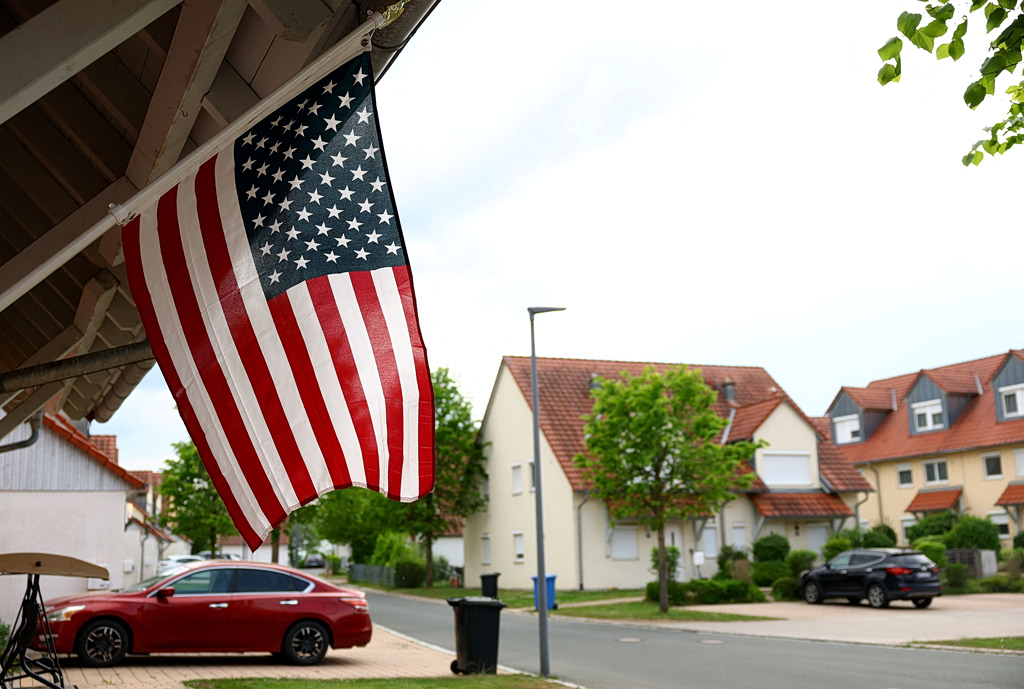
A national flag of the United States hangs in front of a duplex house in Netzaberg housing area where personnel of the U.S. military and their families have their homes near Grafenwoehr military training area, around 20 kilometres north of Vilseck, in Netzaberg, Germany, May 5, 2026. REUTERS/Lisi Niesner
As reported in Reuters, Graedler said that while the withdrawal has not yet been officially confirmed, uncertainty alone is already causing concern among residents and businesses.
“I haven’t given up hope yet,” he said.
Germany’s government said the announcement was not unexpected, as Berlin continues to increase defence spending in response to long-term underinvestment.
Vilseck, a town of around 6,500 people, has for decades lived alongside a U.S. military population that at times outnumbered locals. Even today, American personnel and their families remain a visible part of daily life, frequenting local restaurants, shops and clubs.
For many residents, the possible departure carries not only economic risk but also emotional weight.
“I’ve never known Vilseck any other way than living side by side with the Americans,” Graedler said.
A national flag of the United States hangs in front of a duplex house in Netzaberg housing area where personnel of the U.S. military and their families have their homes near Grafenwoehr military training area, around 20 kilometres north of Vilseck, in Netzaberg, Germany, May 5, 2026. REUTERS/Lisi Niesner
Local business owners also warned of severe impacts. One restaurant owner said the withdrawal of thousands of troops would sharply reduce customer numbers, while a car dealer who sells to U.S. personnel said much of his business depends entirely on the base.
Some residents said the town’s dependence on the U.S. presence should have been addressed earlier, warning that younger generations already face limited local job opportunities outside the base.
Others, however, reflected on the long history of uncertainty surrounding the American presence, noting that rumors of withdrawal have circulated for decades without fully materializing.
Despite the uncertainty, U.S. soldiers currently stationed in the area continue to describe life in Germany positively, contributing to local sports clubs, businesses and community life.
Still, for Vilseck, the prospect of change is looming large, raising questions about the future of a town that has grown around one of the United States’ most enduring military footprints in Europe.