Just weeks after a surge of cartel-related violence shook the city, Guadalajara stepped onto the global stage Thursday, hosting a World Cup qualifying playoff match under heavy security as it prepares for the 2026 tournament.
The match, held at the nearly full Akron Stadium, saw Jamaica’s “Reggae Boyz” defeat New Caledonia 1-0, bringing them closer to a return to the World Cup after 28 years. But while fans filled the stands, much of the attention focused on safety outside the stadium.
Security Takes Center Stage
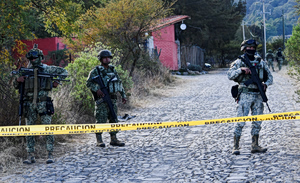
Authorities deployed more than 2,000 security personnel, including military and police forces, to safeguard teams and spectators. Armed escorts accompanied players from the moment they arrived in the city, reflecting heightened concerns following recent unrest.
Jalisco’s Secretary of Public Security, Juan Pablo Hernandez, said the visible presence of officers was key to reassuring visitors.
“The best way to feel safe is to see security personnel nearby,” he said, noting efforts to reinforce institutional control across the state.
Some visitors expressed confidence in the measures. One fan attending the match with his children said he felt safe amid the strong security presence, despite recent events.
A City Under Pressure
The match marked Guadalajara’s first international football event since a wave of violence triggered by the capture and death of cartel leader Ruben “El Mencho” Oseguera. The unrest left streets littered with burnt vehicles and businesses shuttered.
Now, the city is working to project stability ahead of the FIFA World Cup 2026, which Mexico will co-host with the United States and Canada.
Guadalajara is scheduled to host four group-stage matches and serve as a base for several national teams, including Mexico, Spain, Uruguay, South Korea and Colombia. Officials expect millions of visitors, placing further pressure on local infrastructure and security systems.
Tourism Drive Meets Harsh Realities
Authorities have invested in beautification projects and infrastructure upgrades to attract tourists, but critics argue the focus on image overlooks deeper issues.
Jalisco is at the center of Mexico’s disappearance crisis. Of more than 132,000 missing persons nationwide, roughly 10% are from the state. Researchers say the true number may be higher, as many cases go unreported.
Search groups and families of victims have increasingly taken matters into their own hands, often conducting searches independently due to frustration with authorities.
One such group uncovered a site last year containing hundreds of personal items and human remains, believed to be linked to organized crime. Additional discoveries of mass graves near the stadium have underscored the scale of the crisis.
Calls for Accountability
Activists say the World Cup offers an opportunity to draw international attention to the situation.
“It’s not that we disagree with the World Cup,” said Hector Flores, co-founder of a search group. “We disagree with excessive public spending on aesthetics when Mexico is facing serious crises, especially in public safety and disappearances.”
Mexico’s President Claudia Sheinbaum has pledged to improve coordination between agencies and strengthen efforts to locate missing persons, though critics say progress remains limited.