Japan, long seen as a stable and predictable democracy, is witnessing a political shift with the rapid rise of the far-right Sanseito party. In the latest Upper House elections, the ultra-conservative party—founded only five years ago—emerged as the country’s third-largest political force and a new power broker.
Sanseito blends familiar themes of the global far right: skepticism toward COVID-19 vaccines, traditional anti-Marxist rhetoric, and opposition to gender equality—its leader, Sohei Kamiya, has publicly called gender equality “a form of communism.” However, it is the party’s deep-seated xenophobia, particularly its hostility toward China, that distinguishes it within Japan’s political landscape.
Nationalism Fueled by Regional Competition
Japan’s growing participation in military exercises and its strategic alignment with the United States in the Pacific have created fertile ground for nationalist sentiment. Many Japanese feel that China has overtaken their country in military, economic, and technological strength, a perception that Sanseito taps into.
Kamiya recently accused China and Japan’s domestic left of having “stolen the country’s proud martial spirit,” referring to World War II as an “entirely honorable” war. His remarks—criticizing both China and the United States—have caused unease, especially across the sea in China, a nation that suffered heavily during Japan’s wartime aggression.
Ironically, the U.S.-imposed postwar pacifist constitution was designed precisely to prevent a resurgence of the militarist ideology once rooted in imperial arrogance and racial supremacy. Yet, with increasing military exercises and a growing presence in the Pacific, Japan finds itself closer than ever to potential conflict.
Military Drills and Strategic Shifts
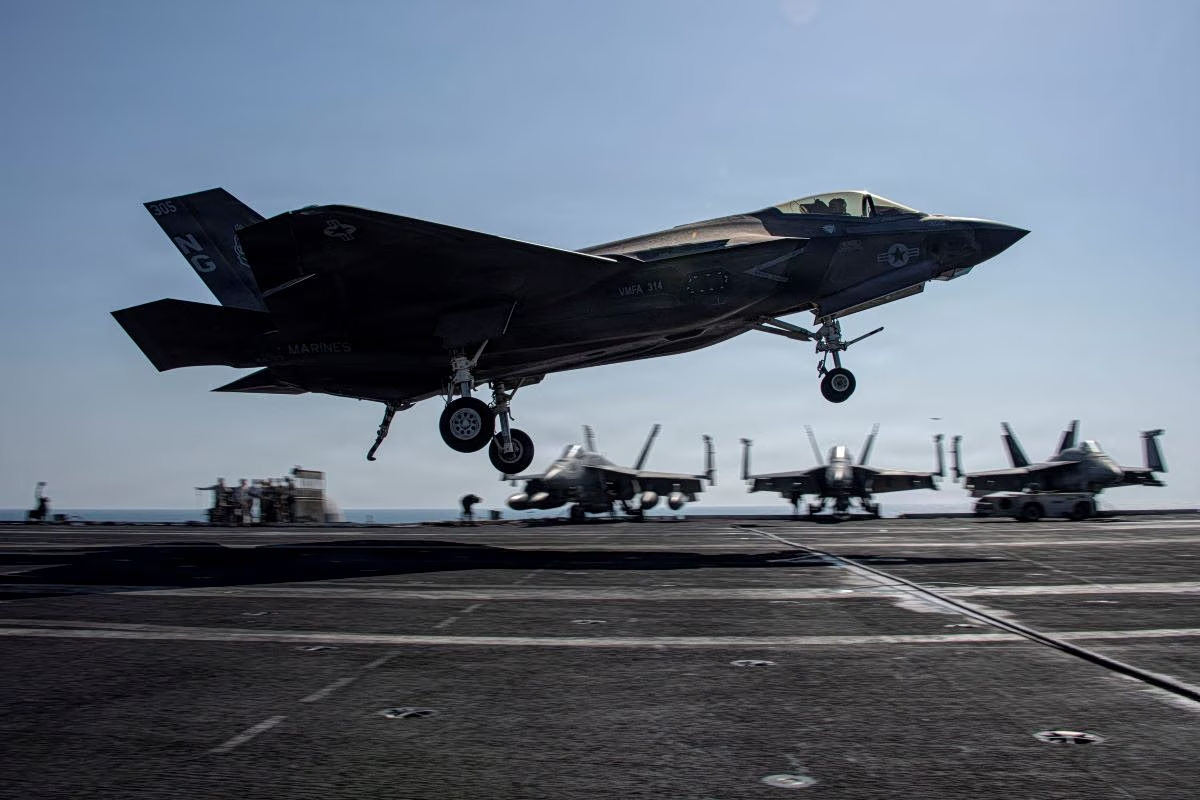
The recent Talisman Sabre exercise, held across Australia and Papua New Guinea, involved over 40,000 troops from 19 countries. The United States Indo-Pacific Command highlighted the event’s success and expressed hope that Japan could soon contribute up to 2,000 troops to future exercises. U.S. military officials praised Japan’s role in medical support, underscoring the country’s growing involvement in regional security efforts.
Meanwhile, another major drill—Resolute Force Pacific 2025—is unfolding across 50 locations including Hawaii, Guam, and Japan, involving 12,000 personnel from the U.S., Japan, Australia, and other allies.
In response, China and Russia launched their own joint exercise, Joint Sea 2025, near Vladivostok—just across the sea from Japan—highlighting the increasing polarization and militarization of the region.
Diplomatic Uncertainty in the Trump Era
The escalating tensions between Washington and Beijing are unfolding alongside shifting dynamics in Japan’s alliance with the United States. Donald Trump recently celebrated a major trade deal with Japan, but his transactional approach to foreign policy continues to raise concerns.
Bill Emmott of the International Institute for Strategic Studies noted that Japan under Trump faces a dual fear: of being entrapped in conflict or abandoned altogether. He warned of the possibility of a U.S.-China “gentlemen’s agreement” over Taiwan—an alarming prospect for Tokyo, which already has territorial disputes with Beijing over the Senkaku Islands.