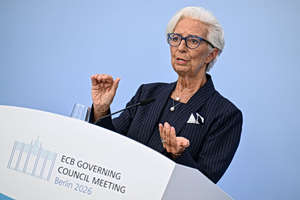
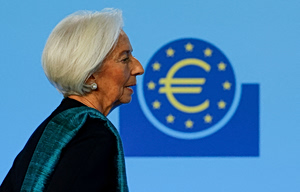
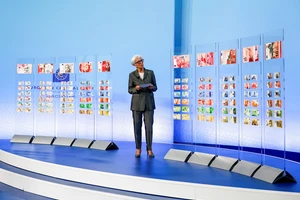
European Central Bank President Christine Lagarde has warned that the energy crisis linked to the conflict in the Middle East poses the most immediate threat to the European economy, as a series of interconnected shocks continues to challenge the region’s economic model.
In an interview with La Croix conducted on September 16 and 28, Lagarde said crises that once occurred separately are now increasingly connected and capable of reinforcing one another.
“The pandemic gave rise to pressures on energy and raw materials, then came the invasion of Ukraine which worsened the energy crisis and the inflation surge,” she said. “Crises no longer follow one after the other, they are interconnected and mutually reinforcing.”
For the ECB, she said, price stability remains the priority. The current energy shock is affecting both prices and economic growth, while the geopolitical situation surrounding it is also changing rapidly.
Europe’s Three Economic Pillars Under Pressure
Lagarde said Europe had historically relied on three major foundations: relatively cheap energy, particularly from Russia; access to the large Chinese market for European exports; and the U.S. security umbrella.
All three are now being challenged, she said.
Russian energy supplies to Europe have been cut off, while China has become a competitor to European producers in advanced markets. At the same time, uncertainty surrounding the U.S. security commitment has raised questions about another longstanding pillar of the European model.
Lagarde said the ECB itself cannot resolve the underlying energy supply problem.
“A central bank cannot reopen the Strait of Hormuz or create new oil or gas reserves,” she said.
Its role, she explained, is to prevent a supply shock caused by falling energy supplies and higher costs from becoming entrenched across the economy and driving inflation higher.
That can require higher interest rates, however, potentially making financing more expensive and weighing on growth. Lagarde said the ECB therefore monitors the strength of economic activity closely before making decisions.
Lagarde Defends Her Approach at the ECB
After seven years as ECB president, Lagarde said she was most proud of the institution’s ability to respond to extraordinary circumstances while maintaining consensus among policymakers.
She described herself as neither a “hawk,” favoring higher interest rates to contain inflation, nor a “dove,” favoring lower rates to support economic activity.
Instead, she continues to identify with the “owl” label she adopted at the beginning of her tenure. The owl, she said, represents Athena and symbolizes intelligence and wisdom, but also reflects her desire to avoid being placed in a fixed policy camp.
“I don’t take sides in monetary policy. I’m guided by facts and prepared to adjust when circumstances require it,” she said. “In such an uncertain world, dogmatism is not a good response.”
Lagarde acknowledged that the ECB had not always anticipated developments correctly. In 2021, policymakers believed the energy shock would be temporary and did not initially consider it necessary to respond immediately.
She said they had failed to foresee the extent to which different crises would become interconnected, the surge in demand following the pandemic and the reduction in gas reserves that she said had been deliberately engineered by Russia.
France Faces Growth and Debt Pressures
Lagarde declined to characterize France as Europe’s new “sick country,” saying she did not want to comment specifically on an individual euro area economy.
She nevertheless pointed to a significant growth gap. The ECB expects the euro area to grow by 0.9% this year, compared with 0.5% for France, she said.
Political uncertainty and budget deficits can weigh on investment and economic activity, while France’s debt level is another concern. With debt approaching 120% of GDP and not yet on a path toward being brought under control, Lagarde said the situation was serious.
She also warned that governments are competing for financing with substantial private-sector needs, including investment related to artificial intelligence, potentially increasing the cost of financing public debt.
At the same time, she said France’s situation should not be compared directly with the financial crises of 2008 or 2011 because the European financial system is now much stronger.
Lagarde pointed to Greece, Portugal, Ireland and Cyprus as examples of countries that endured severe crises, restored their public finances and rebuilt confidence before returning to growth.
For France, she said, restoring confidence requires a credible path forward, political commitment and reforms. She highlighted the need to simplify administrative and regulatory rules, continue labor-market reforms and address the pension system.
As life expectancy increases, she said, pension systems designed in the past cannot continue indefinitely.
She also called for deeper European capital markets so that European savings can provide more financing for investment.
Lagarde Rejects French Debt Cancellation
Asked about proposals to impose higher taxes on wealth and inheritances, Lagarde said governments must consider both revenues and spending, while examining effectiveness, proportionality and the overall tax burden compared with other countries.
There are limits to how far taxes can be increased, she said, recalling the saying attributed to French finance minister Jean-Baptiste Colbert that taxation is like plucking a goose.
“When you pass certain thresholds, there is a risk of diminishing returns,” Lagarde said.
She was more direct when asked about calls, including from Jean-Luc Mélenchon, for France to cancel part of its debt.
Lagarde said such a move would be “technically uncertain and financially very dangerous.” If a government chose not to repay some of its debt, investors could stop lending or demand significantly higher interest rates, she said.
France still needs to borrow, Lagarde said, and debt cancellation would also violate the European treaties.
Lagarde Rules Out Presidential Bid
Lagarde said her current responsibility was to serve the European public interest and rejected the possibility of running in France’s 2027 presidential election.
“That would not be a good idea at all,” she said, adding that the presidency and her current position were fundamentally different jobs.
She also acknowledged that she could leave the ECB a few months before her term ends in October 2027, but said she had made no specific decision.
“One thing is certain: I will still be here in 2027,” she said, adding that any early departure would amount to only a few months.
Asked whether the prospect of the National Rally winning the French presidential election could affect her decision, Lagarde said the French government in office at the time would be responsible for expressing its preferences and reaching an agreement with other European leaders over her successor.
Climate Risks Are Part of the ECB’s Work
Lagarde also defended the ECB’s focus on climate-related risks, rejecting the argument that climate policy falls outside the responsibilities of a central bank.
Climate change has direct economic consequences, she said. Drought, for example, can disrupt navigation on the Rhine or Saône rivers and reduce economic output, affecting projections for prices and growth.
There is also a financial risk because the ECB holds assets whose exposure to climate change needs to be assessed. The same applies to banks supervised by the central bank, she said.
The ECB supports the green transition but is not responsible for setting climate policy, which belongs to governments and parliaments.
Its role is instead to incorporate climate risks into its economic analysis and balance sheet and ensure that banks do the same.
Lagarde Calls for a Stronger Europe
Lagarde said Europe was experiencing a tension between efforts to deepen integration and a growing movement toward nationalism.
On one side, the European Union is considering further enlargement and a stronger political dimension, with Moldova, Ukraine and Balkan countries potentially joining the bloc. On the other, nationalist forces are pushing for countries to turn inward.
She said recent political developments in Poland and Hungary demonstrated that political change remained possible, citing Donald Tusk’s formation of a new majority in Poland in 2023 and the eventual change of government in Hungary after years under Viktor Orbán.
Lagarde said she continued to believe in a European foundation of trust and collective ambition.
The size of individual European countries limits their influence compared with the United States, China and India, she said, recalling her experience representing France at the World Trade Organization.
“But when Europeans speak as one, they matter,” she said. “Their voice is respected.”
A Call for Dialogue and Trust
Lagarde also discussed the broader social and political pressures facing Europe, expressing concern about the way traditional and social media can amplify negative events while everyday acts of solidarity and kindness receive little attention.
Despite this, she said she had not lost faith in people.
She recalled former French Justice Minister Robert Badinter telling her during the Iraq War in 2003, when anti-French sentiment was strong in the United States, that people should never lose faith in the American public.
Lagarde said the lesson had stayed with her and that societies could rediscover what they have in common if they had trust, respect, tolerance and a shared purpose.
She applied the same principle to political change, arguing that governments and institutions cannot impose lasting reforms entirely from the top down.
“Change only succeeds when we bring everybody on board,” she said. “Everyone needs to understand the shared purpose and feel that they have a part to play in it.”
That requires dialogue with unions, intermediary organizations and civil society, she said.