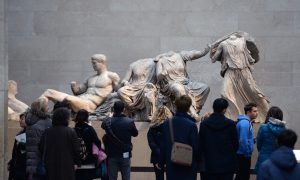
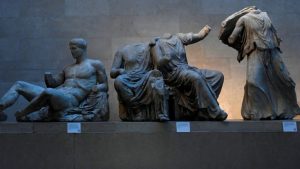
Mario Trabucco della Torretta, the organizer of a recent campaign that sent a letter to the British Prime Minister, speaks exclusively to TO VIMA. The letter, which has sparked debate and made headlines across the British media, was signed by former Prime Minister Liz Truss and members of a lobby group.
It warns of possible legal action concerning what they describe as “covert” negotiations to return the Parthenon marbles to Greece.
See here the letter the campaign sent: Letter Page 1 _ Letter Page 2
What personally motivated you to sign this letter opposing the possible return of the Parthenon sculptures to Greece?
I am a classical archeologist. And I was trained in Athens where I lived for four years and in Sicily. I started my campaign to defend the British Museum in 2022 when the museum of my hometown of Palermo in Sicily decided to give away to the Acropolis Museum, their fragment of the Parthenon frieze, the so-called Fagan fragment. This started an interior conversation because I was debated myself interiorly between, the arguments towards the reunification of an ancient monument as an archeologist, I do appreciate these arguments, but on the other side, there were also arguments about why that particular fragment ended up in Palermo, what was the history attached to that and what we were losing by losing that particular part of history, by rolling back what had happened and said, okay, this history is not important, that history is more important. To me as an historian, as an archeologist, history is important all the same, all pages of the book of history are, have the same importance. It would be an error to say, no, this is particularly important and therefore we sacrifice everything else to that.
This might lead one to expect that, as an archaeologist and historian, as you mentioned, you would prefer—and perhaps even advocate for—the marbles being returned to their original home in Athens, rather than remaining in the British Museum. So, what you made sign this letter opposing the potential return of the Parthenon marbles to Greece?
It’s a great question because as I said, I understand what the conflict between those two positions is. First of all, there is a consideration of quality and quantity. The unification of the Parthenon sculptures, first of all, is not possible because one third of the sculptural decoration of the Parthenon has been completely lost when in 1687, obviously the Parthenon was blown up by the mortar shot, fired by the Danish artillery. So when that third of the decoration has been lost, completely part of it, destroyed also by the Turks, and, part of it destroyed during a “conflagration”, you have no longer the possibility of putting it back together. So now also there is another consideration. The monument that we should be considering to reunify is not just the decoration. The decoration is itself a part of the monument. So, the total monument is the temple plus the decoration. Now we know that also putting back the decoration on the temple is no longer possible for cultural reasons and conservation reasons. So what happens now is then we want to destroy completely another monument, which is the British Museum in itself, which is fruit of a cultural phenomenon in itself to not quite reunify the marbles and not quite reunify the Parthenon.
So these, to me, seems, something that goes against both the preservation of history as it went, not as the way we would’ve liked it to be, and as a cultural action is basically counter to what we want to do with these pieces that is illustrate the history of mankind in all its forms.
Some, however, might challenge this argument by pointing out that there is now a great new Acropolis Museum—home to the Parthenon Marbles—where they ought to be preserved, rather than kept in the British Museum.
I would challenge that. I’ve seen the Acropolis Museum being built because I was in Athens back then when it was being built, and I was among the first visitors of the Acropolis Museum, so I know what it looks like and what the reason for this construction is, but I would hesitate in calling it a great museum, first of all, because, it’s not enough to create a museum to acquire an ownership title to something. If this was the way, obviously the people of Florence would’ve already built a museum for the Mona Lisa, and this way they could claim the Mona Lisa back from the French…
I don’t mean to interrupt you — my main reason for asking this is that, clearly, people aren’t simply saying we’ve built a new museum and can therefore host these artefacts again. What they’re actually saying is that the marbles belong to Greece — that ownership lies with the Greek side. However, I don’t want to focus this interview on the ownership debate, which has dragged on for years without resolution. What I’d really like to ask you is this: do you consider the letter more of a legal, cultural, or political intervention — or perhaps a combination of all three?
I think it’s a combination because the legal ownership is only one leg of this discussion. There is no case whatsoever to dispute the legal ownership of the British Museum over these sculptures, and I invite Greek people and people that support restitution to bring forward proof that the sculptures were not acquired legitimately. We have plenty of proof on the other side, and one of this proof is Byron, who is one of the people that are greatly admired in Greece and one of the people that attacked Elgin and greatly 10 years after the removal of the, of the sculptures, and even he could not, just go beyond the reality.
May I ask why you chose to sign this letter? What were you hoping to achieve?
My goal is to have a frank conversation on the matter of the ownership of the sculptures with the Greek authorities and with the Greek scholars, which is not done behind closed doors, widdling and dealing between the check of the trustees of the British Museum and some parts of the Greek government in a very secretive way and going around what the laws of this country and the laws of the ownership of the marbles would dictate. We should have a cultural discussion, very open, very transparent, and only then we make a reasonable thought after choice.
This letter uses strong language referring to “covert negotiations” and “philosopher kings”. What evidence do you or your co-signatories have that the British Museum or the government is acting in secret or without accountability?
It’s been three years that there has been extensive journalistic coverage of the negotiations ongoing between the leadership of the British Museum and parts of the Greek government.
So it’s not a secret that this government negotiations are ongoing. What is astonishing is that after three years, we know next to nothing about what has been agreed and what is the direction of travel when it comes to the ultimate goal of these negotiations. Because obviously if the goal is to obtain a loan, the British Museum does loans all the time, and if the Greek government is willing to ask for a loan, I’m pretty sure that they will get one. But a loan, obviously is the sticking point because includes the admission of ownership, and a guarantee that you are going to return the sculptures.
I’m very worried that this might not be the case, and I’m very worried that what happens is these negotiations are trying to find ways of going around the letter of the law and to go against the spirit of the law.
Why threaten legal action rather than pursue democratic means of debate and consultation, and what legal grounds do you believe exist to challenge such discussions?
So legal action is necessary because obviously the democratic debate and consultation has been denied by the British Museum leadership. While they’re keeping all these negotiation under wraps, obviously they could be doing any number of things and we will just put in front of the feta complete and we cannot accept this because if the feta complete is actually a permanent move of any of these very important cultural assets for the identity of the British culture and Western culture in general, obviously this is an unacceptable. So what we need to do is go and follow the administrative process and see if there is a legal way to first of all understand exactly what is happening and if they understand exactly what has been agreed so far and what they want to agree, and then if this is against the law, then obviously yes, we want to pursue legal action in order to stop this. There are plenty of ways to do this legal action. The British Museum is a charity and as a charity, it holds all the collection in trust on behalf of the British Nation, who are the beneficiaries of this charity. So all British citizens have a right to challenge the trustees, should we have the suspect that they are not acting in the best interest of the beneficiaries or in the best interest of the conservation of the collection. There are judicial reviews as well because for example should a loan be agreed, the ministry of Culture of the UK DCMS…
The term loan is not accepted by the Greek Government.
Yes but should there be such a loan, then obviously what happens is there is a procedure, there is a decision, and there is a statutory guidance. If the terms of this loan would not go, following this guidance and these laws, then obviously you have a way of challenging to the judicial review process this particular administrative action. So there are plenty of evidence that we can pursue.
You led and organised this campaign—may I ask, we see among the signatories former Prime Minister Liz Truss—how were the signatories brought together for this letter? And are all of them united in their objective, or is there a range of opinions within the group? For instance, are some in favour of blocking a full return, while others simply wish to pause ongoing discussions?
I am an archeologist and I’m campaigning for this goal of stopping a permanent deposit or giving away of the Elgin Marbles to Greece. I could not possibly have done what I’ve done, on my own. I needed support and I found a group of like-minded people in the Great British Pack. They started a letter one month ago denouncing any hypothesis of giving away permanently the marbles. So I contacted them and I said, why don’t we work together to do a little bit something that is a little bit more strong? And that’s something that is a little bit more incisive. So we put together among contacts that we have among us. A group of 34 like-minded people from Lords, MPs, former Prime Minister, Professors of history of law, of economics, and people from the media world, people from the art world who are all in agreement that Elgin marbles are a key cultural asset. So if we want to have a loan like we do all the time, by all means, let’s talk about it. But if it’s anything different from that, I think we should have a very robust discussion in the open forum and not behind closing doors.
Some archeologists and museum professionals, including Professor Dan Hicks, have described this campaign as a “desperate culture warrior exercise”. How do you respond to the charge that this is a political theatre rather than cultural advocacy?
It’s very easy to respond because Dan Hicks is already under profound criticism for the way he uses historical evidence to support an ideological narrative. His book, the British Museum, has been hit worldwide, obviously because of the Black Lives Matters and all the conversations that were going on around that.
But from a scientific point of view is under intense pressure and scrutiny for the very dishonest way. He uses his own historical evidence. And that’s exactly the same way that goes around when it comes to the Parthenon sculptures in general. There are other scholars that are very unscrupulous in the way they use historical evidence and they use selection bias. They use selective quotes to convince the public and sometimes even unsuspecting scholars that their argument is actually well based, which is not.
Standing up for the cultural assets of the UK is not political theatre and is definitely not a cultural warrior exercise. If cultural warrior means standing up for culture in this country, by all means count me as a cultural warrior.
Do you believe the public supports your position? Polling in recent years suggest a majority of Britain support the return of the Parthenon sculptures. Does this not undermine your argument?
That polling is very biased, is made with very small samples because we’re talking about only 4,000 people being polled 7,000 at most. And the way the questions are posed is misleading. So I am entirely unconvinced about the validity of this particular type of consultations and I think that should the British people know what we are really talking about. Should they be educated about the historical reasons why we own the marbles, and why we should keep them from a cultural point of view. They would be fully convinced and fully standing behind what we are doing.
Have you personally spoken with former Prime Minister Liz Truss about her individual views on this matter?
I didn’t meet her personally, but she was very supportive. In October 22, she gave an interview where she was asked explicitly and she said, I don’t support the restitution of the part of Marbles to Greece.
What exactly would you like Keir Starmer or the British Museum trustees to do now following receipt of your letter, what is your desired outcome?
My desired outcome is that we have a more open and transparent process, and so we change the rules to include this open and transparent process when it comes to national collection to say a clear word when it comes to any idea of empowering museum directors, national Museum directors and national museum trustees to alienate parts of the national collection that this is not acceptable. This is something that should never happen. We would like them to say a clear word about that, and to be honest, I would love for our representative in the UNESCO to challenge the basis for the ongoing claim that was filed by Melina Merkouri in 1983.
The British government has made it clear that there are no plans to change the law, which currently prohibits any potential return of the marbles. In light of that, isn’t the legal threat outlined in your letter effectively moot under the existing legal framework? You’ve advocated for public transparency, yet some critics—particularly following the publication of this letter—have accused you and the Great British Pac of lacking clarity regarding your funding and motives. Shouldn’t transparency work both ways?
The government has said that they won’t change the law, but they have also said that they won’t stand in the way. We would ask the government to firmly stand in the way of any hypotheses of alienating forever, the Elgin marbles, or even only the portion of the Elgin marble that is comprised of elements from the Parthenon. When it comes to the argument of transparency, we are way more transparent than organisations that are right now pursuing the goal of repatriation of these items.
So the funding comes from the people. They’ve put together 20,000 people and these people every now and then chip in with their own money, to support goals that are specific, motivated, and, pursued in a very transparent way.
What is your response to those who label the Great British Pac as a far-right organisation?
I think that the definition of what is far right has been expanding in the last year to encompass everything that is to the right of socialism, which is definitely distortion of the political discourse in this country in generally abroad.
Anything that is not socialist is immediately labelled as far right. We are definitely not far right. We are not people that have shared even the same political opinion, because if you look at the signature is that there are people that are from Reform, there are people that are from the Conservatives, there are people even that come from the Socialist Democratic party. We are all united across the board, across the political spectrum on this political and cultural goal. It’s a specific action and it doesn’t come from one particular political affiliation.
If the marbles remain indefinitely in Britain, what message does that sent internationally about the UK’s approach to colonial-era acquisition and cultural restitution?
The acquisition of the sculptures from the Parthenon is not a colonial or imperial act. Elgin acted independently, without the support of the British government. So we cannot talk about colonialism or imperialism. Let’s remember also that Athens in 1801 was not a colony of the UK, nor colony of the Ottoman Empire, was an integral part of the Ottoman Empire, ruled exactly in the same way as all the other provinces of the empire.