Athens’ reasoning behind forming a five-party conference among the neighboring states of the Eastern Mediterranean is relatively simple: despite the structural problems and the diametrically opposed positions of the potential participants (Greece – Cyprus – Egypt – Turkey – Libya), mainly on the issue of maritime zones, the modern era—marked by major challenges and upheavals—indeed calls for convergence. However, from October 16, when Prime Minister Kyriakos Mitsotakis announced the initiative in Parliament, until today, a series of questions remain unanswered, while the exploratory process led by Foreign Minister Giorgos Gerapetritis to determine the intentions of his counterparts is unfolding at notably slow pace. What is striking is that Nicosia, Athens’ natural ally in the region, has not only refrained from publicly stating its positions regarding the creation of such a framework, but also appears to harbor second thoughts and concerns—not so much about its purpose as about the potential outcomes of the planned five-party meeting.
Nicosia’s Surprise and Positions
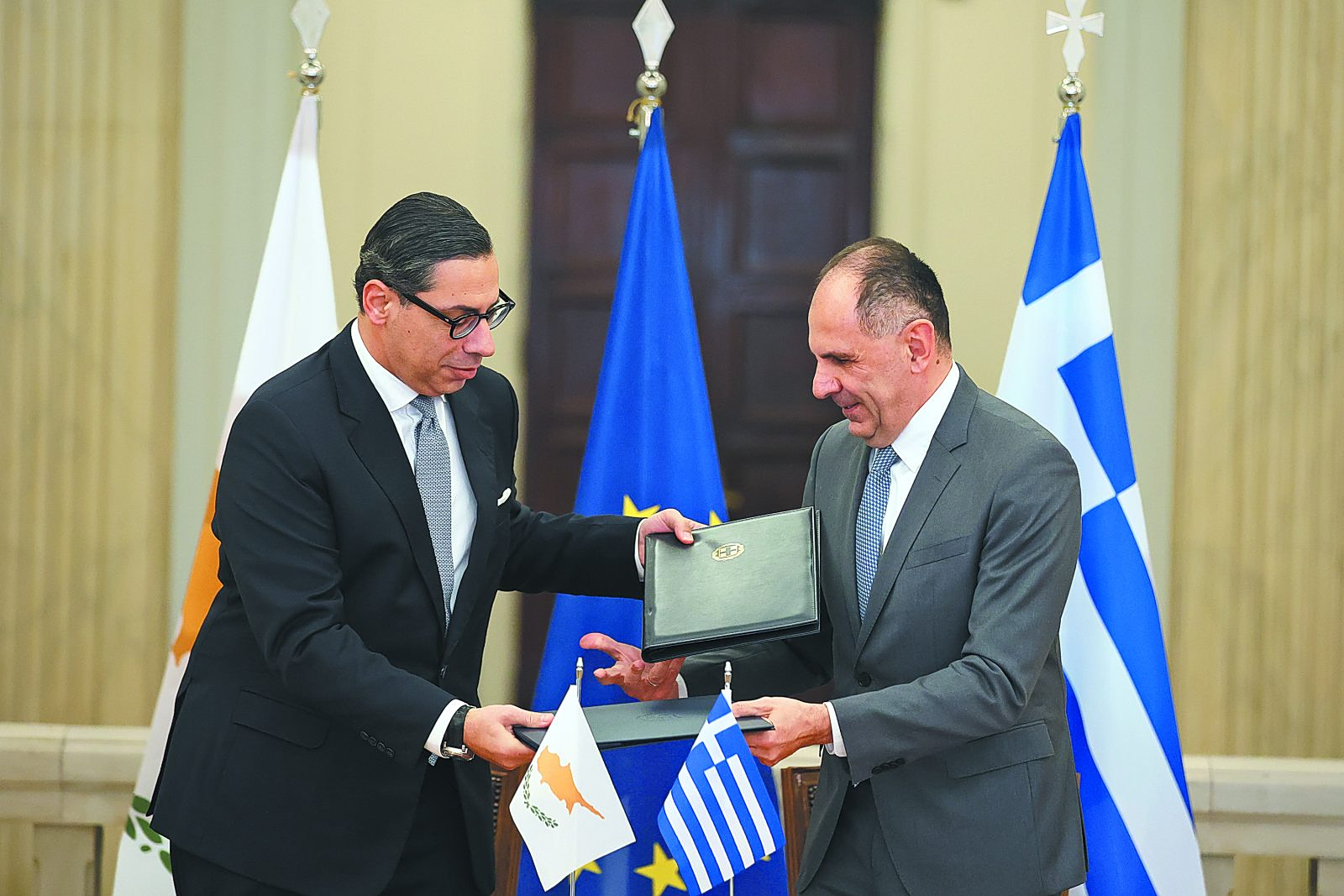
According to information obtained by To Vima, the Foreign Minister has not substantively briefed his Cypriot counterpart, Constantinos Kombos, on the rationale of the Greek proposal, despite the two men having had the chance to speak at two Foreign Affairs Councils (FAC), as well as to meet both on the sidelines of last week’s Intergovernmental Conference in Athens and earlier at the Manama Dialogue in Bahrain. The matter was not discussed between Mitsotakis and Christodoulides either, and according to reliable sources in Nicosia, the President of the Republic of Cyprus and his team were caught by surprise upon first hearing of the Greek Prime Minister’s proposal. It is also notable that none of the senior Cypriot officials has spoken—nor been asked publicly—about the five-party format.
“The obvious starting point would have been for the briefing to begin with Cyprus,” the same sources say, though they avoid linking Mitsotakis’ announcement to President Christodoulides’ own proposal (in early November) for creating a kind of “NATO or OSCE of the wider Middle East.” In Nicosia, however, commentary was not lacking at the time about a perceived attempt by the Cypriot President to “pre-empt” the five-party initiative. Meanwhile, it is becoming ever clearer that Christodoulides currently has different priorities than Athens. On the one hand, Nicosia is feverishly preparing for its presidency of the EU—which it assumes on January 1, 2026—at a pivotal moment for Europe, and the Cypriot President is determined to further highlight the Euro-Turkish dimension of the Cyprus issue, having already announced that he will invite Recep Tayyip Erdoğan to the island. On the other hand, following his first meeting with the new Turkish Cypriot leader Tufan Erhürman, Christodoulides is expected to seek to accelerate informal contacts in the hope of resuming official negotiations from the point where they collapsed in Crans-Montana in 2017.
Cyprus in the Eastern Mediterranean
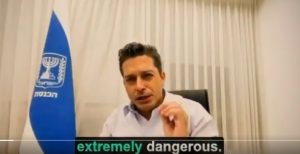
At the same time, the Cypriot government is showing signs of pursuing a more autonomous energy policy through closer cooperation with Tel Aviv—indicative was the remark by Israel’s Energy Minister about reversing the research and laying of the cable so that it begins first between the two countries and only then with Greece. There is also the Cypriot effort to present itself as an integral component of the IMEC corridor (linking India – the Middle East – Europe), which, though still only on paper, is under U.S. auspices. The prospects of IMEC were a principal topic in Kombos’ meeting with U.S. Secretary of State Marco Rubio last Monday in Washington, with diplomatic sources in Nicosia noting that the turbulence in the Eastern Mediterranean is, by its nature, upgrading Cyprus’ strategic position—perhaps even more than Greece’s—principally due to geography.
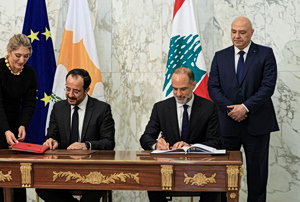
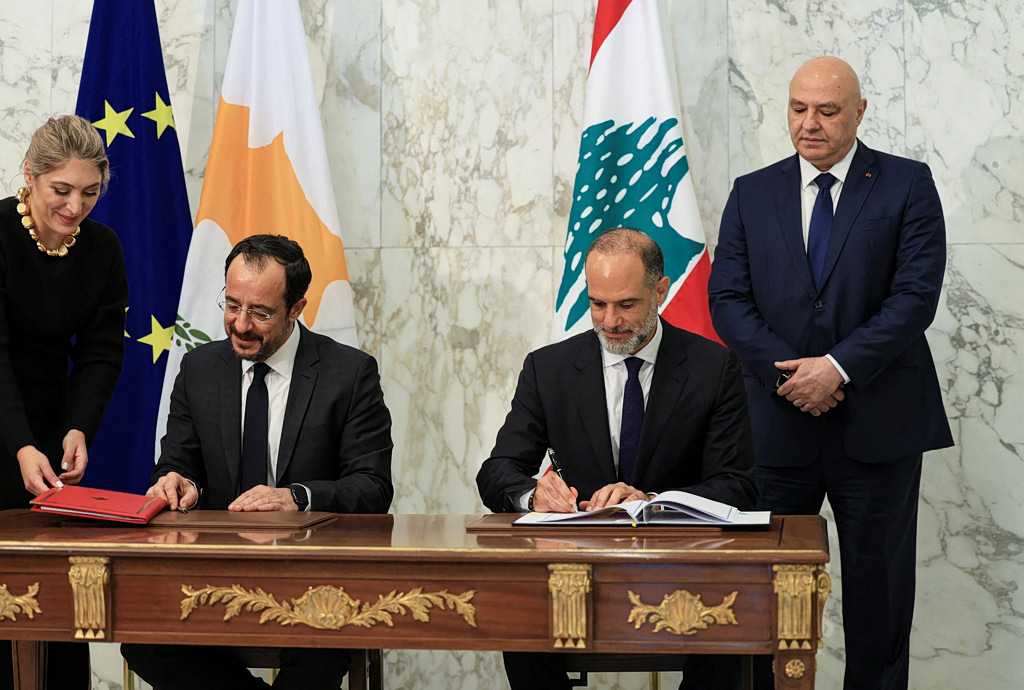
Moreover, the fact that the Republic of Cyprus now has agreements delimiting Exclusive Economic Zones (EEZs) with three states in the Eastern Mediterranean (Egypt, Israel, Lebanon) makes its participation in the five-party meeting even more complex, especially since both Israel and Lebanon are excluded from the proposed format. This is particularly relevant given that the main topic of such a conference would be the settlement of maritime zones. At the same time, both from opposition benches in Greece and from voices in Cyprus, a simple question is heard with increasing frequency: “Why don’t Athens and Nicosia first delimit their own EEZ and then sit at the table with the others?”
The “Ghost” of Turkey
Sources in Athens, however, consider it almost impossible that Nicosia would refuse to participate in the five-party meeting. It is also quite possible that events will never reach that point, since the greatest procedural obstacle is that Turkey will not recognize the statehood of the Republic of Cyprus and will simultaneously attempt to impose the equal participation of the Turkish Cypriot community in the scheme. It is precisely this—namely the presence of the Turkish Cypriots in the discussions, even as represented by Ankara—that concerns Nicosia, which does not wish to face any form of—direct or indirect—attempt or external pressure for international legitimization of the community, whether autonomously or under Turkey’s umbrella, through the inclusion of Erhürman.
Foreign Minister Hakan Fidan is, in fact, the only one of the four foreign ministers whom Gerapetritis has briefed, as was announced by diplomatic sources on the sidelines of the FAC meeting in Luxembourg (October 20). Athens is, of course, aware that Turkish revisionism, combined with Libya’s satellite-like dependence on Ankara, are the greatest obstacles to convening the five-party meeting. This is why Gerapetritis has described the endeavor as “difficult,” setting as a precondition respect for international law and state sovereignty. At the same time, however, he has repeatedly spoken of the “hour of responsibility for all,” while spokesperson Lana Zochiou has emphasized that Greece aims to turn a field of competition into an environment of stability and, above all, to show that it “moves in the Eastern Mediterranean without fear complexes—shaping developments rather than merely following them.”
The pace of the process, however, remains extremely slow. According to information so far, Gerapetritis’ goal is to complete his informal consultations by year’s end to gauge the intentions of his counterparts. Should there be a shared understanding, next steps could follow—steps that, according to the Foreign Minister, might include signing a joint communiqué and holding an initial meeting. Until then, the first official reaction from Nicosia will be awaited with interest. As for other potential interventions in the Eastern Mediterranean—which, according to one view, Athens wishes to pre-empt through its own proposal—the certainty is that one initiative does not negate the other; on the contrary, it may even accelerate it.