President Trump’s recent push to deregulate climate-related rules, including a proposal to revoke the EPA’s authority to regulate greenhouse gas emissions, has stirred a mix of relief and alarm across corporate America. While the White House frames this as a major cost-cutting measure, US automakers aren’t cheering.
On Tuesday, Environmental Protection Agency (EPA) Administrator Lee Zeldin said the move, which would end federal limits on greenhouse gas pollution from vehicle tailpipes, power plants, smokestacks, and other sources, could save companies $52 billion in environmental compliance costs, according to Reuters.
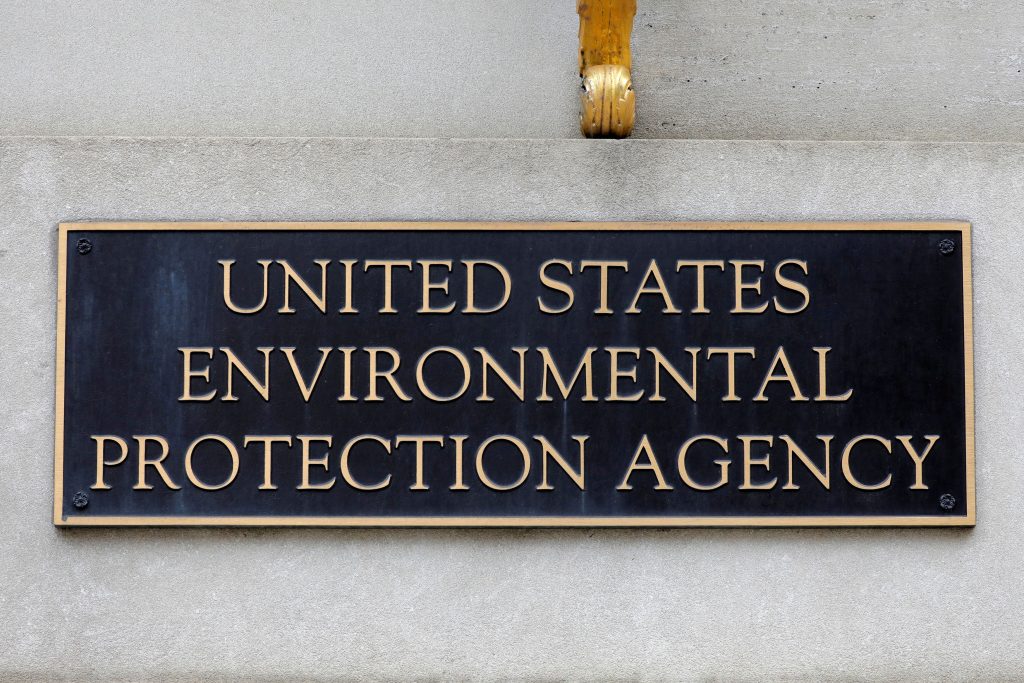
FILE PHOTO: Signage is seen at the headquarters of the United States Environmental Protection Agency in Washington, D.C., U.S., May 10, 2021. REUTERS/Andrew Kelly/File Photo
Underpinning this deregulation push is the Trump administration’s move to revoke the EPA’s “endangerment finding”—a landmark 2009 scientific determination that greenhouse gases pose a threat to public health and must therefore be regulated under the Clean Air Act.
This legal finding has formed the backbone of all federal climate policy for over a decade, enabling the EPA to impose emission limits on vehicles, power plants, and industrial sources.
Revoking it, as reported by Reuters and the Wall Street Journal, would effectively strip the federal government of its authority to regulate carbon dioxide and other greenhouse gases, throwing U.S. climate policy into legal and regulatory limbo.
The move is a delivery of Trump’s campaign promises to push back from the table of climate leadership in favor US industries. In fear of the potential economic fallout from going “too green too fast,” the EU has recently scaled back the level of ambition of its Green Deal, but has not abandoned the green transition entirely.

FILE PHOTO: People charge their electric cars at a Tesla super charging station next to an EVgo electric charging location in Carlsbad, California, U.S., March 7, 2022. REUTERS/Mike Blake/File Photo
However, the deregulation happens at a time when climate experts note that China’s emissions have peaked, as their renewable energy investments begin to payoff, and technological advances in their EV market promises to leave the world’s automakers far behind.
Yet for many in the US auto sector, that “savings” comes with new risks. “Industries that have GHG standards set by EPA have long been complying with them and don’t want them to be stripped away,” said Meghan Greenfield, partner at Jenner & Block and former EPA counsel who represents automotive clients. “The stability of the regulatory regime is extremely important for industry as a baseline,” reports Reuters.
Auto companies have made long-term investments, often under shareholder pressure, to reduce emissions and align with global standards. If these federal rules are revoked, they may be caught between state laws, legal battles, and changing consumer expectations. The risk of a fractured regulatory landscape is a logistical and financial headache.

FILE PHOTO: FILE PHOTO: BYD Dolphin Surf electric cars at a vehicle presentation event in Berlin, Germany May 21, 2025. REUTERS/Annegret Hilse/File Photo
While some companies welcome looser regulations, others, including GM, Ford, and Honda, continue to follow stricter standards set by California. These voluntary agreements reflect concerns over reputational risk, global competitiveness, and long-term planning.
Rolling back emissions rules and tax incentives could chill the electric vehicle market. With consumer uncertainty rising and regulatory consistency gone, automakers may hesitate to ramp up EV investment, even as global competitors, like China, surge ahead.