The latest International Labour Organization report on youth employment leaves little room for optimism about European economies.
To start, Northern, Southern, and Western Europe, which the UN and by extension the ILO treat as a single zone, rank among the world subregions where conditions for young people in the labor market are deteriorating fastest.
Unemployment among people under 25 reached 15% in 2025, up from 14.2% in 2023, one of the largest increases worldwide alongside North Africa and North America. That rate places developed European countries third on the global youth unemployment map, among eight subregions overall. The Arab States and North Africa hold first and second place, with unemployment at 26.2% and 22.6% respectively. The global average stands at 12.4%, slightly up from the historic low of 12.3% in 2023.
The picture looks different in Eastern Europe, where youth unemployment fell to 11.1% from 12.7% in 2023, now below the global average. But the report notes the good news is clouded, since the same period saw a rise in the share of young people neither working nor in education or training (NEETs).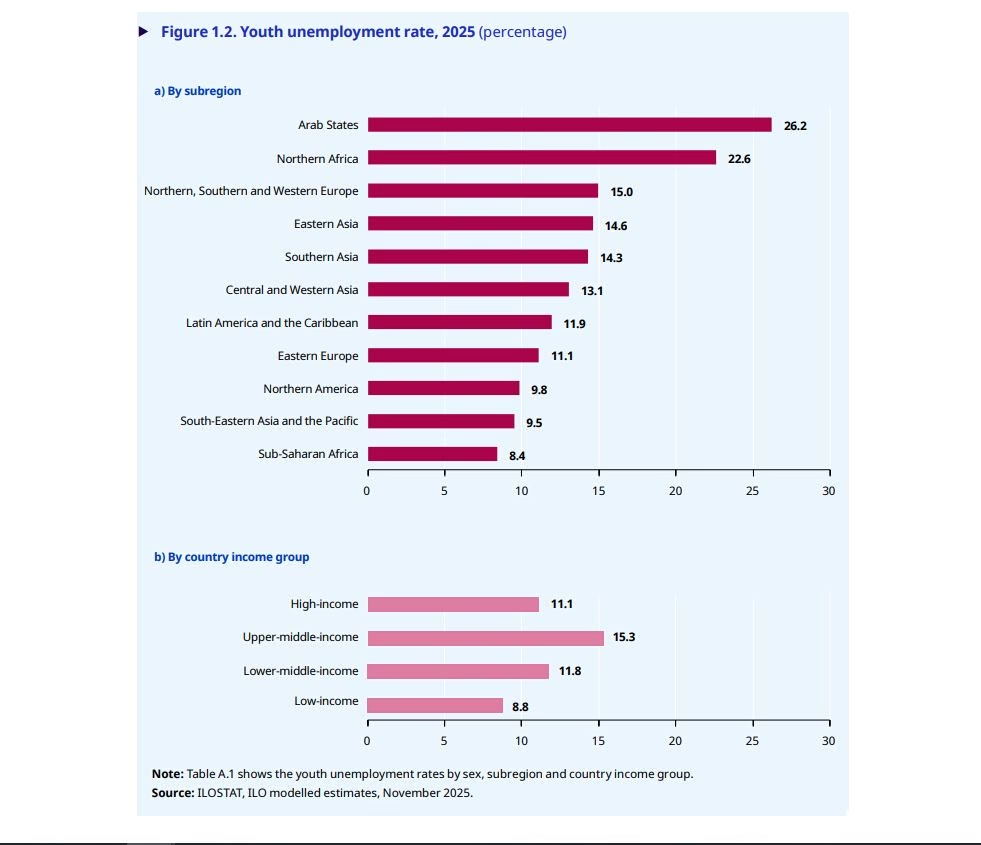
Where Things Got Worse for Young People
According to the ILO report, 20 of the 29 countries making up the Northern-Southern-Western Europe subregion “showed a decline in their economies’ ability to absorb young talent and offer them decent working conditions.” The ILO notes the trend hits secondary and tertiary graduates alike, undercutting the assumption that only degree holders struggle to find work.
Youth Employment in Greece
Greece is among the 9 “lucky” countries that reduced youth unemployment between 2023 and 2025. But because it started from such a high level (26% in 2023), it remains above the European average, at 20% in 2025.
Youth unemployment in Greece also swings sharply. Notably, it stood at 15.9% in May 2026 before jumping to 19.5% in June. These figures come from official Eurostat data, which in turn draws on figures from Greece’s statistical authority, ELSTAT. It’s worth noting that Greece’s Public Employment Service reports unemployment rates as much as double these figures, since it follows a different methodology.
European Media Coverage Skews Pessimistic on Jobs
One of the report’s more interesting, and less-noticed, findings isn’t about the statistics themselves but about how the media frames youth employment.
To examine this, the ILO used the GDELT database, one of the largest global archives of news content, analyzing more than 207,000 articles worldwide from April 2023 to April 2026 to measure the emotional “tone” of coverage, essentially whether the language used skewed positive or negative.
The findings were striking. Europe is the only region in the world where the average tone of media coverage on youth employment stayed negative across all three periods studied. The score held steady between roughly -0.1 and -0.2, a small but persistent tilt toward pessimism found nowhere else.
The contrast with other regions is sharp. In Africa, where youth unemployment and NEET rates are among the highest in the world, coverage tone remained the most positive globally throughout, despite a mild downward drift over time. Latin America saw a notably positive tone in 2024-2025 before a sharp drop afterward, while Asia showed the steepest decline worldwide, moving from moderately positive to essentially neutral in just two years. North America, like Europe, kept a low tone throughout but never dipped into negative territory.
In other words, European media portray youth employment in darker terms than media elsewhere, even in regions where the underlying crisis is statistically worse. This likely reflects the expectations European societies have built around job security and career prospects. As the youth labor market grows more unstable, those expectations get shaken, and media coverage reflects that broken expectation, creating a sense of crisis even where unemployment rates are comparatively milder.
Skilled Work Holds Up
Despite the overall decline, the report finds one relatively bright spot for Northern, Southern, and Western Europe. Youth employment in highly skilled occupations grew by 3.1% between 2023 and 2025, while medium-skilled employment stayed nearly flat, edging up just 0.4%.
Eastern Europe moved in the opposite direction. Even though youth unemployment fell to 11.1%, medium-skilled employment shrank by 5.4%, a trend the ILO attributes largely to the effects of the war in Ukraine.
Europe Faces the World’s Highest AI Exposure
The report’s most worrying finding concerns artificial intelligence and its impact on youth employment. Northern, Southern, and Western Europe post the highest rate of young workers exposed to AI in the world, at 14.9%, even surpassing North America’s 14.3%.
Under a scenario where just 10% of jobs exposed to AI disappear entirely, the ILO estimates that around 590,000 young workers in the region would be affected, either through unemployment or job changes. These are largely clerical and administrative roles that have traditionally served as the first entry point into the labor market for young graduates.
Weak Growth, Disproportionate Burden on Youth
Economic growth in Northern, Southern, and Western Europe remains among the lowest in the world, at 1.2% for 2025, with forecasts of 1.3% and 1.4% over the next two years. At the same time, job creation isn’t keeping pace with the growth in the youth population, leaving a negative gap of 1.2 percentage points across all three forecast years.
The ILO notes that when an economy fails to generate enough new jobs, the burden falls disproportionately on young people trying to enter the labor market for the first time, while adults with existing work experience remain comparatively better positioned.