The Falcons Flight roller coaster hurtles riders up a red-rock cliff in the shadow of Saudi Arabia’s Tuwaiq Mountains, before dropping them down through a tunnel and rocketing at 155 miles an hour up the ride’s signature camelback hill.
Opened on Dec. 31 as part of the Six Flags Qiddiya City theme park, the roller coaster ranks as the world’s fastest, tallest and longest. Nearby stands Sirocco Tower, the tallest drop-tower ride in the world.
Less than an hour drive from Riyadh, the Six Flags park ranks among the biggest bets that Middle Eastern cities can be oases of luxury and indulgence in a part of the world historically associated with regional conflict. There is also a Formula One racetrack, a soccer stadium and an esports venue under construction in Qiddiya.
“It turns out you’re only a drone flight away from a major hot spot,” said Jan Freitag , national director of hospitality analytics at CoStar , a real-estate data firm.
The weekslong conflict between Iran and the U.S. and Israel has upended efforts by Persian Gulf governments and global businesses to tap in to the region’s wealth and population. The fighting, which has choked the flow of oil and natural gas through the vital Strait of Hormuz, has been felt far beyond the energy industry.
Airlines have diverted hundreds of flights. Banks and embassies have evacuated staff. Three of Amazon’s data centers were damaged. Formula One canceled two upcoming Grand Prix races in Bahrain and Saudi Arabia. Schools like New York University that opened satellite campuses in the region have switched to remote classes.
“The world has changed,” said Vitaly Umansky , a gaming analyst with Seaport Research Partners. “The risk profile of a project in the U.A.E. is much higher than it was one year ago.”
Despite the elevated risks, Western companies have spent years developing megaprojects in the Gulf and are leaning on them for growth, making it difficult or expensive to change course. Wynn Resorts quickly restarted construction on a $5 billion casino resort in the United Arab Emirates that is set to open next year. Walt Disney’s new boss signaled to investors that the conflict hadn’t changed its plans to open its first theme park in the region.
Much of the expansion has been facilitated, if not funded, by Middle Eastern governments that have invested hundreds of billions of dollars to diversify their economies by adding megaprojects , luxury shopping and tourist destinations—and draw visitors like Matthew Twilley.
The 36-year-old from Orlando, Fla., arrived in late February for a weeklong trip with friends, checking off a laundry list of theme parks. In the midst of his trip, the U.S. and Israel launched attacks on Iran. Twilley tracked the fighting on local news sources and worried about rebooking flights between rides at the Six Flags park.
After boarding his plane home, the flight was canceled because of Iranian strikes on the U.S. Embassy just miles away. At one point during the ordeal, Twilley posted to Facebook to update friends and family—and send his love in a worst-case scenario.
He made it onto a different flight a couple of days later, but it wasn’t until the plane was over Europe that Twilley felt he could relax again. “I was trying to enjoy my time in the Middle East,” he said. “I was a frazzled, nervous wreck.”
Theme parks
Tourism is a pillar of Middle Eastern governments’ quest to diversify and burnish their standing on the world stage. The theme-park development follows earlier investments in luxurious beach resorts, state-of-the-art museums and vast sports facilities. The Abu Dhabi government is paying to build a Sphere entertainment venue similar to the giant dome in Las Vegas.
The approach has been working: The Middle East welcomed 39% more visitors in 2025 than it did in 2019, before the Covid-19 pandemic. That represented the largest increase for any region across the globe, according to a report released in January by UN Tourism.
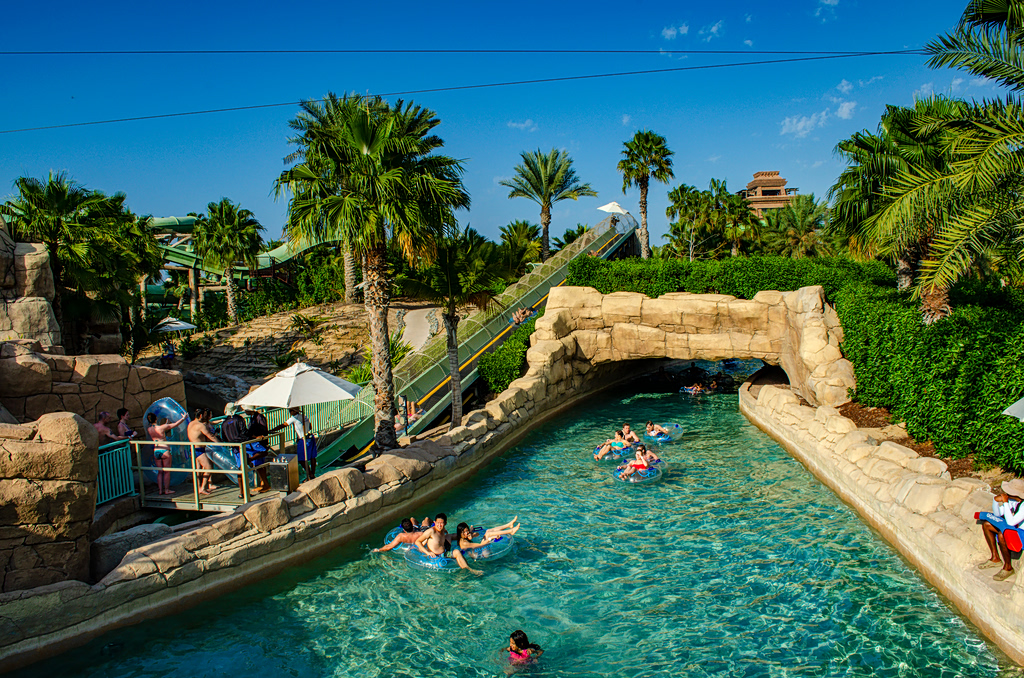
Aquaventure World, one of the world’s most popular water parks, is located on Dubai’s man-made Palm archipelago, as is the Fairmont hotel that was hit in late February by debris from an Iranian missile. In Abu Dhabi, a missile earlier this month landed close to a cruise ship docked at Zayed Port, prompting panic onboard.
Some theme parks in Dubai, including Legoland and Real Madrid World, have remained closed as a precaution. Other attractions, including Aquaventure and the sprawling Dubai Miracle Garden, recently distributed free tickets to residents as a goodwill gesture.
Executives at the Saudi Public Investment Fund, which bankrolled Six Flags Qiddiya City, have told others that things are “business as usual,” according to people familiar with those discussions. Iran hasn’t targeted Riyadh to the same extent as other cities.
Six Flags Qiddiya City recently hosted iftar celebrations that marked the end of the daily Ramadan fasts. The park was closed for multiple days, which a Six Flags spokesman said was preplanned. It reopened Friday.
The park has courted a local clientele, with Saudi citizens and residents representing 95% of visitors so far, according to a person close to the project. The park’s proximity to Riyadh, which is home to nearly 8 million people, could help insulate it from any downturn in international tourism.
Travel to the Middle East is now expected to fall 11% to 27% this year, instead of growing 13% as previously estimated, according to a report released in early March from research firm Tourism Economics. The region could lose up to $56 billion in visitor spending this year if the conflict isn’t resolved within a few weeks.
“There is a tremendous amount of uncertainty,” said John Gerner, managing director of Leisure Business Advisors, a consulting firm that works on attractions including theme parks and museums. “That uncertainty alone can have a major impact on future tourism the longer it occurs.”
The war has coincided with the month of Ramadan, and this year more local people opted to stay home or travel locally, said Fahad Al-Obailan, chief executive of BAAN Holding, a Saudi company that operates family-entertainment centers and hotels across the region.
As the holiday period draws to a close, the focus now shifts to whether business travelers will return. Many conferences and corporate meetings were canceled or postponed to later this year after fighting broke out.
Casino resorts
Just weeks before the Iran war erupted, Wynn Resorts CEO Craig Billings told investors that the company’s U.A.E. project was central to its growth strategy and a bet on the Middle East as an emerging hub of global wealth and travel.
With casinos in Las Vegas and Macau as well, Wynn is “on track to become one of the most globally diversified companies in our industry,” Billings said. The casino resort, rising on a man-made island near the Strait of Hormuz, features a superyacht marina, 1,500 rooms and 22 bars and restaurants.
The U.A.E. gambling push signaled a profound shift in a region where gambling has been constrained by Islamic prohibitions, and the opening of the last major untapped markets for the global casino industry.
The immediate impact on the hotel industry has been devastating, with occupancy in Dubai in mid-March down 68% from the same period last year. In the U.A.E., occupancy was down 62%, according to CoStar.
Wynn has played down the effect on its construction project, which had a planned spring 2027 opening. The company said work, which topped out last year, was halted for a day before resuming and largely continuing as normal.
“We think about it long term,” said Bill Hornuckle , CEO of MGM Resorts International , which has a deal to operate a roughly 1,400-room beachfront resort under development in Dubai. “We believe and everybody believes” the war will be resolved and safety will return to the region.
Luxury stores
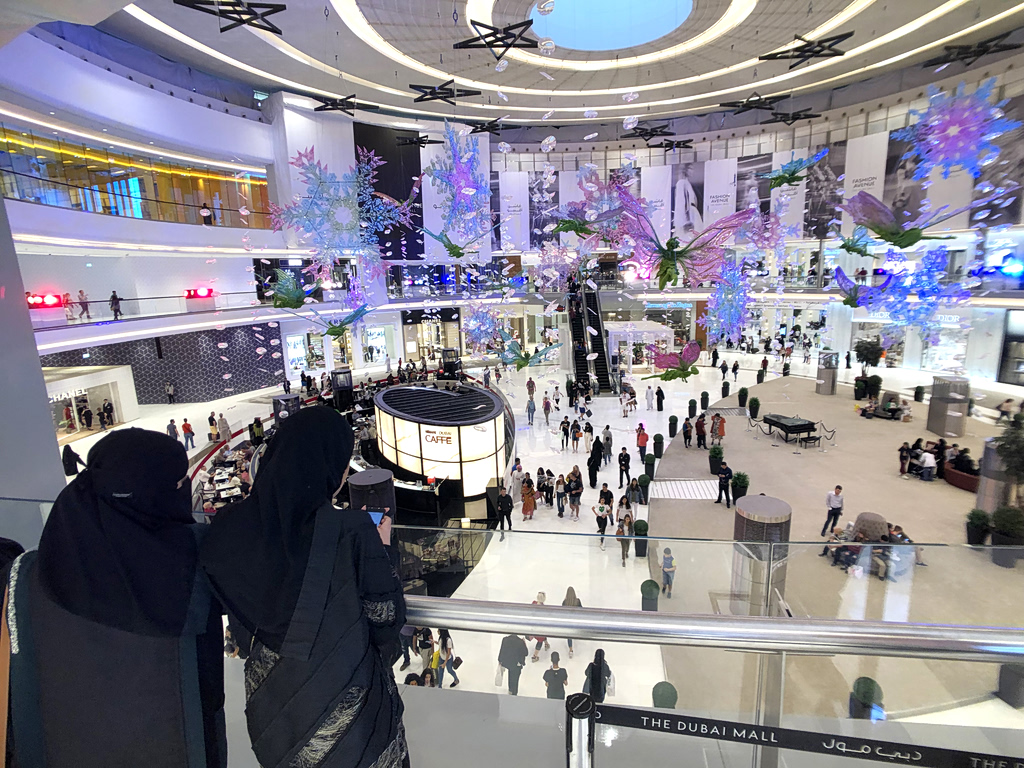
Saudi women use their smartphones in Dubai Mall in Dubai, United Arab Emirates, December 29, 2018. Picture taken December 29, 2018. REUTERS/ Hamad I Mohammed
At the start of the conflict, authorities shut malls in parts of the Gulf. The flagship Dubai Mall stayed open, and operators reopened most locations within days, but some shops in airports remained shut and foot traffic dropped sharply, particularly in Dubai, which relies heavily on international visitors.
“There is less traffic and there is less energy,” said Gildo Zegna, executive chairman of the Milan-listed luxury group Ermenegildo Zegna.
Sales staff have shifted focus toward client outreach, contacting high-spending customers directly, a strategy reminiscent of the Covid-19 period, when wealthy shoppers spent more time at home but remained active buyers.
Executives say the conflict has made it difficult to replenish stores in the Gulf, with shipping and airfreight disruptions delaying deliveries, though most spring/summer collections were already in place.
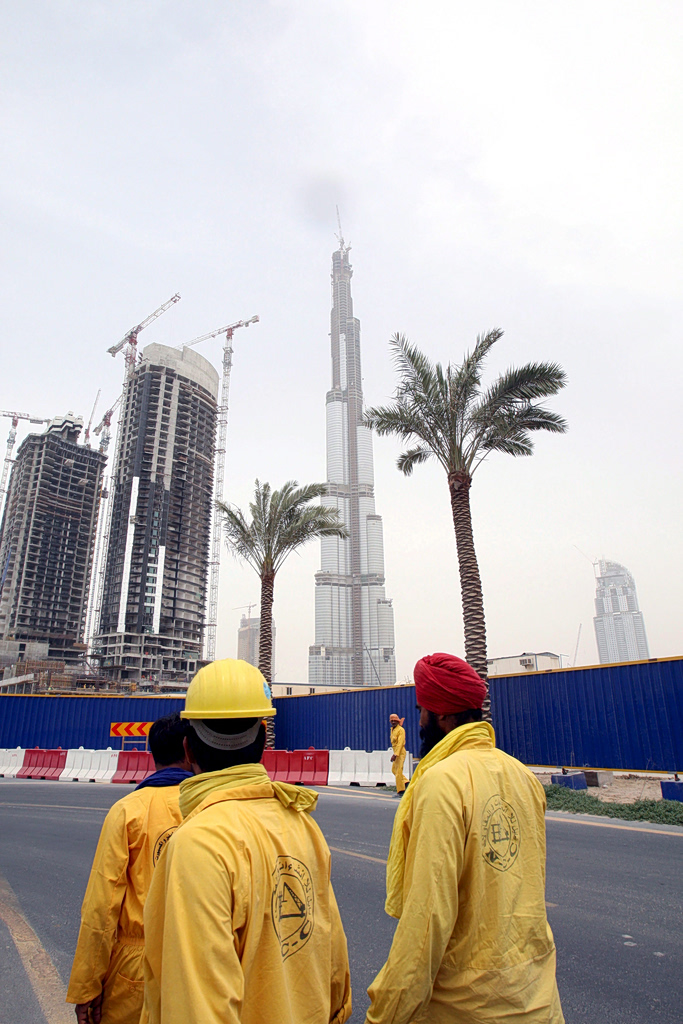
epa01309038 Asian construction workers at the Dubai complex which includes a huge mall and Burj Dubai (C) in Dubai city in UAE, 09 April 2008. Now 629m high, the United Arab Emirates skyscraper, Burj Dubai, has surpassed the height of the KVLY-TV mast in North Dakota in the US. The building will be officially recognised as the world’s tallest structure only when the construction is fully completed. The Dubai Mall, also on the construction site, will be one of the world’s largest shopping malls and is due to open toward the end of the year. EPA/ALI HAIDER
Luxury groups have invested heavily in the region in recent years, building extensive retail networks in cities and transport hubs such as Dubai, Doha and Abu Dhabi. Brands have also increased their focus on local clients through Ramadan collections, pop-ups and events.
The Middle East has become an increasingly important market for the sector, accounting for about 6% of global luxury sales—roughly in line with Japan—with higher exposure for groups including LVMH and Kering. It was also the fastest-growing region for the industry last year, expanding by about 6% while the broader sector was flat.
Most luxury executives continue to assume the disruption will be relatively short-lived. Luca Solca, an analyst at Bernstein, estimates that sales of luxury goods in the region in March will fall by roughly half rather than collapse entirely.
Despite the disruption, Zegna said the group still plans to open two new stores in the region in the coming months.
Data centers
For Amazon and other major tech companies, building data centers in the Persian Gulf was an opportunity to tap in to cheap land, abundant energy and a business-friendly environment, though they faced other challenges such as water scarcity and extreme heat.
“We are really just giddy that we are getting very close to launching our very first set of data centers here in the Middle East,” Teresa Carlson, a former Amazon vice president, said at a company event in 2018.
Amazon in 2024 began investing more than $10 billion in Saudi Arabia after earlier expansions in the U.A.E. Three of the company’s facilities were damaged by drone strikes in the early days of the conflict.
This week, Amazon said its services were still disrupted. It said it was working with the authorities in Bahrain to give priority to staff safety and was helping affected customers move operations to alternative data centers around the world.
There are reasons to set up data centers in the Gulf beyond the financial incentives. Governments there, like many countries, have data sovereignty laws requiring that certain business and personal information be stored within the country.
Amazon and others have had the support of the Trump administration, which has been eager to make deals between tech companies and countries in the Gulf, in part because of competition with China.
Oracle launched a 1 gigawatt computing cluster with OpenAI in the U.A.E. under the companies’ Stargate project, with the support of Abu Dhabi-based AI company G42.
The conflict has changed the calculus. “You won’t want to spend hundreds of millions on building a data center that you can destroy by dropping a $7,000 drone on it,” said Justin Alexander, an economist who specializes in the Gulf region.
Write to Jacob Passy at jacob.passy@wsj.com , Peter Grant at peter.grant@wsj.com , Nick Kostov at nick.kostov@dowjones.com and Sebastian Herrera at sebastian.herrera@wsj.com