President Trump’s desire to end the Iran war is being put to the test after Tehran fired at American warships on Monday and violently disrupted a U.S. effort to revive shipping in the Strait of Hormuz .
U.S. officials say Trump for days has toggled between two competing impulses: severely punishing Iran for failing to abandon its nuclear work, and avoiding a significant escalation that could draw the U.S. deeper into a Middle East conflict. Trump wants to avoid a fresh bombing campaign, officials say, preferring a negotiated end to Tehran’s nuclear advancements and the weekslong war that has raised gas prices and hurt the global economy.
Now, Trump has little choice but to make a decision between ordering a fresh round of airstrikes against Iran or brushing off Tehran’s provocations and charging ahead with his diplomatic initiative.
Speaking at the White House on Monday, Trump suggested he planned to stick with the status quo for now.
“I call it a mini war,” he told a room of small-business owners at the White House. The conflict, he continued, is a “little detour, and it’s working very nicely.”
The U.S.-Iran cease-fire creaked Monday after the U.S. military was forced to fend off attacks in the Strait of Hormuz. After Iran fired cruise missiles and other projectiles at U.S. warships and commercial vessels, U.S. Central Command said it used Apache helicopters to sink the Iranian speedboats that were harassing traffic in the strait.

A woman walks past an anti-U.S. billboard depicting U.S. President Donald Trump and the Strait of Hormuz, in Tehran, Iran, May 2, 2026. Majid Asgaripour/WANA (West Asia News Agency) via REUTERS ATTENTION EDITORS – THIS PICTURE WAS PROVIDED BY A THIRD PARTY
Following the chaotic chain of events, Trump stopped short of declaring that Tehran was in violation of the cease-fire, suggesting he might be willing to look past Iran’s Monday actions. Instead, the president encouraged South Korea to enter the fray in the Strait of Hormuz after one of its ships caught fire following an explosion.
Trump also announced a Tuesday press conference by senior Pentagon officials, leaving it up to Defense Secretary Pete Hegseth and Gen. Dan Caine , chairman of the Joint Chiefs of Staff, to outline the administration’s next steps.
Trump also on Monday suggested he was in a strong position, whether he chose to restart the war or continue negotiating with Tehran.
“One way or the other, we win. We either make the right deal, or we win very easily from the military standpoint,” Trump told conservative radio host Hugh Hewitt on Monday.
Pressure on Trump was mounting Monday from the president’s own political allies to authorize new strikes as a swift retaliation. Iran has “absolutely” violated the cease-fire, said Sen. Lindsey Graham , the South Carolina Republican and advocate for U.S. intervention in Iran, so Trump should respond with a “big, strong, painful and short” attack.
“The actions today are inconsistent with a regime that wants a diplomatic solution,” Graham continued.
Trump didn’t want to be back in the position of striking Iran again, officials said, even as he has grown deeply dissatisfied with Tehran’s unwillingness to budge on the nuclear issue during talks.
In several recent conversations with aides, Trump expressed frustration that the U.S. blockade of the Strait of Hormuz, while effective in crushing Iran’s economy, hadn’t forced Tehran to meet his nuclear demands. He considered a series of military options, officials said, ranging from striking the remaining 25% of Iranian sites on the Pentagon’s target list to authorizing naval escorts of tankers through the vital waterway.
Instead, Trump approved the latest plan to provide commercial ships detailed information that would enable them to safely transit the Strait of Hormuz. The decision was viewed as the middle course between all-out war and the blockade after meeting with senior Pentagon officials last week. That operation, known as Project Freedom, began Monday without any commitments from allies to assist, after U.S. diplomats were dispatched to ask foreign counterparts only five days prior.
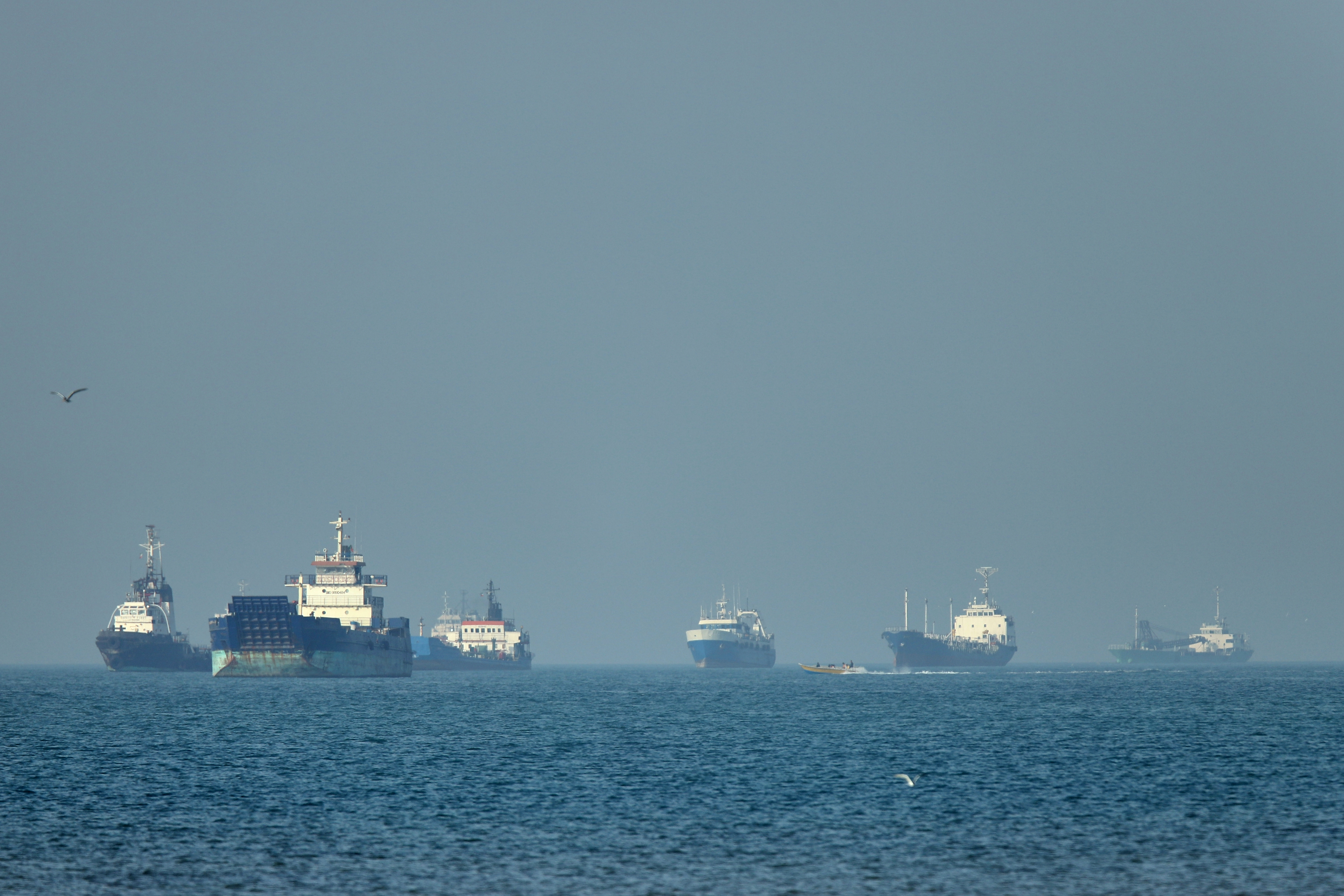
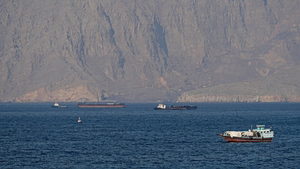
Cargo ships, including bulk carriers and general cargo vessels, sit at anchor offshore as a small motorboat passes in the foreground, in the Strait of Hormuz off Bandar Abbas, Iran, Monday, May 4 , 2026.(Amirhosein Khorgooi/ISNA via AP)
Within hours, Iran shot cruise missiles at two U.S. Navy vessels, according to Adm. Brad Cooper , the chief of U.S. Central Command, and attacked the United Arab Emirates. Any interference with the American operation “will, unfortunately, have to be dealt with forcefully,” Trump posted Sunday on Truth Social.
Some U.S. and foreign officials said they believed Trump was likely to authorize a military response to Iran within days, even though analysts noted the president’s apparent unease with new airstrikes.
“The advice he took at the beginning of the war—that bombing Iran would lead to quick and easy victory—has proven false. I suspect he is now skeptical that the U.S. should keep bombing,” said Vali Nasr , a former U.S. official and Iran expert now at Johns Hopkins University.
White House spokeswoman Anna Kelly said Trump keeps all options open while pursuing a settlement with Iran. “The president has all the cards as negotiators continue to work to ensure Iran can never possess a nuclear weapon,” Kelly said.
Trump’s war-or-deal toggling hasn’t stopped the administration from following a policy of gradual pressure increases on Iran.
After the cease-fire started April 7, the U.S. engaged in talks to strip Iran of its nuclear infrastructure and enriched uranium. Tehran resisted, leading Washington on April 13 to impose a blockade on ships going to and from Iranian ports. Efforts to make a deal still fell short, but Trump was confident the move would work, telling reporters it was “100% foolproof.”
The U.S. then Monday launched the coordination cell to help ships safely transit the Strait, and announced a forthcoming United Nations resolution condemning Iran for placing mines in the waterway and looking to collect tolls from passing vessels.
Trump and some aides worry a mounting crisis in the Strait might overshadow next week’s summit with Chinese leader Xi Jinping , officials said. Treasury Secretary Scott Bessent on Monday urged Beijing to convince Tehran to release its grip on the chokepoint. “Let’s see them step up with some diplomacy,” he said on Fox News.
Last week, China’s Ministry of Commerce ordered five Chinese refineries not to comply with U.S. sanctions targeting them over their ties to Iran’s oil sector, a sign that Beijing is unlikely to listen to Washington.
Graham, the senator and Trump confidant, urged the president to resolve the Strait crisis before flying to China, a nation that provides material and economic support to Iran.
“While we want stable relationships,” Graham said, “we will not be trifled with.”
Write to Alexander Ward at alex.ward@wsj.com